



Rhinobatos punctifer Compagno & Randall, 1987
Spotted guitarfish
Beobachtung melden im Fish Watcher
| Native range | All suitable habitat | Point map | Year 2050 |

|
| This map was computer-generated and has not yet been reviewed. |
| Rhinobatos punctifer AquaMaps Data sources: GBIF OBIS |
Hochladen Photos und videos
Bilder | videos | Google Bild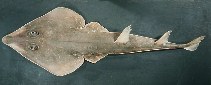 Rhinobatos punctifer
Photo von Randall, J.E.
Bilder | videos | Google Bild
Photo von Randall, J.E.
Klassifizierung / Names Namen | Synonyme | Catalog of Fishes(Gattung, Arten) | ITIS | CoL | WoRMS | Cloffa
Elasmobranchii (Haie und Rochen) (sharks and rays) > Rhinopristiformes (Shovelnose rays) > Rhinobatidae (Guitarfishes)
Etymology: Rhinobatos: Greek, rhinos = nose + Greek, batis, -idos = a ray (Raja sp.) (Ref. 45335).
More on authors: Compagno & Randall.
Etymology: Rhinobatos: Greek, rhinos = nose + Greek, batis, -idos = a ray (Raja sp.) (Ref. 45335).
More on authors: Compagno & Randall.
Umwelt: Milieu / Klimazone / Tiefenbereich / Verbreitungsgebiet Ökologie
seewasser benthopelagisch; tiefenbereich 70 - 150 m (Ref. 100719). Tropical; 29°N - 12°N, 32°E - 66°E (Ref. 114953)
Verbreitung Territorien | FAO Gebiete | Ökosysteme | Vorkommen | Punkt Karte | Einführungen | Faunafri
Western Indian Ocean: Gulf of Aqaba, Gulf of Suez, Red Sea, Muscat (Oman) to Pakistan.
Größe / Gewicht / Alter
Kurzbeschreibung Bestimmungsschlüssel | Morphologie | Morphometrie
This species is distinguished by the following set of characters: disc wedge-shaped, its width 29-34% TL, length 1.2-1.3 times width; snout is relatively short, its length 2.2-2.6 times interspiracular distance, 3.6-3.9 times interorbital width in large males (2.9-3.4 in females); orbit diameter 1.2-1.7 times the spiracle length; nostrils are weakly oblique, their length 1.3-1.9 times internarial distance; mouth is narrow, its width 5.4-5.6% TL in large males (5.8-6.2% in females); posterior nasal flaps are broad; two spiracular folds, with outermost fold slightly taller than inner fold; ridges of rostral cartilage almost parallel, converging slightly anteriorly but not constricted medially; anterior cartilage subtriangular to sickle-shaped, usually blunt posteriorly; distance between fifth gill slits 2.8-3.1 times in ventral head length in large males (2.5-2.6 in females); prebranchial sensory pore patch distinct, extending to outer margin of first gill slit; postscapular sensory canal usually distinct, notched, with exposed lateral pores; inconspicuous thorn patches on the supraorbit and scapular region, with a single row along dorsal midline rudimentary; denticles are confined to anterior portion of dorsal fins, posterior two-thirds naked; dorsal fins are relatively tall, height of first 7.6-9.5% TL; pelvic-fin inner margin shorter than its base length; interdorsal distance 2.1-2.7 times first dorsal-fin base; dorsal caudal margin 2.1-2.2 times the preventral margin; upper jaw with ~76 tooth rows; snout angle 60-75°; pectoral radials 69-75; post-synarcual centra 175-184; nasal lamellae ~59, Colouration: dorsal highly variable, plain brownish to greenish brown, faintly or strongly marked with small white spots, ocellated, or with a combination of reticulations and ocelli; the posterior half of dorsal and caudal fins usually dusky or blackish; snout with a pale or dusky tip, no long teardrop-shaped marking (Ref. 123963).
Cross section: flattened.
Cross section: flattened.
Demersal inshore on continental shelf to 70 m depth. Feeds on small crustaceans and fishes. Matures at ca. 62 cm TL; born at ca. 25 cm TL (Ref. 114953). Ovoviviparous (Ref. 50449). Produces litters of up to 7 pups (Ref. 114953).
Lebenszyklus und Paarungsverhalten Geschlechtsreife | Fortpflanzung | Ablaichen | Eier | Fruchtbarkeit | Larven
Exhibit ovoviparity (aplacental viviparity), with embryos feeding initially on yolk, then receiving additional nourishment from the mother by indirect absorption of uterine fluid enriched with mucus, fat or protein through specialised structures (Ref. 50449).
Hauptreferenz
Laden Sie Ihre Referenzen hoch | Referenzen | Koordinator : McEachran, John | Partner
Randall, J.E. and L.J.V. Compagno, 1995. A review of the guitarfishes of the genus Rhinobatos (Rajiformes: Rhinobatidae) from Oman, with description of a new species. Raffles Bull. Zool. 43(2):289-298. (Ref. 11293)
IUCN Rote Liste Status (Ref. 130435: Version 2025-2 (Global))
Gefährdung zunehmend (NT) (A2d+3d); Date assessed: 08 February 2017
Bedrohung für Menschen
Harmless
Nutzung durch Menschen
FAO - Publication: search | FishSource |
Mehr Information
Trophische Ökologie
Lebensmittel (Beutetiere)
Nahrungszusammensetzung
Nahrungsaufnahme
Lebensmittelrationen
Räuber
Lebensmittel (Beutetiere)
Nahrungszusammensetzung
Nahrungsaufnahme
Lebensmittelrationen
Räuber
Populationsdynamik
Wachstumsparameter
Max. Alter/Größen
Länge-Gewicht-Rel.
Länge-Länge-Verhältnis.
Längenhäufigkeiten
Massenkonvertierung
Rekrutierung
Dichte
Wachstumsparameter
Max. Alter/Größen
Länge-Gewicht-Rel.
Länge-Länge-Verhältnis.
Längenhäufigkeiten
Massenkonvertierung
Rekrutierung
Dichte
Lebenszyklus
Fortpflanzung
Geschlechtsreife
Reifung/Kiemen rel.
Fruchtbarkeit
Ablaichen
Laichaggregationen
Eier
Eientwicklung
Larven
Larven Pop.Dyn.
Fortpflanzung
Geschlechtsreife
Reifung/Kiemen rel.
Fruchtbarkeit
Ablaichen
Laichaggregationen
Eier
Eientwicklung
Larven
Larven Pop.Dyn.
Anatomie
Kiemenoberfläche
Gehirn
Otolith
Kiemenoberfläche
Gehirn
Otolith
Physiologie
Körperliche Zusammensetzung
Nährstoffe
Sauerstoffverbrauch
Schwimmart
Schwimmgeschwindigkeit
Visuelle Pigmente
Fischgeräusche
Krankheiten und Parasiten
Toxizität (LC50s)
Körperliche Zusammensetzung
Nährstoffe
Sauerstoffverbrauch
Schwimmart
Schwimmgeschwindigkeit
Visuelle Pigmente
Fischgeräusche
Krankheiten und Parasiten
Toxizität (LC50s)
Genetik
Genom
Genetik
Heterozygotie
Vererbbarkeit
Genetische Vielfalt
Genom
Genetik
Heterozygotie
Vererbbarkeit
Genetische Vielfalt
Menschenbezogen
Aquakultur-Systeme
Aquakultur Profile
Zuchtlinien
Ciguatera-Fälle
Briefmarken, Münzen, Verschiedenes.
Aquakultur-Systeme
Aquakultur Profile
Zuchtlinien
Ciguatera-Fälle
Briefmarken, Münzen, Verschiedenes.
Tools
Zusatzinformationen
Download XML
Zusammenfassung | Punktdaten | Namen | Photos
Internet Quellen
AFORO (otoliths) | Aquatic Commons | BHL | Cloffa | Websites from users | FishWatcher Einträge suchen | CISTI | Catalog of Fishes: Gattung, Arten | DiscoverLife | ECOTOX | FAO - Publication: search | Faunafri | Fishipedia | Fishtrace | GloBI | Google Books | Google Scholar | Google | IGFA World Record | OneZoom | Open Tree of Life | Otolith Atlas of Taiwan Fishes | PubMed | Reef Life Survey | Socotra Atlas | TreeBase | Tree of Life | Wikipedia: Gehe zu, Suchen | | Zoobank | Zoologischer Rekord
Schätzungen auf der Grundlage von Modellen
|
Phylogenetischer Diversitätsindex (Ref. 82804) |
PD50 = 0.5000 [Uniqueness, from 0.5 = low to 2.0 = high]. |
| Bayesian length-weight | a=0.00195 (0.00128 - 0.00298), b=3.13 (3.00 - 3.26), in cm total length, based on LWR estimates for this species & (Sub)family-body (Ref. 93245). |
|
Trophische Ebene (Ref. 69278) |
3.7 ±0.4 se; based on size and trophs of closest relatives |
|
Widerstandsfähigkeit (Ref. 120179) |
niedrig, Verdopplung der Population dauert 4,5 - 14 Jahre. (Fec assumed to be <100). |
|
Anfälligkeit der Fischerei (Ref. 59153) |
Moderate vulnerability (42 of 100). 🛈 |