



Occidentis ayresii (Günther, 1870)
Western river lamprey
Ανεβάστε το φωτογραφίες και Βίντεο
Φωτογραφίες | Google image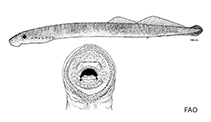 Occidentis ayresii
Male Εικόνα από FAO
Φωτογραφίες | Google image
Male Εικόνα από FAO
Ταξινόμηση / Ονόματα Κοινά ονόματα | Συνώνυμα | Catalog of Fishes(Γένος, Είδη) | ITIS | CoL | WoRMS | Cloffa
> Petromyzontiformes (Lampreys) > Petromyzontidae (Northern lampreys) > Lampetrinae
Etymology: ayresii: In honor of physician-ichthyologist William O. Ayres (1817-1887), founding member of the California Academy of Sciences, who described this species in 1855 but used a preoccupied name (Petromyzon plumbeus) (See ETYFish).
Eponymy: Dr William Orville Ayres (1817–1887) was an American ichthyologist, ornithologist and physician. [...] (Ref. 128868), visit book page.
More on author: Günther.
Etymology: ayresii: In honor of physician-ichthyologist William O. Ayres (1817-1887), founding member of the California Academy of Sciences, who described this species in 1855 but used a preoccupied name (Petromyzon plumbeus) (See ETYFish).
Eponymy: Dr William Orville Ayres (1817–1887) was an American ichthyologist, ornithologist and physician. [...] (Ref. 128868), visit book page.
More on author: Günther.
Taxonomic Remarks
The specific identity of Ammocoetes cibarius Girard 1858 cannot be established with certainty and could be either Lampetra ayresii or Entosphenus tridentatus (see that species’ account) (Ref. 89241).
Περιβάλλον: περιβάλλον / κλιματική ζώνη / εύρος βάθους / εύρος διανομής Οικολογία
Θαλασσινό(ά); Γλυκού νερού; Υφάλμυρο βενθικό(ς); ανάδρομο (Ref. 89241). Temperate; 59°N - 37°N
Κατανομή Εδάφη | Περιοχές FAO | Οικοσυστήματα | Παρουσίες | Σημειακός χάρτης | Εισαγωγές | Faunafri
Eastern Pacific: Tee Harbor, Alaska to Sacramento-San Joaquin drainage in California, USA. Freshwater resident population in Morrison Creek, Vancouver Island, British Columbia (Ref. 12269).
Μήκος κατά την πρώτη ωρίμανση / Μέγεθος / Βάρος / Ηλικία
Γεννητική Ωρίμανση: Lm 16.2 range ? - ? cm
Max length : 28.1 cm TL αρσενικό/απροσδιόριστο; (Ref. 1998); 31.1 cm TL (female); common length : 20.5 cm TL αρσενικό/απροσδιόριστο; (Ref. 12193)
Max length : 28.1 cm TL αρσενικό/απροσδιόριστο; (Ref. 1998); 31.1 cm TL (female); common length : 20.5 cm TL αρσενικό/απροσδιόριστο; (Ref. 12193)
Σύντομη περιγραφή Κλείδες προσδιορισμού | Μορφολογία | Μορφομετρία
Distinguished by 2 large teeth on the supraoral bar, a large middle tooth on the tongue, 3 points (rarely 2) on each central lateral tooth plate, and the absence of posterial teeth (Ref. 27547). Anterior dorsal fin being lower than posterior, the fins separate in nonbreeding individuals but coming into contact at spawning; caudal fin lobes about equal, lower lobe joined to anal fin; anal fin virtually absent in males (Ref. 27547). Dark brown or brownish gray on sides and back; belly yellowish, silvery around head, gill openings and lower sides; caudal fin has a band of dark pigment inside its margins, symmetrical on each lobe (Ref. 27547). Other diagnostic features: Adults: 11.4-31.1 cm TL. Body wet weight in individuals 17.5-23.0 cm TL, 20-24 g. Body proportions, as percentage of TL (based on 68 specimens measuring 11.7-31.1 cm TL): prebranchial length, 10.9-14.1; branchial length, 7.8-11.8; trunk length, 45.9-55.9; tail length, 24.4-29.5; eye length, 2.3-4.3; disc length, 4.7-7.2. The urogenital papilla length, as a percentage of branchial length, in two spawning males measuring 17.4-18.7 cm TL, 10.3-12.5. Trunk myomeres, 60-71. Dentition: supraoral lamina, 2 unicuspid teeth; infraoral lamina, 7-10 teeth, the lateralmost often bicuspid, the others unicuspid; 3 endolaterals on each side; endolateral formula, typically 2-3-2, very rarely 2-2-2; 3 rows of anterials; first row of anterials, 4 unicuspid teeth; exolaterals absent; posterials absent; transverse lingual lamina, 12-17 unicuspid teeth, the median one greatly enlarged; longitudinal lingual laminae each with 9-12 unicuspid teeth. Velar tentacles, 3-5, with tubercles. Body coloration in marine waters (live), lead gray on dorsal and upper lateral aspects, silvery on the lateral aspect, and white on the ventral aspect. Body coloration (preserved), dorsal and lateral aspects brownish gray and ventral aspect whitish. Lateral line neuromasts unpigmented. Extent of caudal fin pigmentation, 25% to more than 75%. Caudal fin shape, spade-like or rounded. Oral fimbriae, 88-117. Oral papillae, 12-18 (Ref. 89241).
Body shape (shape guide): eel-like.
Body shape (shape guide): eel-like.
Anadromous. A permanent freshwater resident population is believed to occur in Morrison Creek, British Columbia. In marine waters, they inhabit surface waters. In fresh waters, they occur in lakes, rivers, and creeks. They leave rivers to enter the sea in late spring or early summer, where they actively feed throughout the summer, and return to the rivers in the fall (Ref. 89241). Parasitic adults are found in estuaries and the ocean, migrating to clear gravel riffles of streams to spawn (Ref. 5723). Ammocoetes burrow into the mud where they live for an unknown period and migrate to the sea only after transformation (Ref. 1998). Adults feed by ripping flesh from other fishes (Ref. 2850), ammocoetes feed on microscopic plants and animals just like other members of this family (Ref. 1998). Parasitism can take place at a length of 16.2 cm TL (Ref. 1998). Preyed upon by a number of fishes, e.g. lingcod, and birds (Ref. 1998). In the Sacramento River, California, the spawning season is thought to be from late April into May. Fecundity, 11,398-37,288 eggs/female. Egg diameter, 0.6-0.7 mm (Ref. 89241). Because of its small size, it is unlikely to pose a threat to economically important fish (Ref. 1998). Utilized fresh or smoked by some cultures (Ref. 27436).
Κύκλος ζωής και συμπεριφορά ζευγαρώματος Γεννητική Ωρίμανση | Αναπαραγωγή | Γεννοβολία | Αβγά | Γονιμότητα | Προνύμφες
Probably spawns in gravel, with an activity similar to Lethenteron japonicum (Ref. 1998).
Κύρια αναφορά
Ανεβάστε τις αναφορές σας | Αναφορές | Συντονιστής | Συνεργάτες
Page, L.M. and B.M. Burr, 1991. A field guide to freshwater fishes of North America north of Mexico. Houghton Mifflin Company, Boston. 432 p. (Ref. 5723)
Κατάσταση Κόκκινου Καταλόγου IUCN (Ref. 130435: Version 2025-2 (Global))
Least Concern (LC) ; Date assessed: 21 February 2012
CITES
Not Evaluated
Απειλή για τον άνθρωπο
Harmless
Ανθρώπινες χρήσεις
αλιεία: περιορισμένης εμπορικότητας
FAO - Publication: search | FishSource |
Περισσότερες πληροφορίες
Πληθυσμιακή δυναμική
Παράμετροι Αύξησης
Μέγιστες ηλικίες / μεγέθη
Μήκος-βάρος σχετ.
Μήκος-μήκος rel.
Μήκος-συχνότητες
Μετατροπή μάζας
Στρατολόγηση
Αφθονία
Παράμετροι Αύξησης
Μέγιστες ηλικίες / μεγέθη
Μήκος-βάρος σχετ.
Μήκος-μήκος rel.
Μήκος-συχνότητες
Μετατροπή μάζας
Στρατολόγηση
Αφθονία
Κύκλος ζωής
Αναπαραγωγή
Γεννητική Ωρίμανση
Ωριμότητα / Gills rel.
Γονιμότητα
Γεννοβολία
Συγκεντρώσεις αναπαραγωγής
Αβγά
Ανάπτυξη αυγών
Προνύμφες
Δυναμική προνυμφών
Αναπαραγωγή
Γεννητική Ωρίμανση
Ωριμότητα / Gills rel.
Γονιμότητα
Γεννοβολία
Συγκεντρώσεις αναπαραγωγής
Αβγά
Ανάπτυξη αυγών
Προνύμφες
Δυναμική προνυμφών
Ανατομία
Επιφάνεια βραγχίων
Εγκέφαλος
Ωτόλιθος
Επιφάνεια βραγχίων
Εγκέφαλος
Ωτόλιθος
Φυσιολογία
Σύνθεση σώματος
Θρεπτικά συστατικά
Κατανάλωση οξυγόνου
Τύπος κολύμβησης
Ταχύτητα κολύμβησης
Οπτικές χρωστικές ουσίες
Ήχος ψαριών
Ασθένειες & παράσιτα
Τοξικότητα (LC50)
Σύνθεση σώματος
Θρεπτικά συστατικά
Κατανάλωση οξυγόνου
Τύπος κολύμβησης
Ταχύτητα κολύμβησης
Οπτικές χρωστικές ουσίες
Ήχος ψαριών
Ασθένειες & παράσιτα
Τοξικότητα (LC50)
Γενετική
Γονιδίωμα
Γενετική
Ετεροζυγωτία
Κληρονομικότητα
Γενετική ποικιλομορφία
Γονιδίωμα
Γενετική
Ετεροζυγωτία
Κληρονομικότητα
Γενετική ποικιλομορφία
Ανθρώπινη σχέση
Συστήματα υδατοκαλλιέργειας
Προφίλ υδατοκαλλιεργειών
Στελέχοι
Περιπτώσεις Ciguatera
Γραμματόσημα, νομίσματα, διάφορα.
Συστήματα υδατοκαλλιέργειας
Προφίλ υδατοκαλλιεργειών
Στελέχοι
Περιπτώσεις Ciguatera
Γραμματόσημα, νομίσματα, διάφορα.
Εργαλεία
Ηλεκτρονικό βιβλίο | Οδηγός πεδίου | Κλείδες προσδιορισμού | Ανάλυση κατά μήκος συνθέσεων | Εργαλείο ιστορίας ζωής | Σημειακός χάρτης |
Catch-MSY |
Ειδικές εκθέσεις
Έλεγχος για συντήρηση ενυδρείου | Ελέγξτε για ενημερωτικά δελτία ειδών | Ελέγξτε για ενημερωτικά δελτία υδατοκαλλιέργειας
Λήψη XML
Διαδικτυακές πηγές
AFORO (otoliths) | Aquatic Commons | BHL | Cloffa | Websites from users | Check FishWatcher | CISTI | Catalog of Fishes: Γένος, Είδη | DiscoverLife | ECOTOX | FAO - Publication: search | Faunafri | Fishipedia | Fishtrace | GloBI | Google Books | Google Scholar | Google | IGFA World Record | OneZoom | Open Tree of Life | Otolith Atlas of Taiwan Fishes | PubMed | Reef Life Survey | Socotra Atlas | TreeBase | Δέντρο Ζωής | Wikipedia: Go, αναζήτηση | World Records Freshwater Fishing | Zoological Record
Εκτιμήσεις βάσει μοντέλων
Προτιμώμενη θερμοκρασία (Αναφ. 123201): 8.6 - 11.7, mean 9.6 °C (based on 64 cells).
Δείκτης φυλογενετικής ποικιλότητας (Αναφ. 82804): PD50 = 0.6250 [Uniqueness, from 0.5 = low to 2.0 = high].
Bayesian length-weight: a=0.00132 (0.00060 - 0.00290), b=2.99 (2.80 - 3.18), in cm total length, based on LWR estimates for this (Sub)family-body shape (Ref. 93245).
Τροφικό Επίπεδο (Αναφ. 69278): 4.5 ±0.80 se; based on food items.
Ελαστικότητα (Αναφ. 120179): Χαμηλό, ελάχιστος χρόνος για διπλασιασμό πληθυσμού 4,5 - 14 έτη (Fec=11,398).