



Eptatretus stoutii (Lockington, 1878)
Pacific hagfish
Beobachtung melden im Fish Watcher
| Native range | All suitable habitat | Point map | Year 2050 |

|
| This map was computer-generated and has not yet been reviewed. |
| Eptatretus stoutii AquaMaps Data sources: GBIF OBIS |
Hochladen Photos und videos
Bilder | Google Bild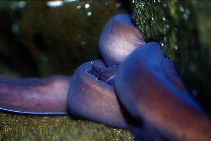 Eptatretus stoutii
Photo von JJPhoto
Bilder | Google Bild
Photo von JJPhoto
Klassifizierung / Names Namen | Synonyme | Catalog of Fishes(Gattung, Arten) | ITIS | CoL | WoRMS | Cloffa
Myxini (Kieferlose) (hagfishes) > Myxiniformes (Hagfishes) > Myxinidae (Hagfishes) > Eptatretinae
Etymology: Eptatretus: hepta (Gr.), seven; tretos (Gr.), perforated (i.e., with holes), referring to seven gill apertures on what would later be described as Homea banksii (=E. cirrhatus) [range within genus is 6-14 pairs of gill apertures] (See ETYFish); stoutii: In honor of Arthur B. Stout (1814-1898), surgeon and corresponding secretary of the California Academy of Sciences [see box, below] (See ETYFish).
Eponymy: Dr Arthur Breese Stout (1814–1898) was a prominent surgeon in San Francisco. [...] (Ref. 128868), visit book page.
Etymology: Eptatretus: hepta (Gr.), seven; tretos (Gr.), perforated (i.e., with holes), referring to seven gill apertures on what would later be described as Homea banksii (=E. cirrhatus) [range within genus is 6-14 pairs of gill apertures] (See ETYFish); stoutii: In honor of Arthur B. Stout (1814-1898), surgeon and corresponding secretary of the California Academy of Sciences [see box, below] (See ETYFish).
Eponymy: Dr Arthur Breese Stout (1814–1898) was a prominent surgeon in San Francisco. [...] (Ref. 128868), visit book page.
Umwelt: Milieu / Klimazone / Tiefenbereich / Verbreitungsgebiet Ökologie
seewasser demersal; standorttreu; tiefenbereich 16 - 966 m (Ref. 96339). Temperate; 58°N - 20°N, 137°W - 105°W
Verbreitung Territorien | FAO Gebiete | Ökosysteme | Vorkommen | Punkt Karte | Einführungen | Faunafri
Eastern Pacific: southeastern Alaska to Bahia San Pablo, central Baja California, Mexico.
Länge bei der ersten Reifung / Größe / Gewicht / Alter
Kurzbeschreibung Bestimmungsschlüssel | Morphologie | Morphometrie
Rückenflossenstacheln (insgesamt) : 0; Rückenflossenweichstrahlen (insgesamt) : 0; Afterflossenstacheln: 0; Afterflossenweichstrahlen: 0. No true fins - one dorsal finfold, far back, median, very low, continuous with caudal; caudal broad, rounded; ventral finfold very low, origin somewhat posterior to last gill pore, extending to anus (Ref. 6885). Dark brown, tan, gray, or brownish red, often tinted with blue or purple, never black, lighter ventrally, rarely with large patches of white; preserved specimens light brown (Ref. 6885).
Body shape (shape guide): eel-like.
Body shape (shape guide): eel-like.
Inhabits fine silt and clay bottoms (Ref. 6885). Enters large fishes by way of the mouth and anus and feed on its viscera and muscles (Ref. 6885). May greatly diminish catches taken with fixed gears (Ref. 6885). Produces mucilaginous slime when harassed (Ref. 6885). Probably exhibits hermaphroditism (Ref. 56947). Due to its primitive metabolism it is collected for research purposes (Ref. 6885). TBK: demerspelag.
Lebenszyklus und Paarungsverhalten Geschlechtsreife | Fortpflanzung | Ablaichen | Eier | Fruchtbarkeit | Larven
Copulatory organ absent (Ref. 51361). Presence of bisexual juvenile gonad, requires further investigation regarding hermaphroditism (Ref. 56947). In one study (Ref. 40710), hermaphroditism is exhibited by only 0.2% of the individuals studied.
Hauptreferenz
Laden Sie Ihre Referenzen hoch | Referenzen | Koordinator | Partner
Fernholm, B., 1998. Hagfish systematics. p. 33-44. In J.M. Jørgensen, J.P. Lomholt, R.E. Weber and H. Malte (eds.) The biology of hagfishes. Chapman & Hall, London. 578 p. (Ref. 31276)
IUCN Rote Liste Status (Ref. 130435: Version 2025-2 (Global))
Daten mangelhaft (DD) ; Date assessed: 11 December 2009
CITES
Not Evaluated
Bedrohung für Menschen
Harmless
Nutzung durch Menschen
Fischereien: nicht kommerziell; Aquarium: Öffentliche Aquarien
FAO - Publication: search | FishSource |
Mehr Information
Trophische Ökologie
Lebensmittel (Beutetiere)
Nahrungszusammensetzung
Nahrungsaufnahme
Lebensmittelrationen
Räuber
Lebensmittel (Beutetiere)
Nahrungszusammensetzung
Nahrungsaufnahme
Lebensmittelrationen
Räuber
Populationsdynamik
Wachstumsparameter
Max. Alter/Größen
Länge-Gewicht-Rel.
Länge-Länge-Verhältnis.
Längenhäufigkeiten
Massenkonvertierung
Rekrutierung
Dichte
Wachstumsparameter
Max. Alter/Größen
Länge-Gewicht-Rel.
Länge-Länge-Verhältnis.
Längenhäufigkeiten
Massenkonvertierung
Rekrutierung
Dichte
Lebenszyklus
Fortpflanzung
Geschlechtsreife
Reifung/Kiemen rel.
Fruchtbarkeit
Ablaichen
Laichaggregationen
Eier
Eientwicklung
Larven
Larven Pop.Dyn.
Fortpflanzung
Geschlechtsreife
Reifung/Kiemen rel.
Fruchtbarkeit
Ablaichen
Laichaggregationen
Eier
Eientwicklung
Larven
Larven Pop.Dyn.
Anatomie
Kiemenoberfläche
Gehirn
Otolith
Kiemenoberfläche
Gehirn
Otolith
Physiologie
Körperliche Zusammensetzung
Nährstoffe
Sauerstoffverbrauch
Schwimmart
Schwimmgeschwindigkeit
Visuelle Pigmente
Fischgeräusche
Krankheiten und Parasiten
Toxizität (LC50s)
Körperliche Zusammensetzung
Nährstoffe
Sauerstoffverbrauch
Schwimmart
Schwimmgeschwindigkeit
Visuelle Pigmente
Fischgeräusche
Krankheiten und Parasiten
Toxizität (LC50s)
Menschenbezogen
Aquakultur-Systeme
Aquakultur Profile
Zuchtlinien
Ciguatera-Fälle
Briefmarken, Münzen, Verschiedenes.
Aquakultur-Systeme
Aquakultur Profile
Zuchtlinien
Ciguatera-Fälle
Briefmarken, Münzen, Verschiedenes.
Tools
Bio-Quiz | E-Book | Feldführer | Bestimmungsschlüssel | Längenhäufigkeits Tool | Lebensdaten Tool | Punkt Karte |
Catch-MSY |
Zusatzinformationen
Download XML
Zusammenfassung | Punktdaten | Namen | Photos
Internet Quellen
AFORO (otoliths) | Aquatic Commons | BHL | Cloffa | Websites from users | FishWatcher Einträge suchen | CISTI | Catalog of Fishes: Gattung, Arten | DiscoverLife | ECOTOX | FAO - Publication: search | Faunafri | Fishipedia | Fishtrace | GloBI | Google Books | Google Scholar | Google | IGFA World Record | OceanAdapt | OneZoom | Open Tree of Life | Otolith Atlas of Taiwan Fishes | Öffentliche Aquarien | PubMed | Reef Life Survey | Socotra Atlas | TreeBase | Tree of Life | Wikipedia: Gehe zu, Suchen | World Records Freshwater Fishing | Zoologischer Rekord
Schätzungen auf der Grundlage von Modellen
Bevorzugte Temperatur (Ref. 123201): 5.8 - 9.4, mean 7.1 °C (based on 54 cells).
Phylogenetischer Diversitätsindex (Ref. 82804): PD50 = 0.5000 [Uniqueness, from 0.5 = low to 2.0 = high].
Bayesian length-weight: a=0.00288 (0.00171 - 0.00487), b=2.88 (2.73 - 3.03), in cm total length, based on LWR estimates for this species & (Sub)family-body (Ref. 93245).
Trophische Ebene (Ref. 69278): 4.2 ±0.70 se; based on food items.
Widerstandsfähigkeit (Ref. 120179): niedrig, Verdopplung der Population dauert 4,5 - 14 Jahre. (Fec = 28).