



Thymichthys verrucosus (McCulloch & Waite, 1918)
Warty handfish
Envoyez vos Photos et vidéos
Images Google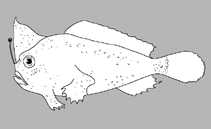 No image available for this species;
drawing shows typical species in Brachionichthyidae.
Images Google
drawing shows typical species in Brachionichthyidae.
Classification / Noms Noms communs | Synonymes | Catalog of Fishes(Genre, Espèce) | ITIS | CoL | WoRMS | Cloffa
> Lophiiformes (Anglerfishes) > Brachionichthyidae (Handfishes)
Etymology: Thymichthys: Greek thymos (warty excrescence) and Greek ichthys (fish) in allusion to the warty protuberances on the skin of these handfishes; verrucosus: Name presumably based on the Latin 'verrucosus' meaning full of warts, referring to the obvious warty nature of its skin (Ref. 82446).
More on authors: McCulloch & Waite.
Etymology: Thymichthys: Greek thymos (warty excrescence) and Greek ichthys (fish) in allusion to the warty protuberances on the skin of these handfishes; verrucosus: Name presumably based on the Latin 'verrucosus' meaning full of warts, referring to the obvious warty nature of its skin (Ref. 82446).
More on authors: McCulloch & Waite.
Environnement : milieu / zone climatique / profondeur / gamme de distribution Écologie
marin démersal. Temperate
Distribution Territoires | Zones FAO | Écosystèmes | Occurrences | Carte par point | Introductions | Faunafri
Eastern Indian Ocean: known only from South Australia.
Taille / Poids / Âge
Description synthétique Clés d'identification | Morphologie | Morphométrie
This species is distinguished by the following set of characters: esca is variable in size, length 23-57% (mean 37%) of illicium length (including esca); short to moderately elongate illicium, not thick and fleshy, without dermal spinules, length 15-27% SL, 1.9-3.4 times in head length, its base adjacent upper jaw (pre-illicial length 1.2-3.2% SL); small eye, its diameter 4.8-7.1 times in head length; body is usually densely covered with prominent, close-set, globular or fleshy warts; skin with small, widely spaced, embedded, spiny scales and variably developed dermal flaps; unicuspid or bicuspid spinules, prostrate, their tips embedded or barely visible); second dorsal-fin rays 14-18 (mainly 16-17), fin base length 60-73 (mean 66)% SL; length of second dorsal-fin spine 1.1-1.6 times length of longest ray of second dorsal fin; anal-fin rays 6-9; pectoral-fin rays usually 8; body brownish with lighter and darker blotches and spots; blackish bar on caudal peduncle and caudal-fin base that extends onto hind parts of dorsal and anal fins (Ref. 82446).
Body shape (shape guide): elongated.
Body shape (shape guide): elongated.
A benthic species (Ref. 75154) which occurs in inshore waters (Ref. 7300, 75154) of the continental shelf (Ref. 75154).
Cycle de vie et comportement reproducteur Maturité | Reproduction | Frai | Œufs | Fécondité | Larves
Référence principale
Téléchargez vos références | Références | Coordinateur | Collaborateurs
Last, P. and D.C. Gledhill, 2009. A revision of the Australian handfishes (Lophiiformes: Brachionichthyidae), with descriptions of three new genera and nine new species. Zootaxa 2252:1-77. (Ref. 82446)
Statut dans la liste rouge de l'IUCN (Ref. 130435: Version 2025-2 (Global))
Données manquantes (DD) ; Date assessed: 01 May 2018
CITES
Not Evaluated
Menace pour l'homme
Harmless
Utilisations par l'homme
FAO - Publication: search | FishSource |
Plus d'informations
Écologie trophique
Aliments (proies)
Composition du régime alimentaire
Consommation alimentaire
Rations alimentaires
Prédateurs
Aliments (proies)
Composition du régime alimentaire
Consommation alimentaire
Rations alimentaires
Prédateurs
Écologie
Écologie
Écologie
Dynamique des populations
Paramètres de croissance
Âges / tailles maximales
Longueur-poids rel.
Rel. longueur-longueur.
Fréquences de longueurs
Conversion de masse
Recrutement
Abondance
Paramètres de croissance
Âges / tailles maximales
Longueur-poids rel.
Rel. longueur-longueur.
Fréquences de longueurs
Conversion de masse
Recrutement
Abondance
Cycle de vie
Reproduction
Maturité
Maturité/épines rel.
Fécondité
Frai
Agrégats de frai
Œufs
Développement de l'œuf
Larves
Dynamique des populations larvaires
Reproduction
Maturité
Maturité/épines rel.
Fécondité
Frai
Agrégats de frai
Œufs
Développement de l'œuf
Larves
Dynamique des populations larvaires
Anatomie
Surface branchiale
Cerveau
Otolithe
Surface branchiale
Cerveau
Otolithe
Physiologie
Composition corporelle
Nutriments
Consommation d'oxygène
Type de natation
Vitesse de nage
Pigments visuels
Son de poisson
Maladies et parasites
Toxicité (CL50)
Composition corporelle
Nutriments
Consommation d'oxygène
Type de natation
Vitesse de nage
Pigments visuels
Son de poisson
Maladies et parasites
Toxicité (CL50)
Génétique
génôme
Génétique
Hétérozygotie
Héritabilité
Diversité génétique
génôme
Génétique
Hétérozygotie
Héritabilité
Diversité génétique
Liées à l'homme
Systèmes d'aquaculture
Profils d'aquaculture
Souches
Cas de ciguatera
Timbres, pièces de monnaie, divers
Systèmes d'aquaculture
Profils d'aquaculture
Souches
Cas de ciguatera
Timbres, pièces de monnaie, divers
Outils
E-book | Guide de terrain | Générateur de fréquences de longueur | Outil de dynamique de population | Carte par point |
Capture-MSY |
Articles particuliers
Télécharger en XML
Sources Internet
AFORO (otoliths) | Aquatic Commons | BHL | Cloffa | Websites from users | FishWatcher | CISTI | Catalog of Fishes: Genre, Espèce | DiscoverLife | ECOTOX | FAO - Publication: search | Faunafri | Fishipedia | Fishtrace | GloBI | Google Books | Google Scholar | Google | IGFA World Record | OneZoom | Open Tree of Life | Otolith Atlas of Taiwan Fishes | PubMed | Reef Life Survey | Socotra Atlas | TreeBase | Arbre de Vie | Wikipedia: aller à, chercher | World Records Freshwater Fishing | Zoological Record
Estimations basées sur des modèles
Indice de diversité phylogénétique (Réf. 82804): PD50 = 0.7501 [Uniqueness, from 0.5 = low to 2.0 = high].
Bayesian length-weight: a=0.00437 (0.00164 - 0.01162), b=3.12 (2.89 - 3.35), in cm total length, based on LWR estimates for this (Sub)family-body shape (Ref. 93245).
Niveau trophique (Réf. 69278): 3.6 ±0.5 se; based on size and trophs of closest relatives