



Hochladen Photos und videos
Bilder | Google Bild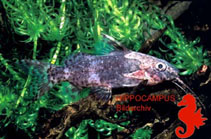 Synodontis obesus
Photo von Hippocampus-Bildarchiv
Bilder | Google Bild
Photo von Hippocampus-Bildarchiv
Klassifizierung / Names Namen | Synonyme | Catalog of Fishes(Gattung, Arten) | ITIS | CoL | WoRMS | Cloffa
> Siluriformes (Catfishes) > Mochokidae (Squeakers or upside-down catfishes) > Mochokinae
Etymology: Synodontis: Greek, syn, symphysis = grown together + Greek, odous = teeth (Ref. 45335).
More on author: Boulenger.
Etymology: Synodontis: Greek, syn, symphysis = grown together + Greek, odous = teeth (Ref. 45335).
More on author: Boulenger.
Umwelt: Milieu / Klimazone / Tiefenbereich / Verbreitungsgebiet Ökologie
; süßwasser benthopelagisch; pH range: 6.0 - 7.5; dH range: 25 - ?. Tropical; 24°C - 28°C (Ref. 2059)
Verbreitung Territorien | FAO Gebiete | Ökosysteme | Vorkommen | Punkt Karte | Einführungen | Faunafri
Africa: coastal drainages of the Bay of Guinea from Ghana to Gabon (Ref. 82238), including the Pra, Sio, Mono, Niger delta, Kwa Ibo (Ref. 57223), Cross (Ref. 57223, 81251), Wouri, Sanaga (Ref. 81251, 82238), Mungo (Ref. 81251), Lobe and Kribi (Ref. 82238). Possibly also in the Nyong (Ref. 81251). Presence in Volta and Comoe basins (Ref. 82238) unconfirmed (Ref. 57223). Presence in Gabon (Ogooue drainage) questionable (Ref. 78218) and unconfirmed (Ref. 81251).
Größe / Gewicht / Alter
Kurzbeschreibung Bestimmungsschlüssel | Morphologie | Morphometrie
Rückenflossenstacheln (insgesamt) : 1; Afterflossenstacheln: 0. Diagnosis: gill slits not extending ventrally beyond pectoral-fin insertions; interorbital space less than 50% of head width (Ref. 57223), 58.5-86.6% of snout length (Ref. 81251); post-orbital length at least 60% of snout length (Ref. 57223, 81251). Entire margin of opercle smooth (Ref. 81251). Maxillary barbels longer than head, unbranched, without tubercles and bordered by a distinct, black basal membrane (Ref. 57223, 81251), at least as broad as barbel (Ref. 81251). Outer mandibular barbels with rather long, numerous, simple and thin ramifications, branches of inner mandibular barbels long, subdivided/dichotomous and moderately thin (Ref. 57223). Mandibular teeth rather long (Ref. 57223), movable (Ref. 81251), numbering 21-46 (30 in the lectotype)(Ref. 57223, 81251). Denticulations of pectoral-fin spines weaker on outer than on inner margin (Ref. 57223), with twice as many serrations along anterior edge as posterior (Ref. 81251). Dorsal-fin spine smooth anteriorly, prolonged into short filament, as are almost all of the branched dorsal-fin rays (Ref. 57223, 81251). Humeral process twice as long as deep, pointed and granulose, not keeled ventrally (Ref. 57223, 81251). Adipose fin little developed and low, distinctly separated from rayed dorsal fin (Ref. 57223), base of adipose fin 1.5-3.4 times distance between dorsal fin and base of adipose fin (Ref. 81251). Body covered with spots of about 1 mm in diameter; caudal fin spotted (Ref. 57223, 81251), but without single dark patch at base of each fin lobe (Ref. 81251).
Body shape (shape guide): fusiform / normal.
Body shape (shape guide): fusiform / normal.
Its electric organ is located dorsally and consists of modified striated muscle (Ref. 10011). Oviparous (Ref. 205). Maximum TL recorded was 37.5 cm (Ref. 57223), maximum SL (for Lower Guinea only?) 16.8 cm (Ref. 81251).
Lebenszyklus und Paarungsverhalten Geschlechtsreife | Fortpflanzung | Ablaichen | Eier | Fruchtbarkeit | Larven
Hauptreferenz
Laden Sie Ihre Referenzen hoch | Referenzen | Koordinator | Partner
Paugy, D. and T.R. Roberts, 2003. Mochokidae. p. 195-268 In C. Lévêque, D. Paugy and G.G. Teugels (eds.) Faune des poissons d'eaux douce et saumâtres de l'Afrique de l'Ouest, Tome 2. Coll. Faune et Flore tropicales 40. Musée Royal de l'Afrique Centrale, Tervuren, Belgique, Museum National d'Histoire Naturalle, Paris, France and Institut de Recherche pour le Développement, Paris, France. 815 p. (Ref. 57223)
IUCN Rote Liste Status (Ref. 130435: Version 2025-2 (Global))
nicht bedroht (LC) ; Date assessed: 02 September 2019
CITES
Not Evaluated
Bedrohung für Menschen
Harmless
Nutzung durch Menschen
Aquarium: Kommerziell
FAO - Publication: search | FishSource |
Mehr Information
Trophische Ökologie
Lebensmittel (Beutetiere)
Nahrungszusammensetzung
Nahrungsaufnahme
Lebensmittelrationen
Räuber
Lebensmittel (Beutetiere)
Nahrungszusammensetzung
Nahrungsaufnahme
Lebensmittelrationen
Räuber
Ökologie
Ökologie
Ökologie
Populationsdynamik
Wachstumsparameter
Max. Alter/Größen
Länge-Gewicht-Rel.
Länge-Länge-Verhältnis.
Längenhäufigkeiten
Massenkonvertierung
Rekrutierung
Dichte
Wachstumsparameter
Max. Alter/Größen
Länge-Gewicht-Rel.
Länge-Länge-Verhältnis.
Längenhäufigkeiten
Massenkonvertierung
Rekrutierung
Dichte
Lebenszyklus
Fortpflanzung
Geschlechtsreife
Reifung/Kiemen rel.
Fruchtbarkeit
Ablaichen
Laichaggregationen
Eier
Eientwicklung
Larven
Larven Pop.Dyn.
Fortpflanzung
Geschlechtsreife
Reifung/Kiemen rel.
Fruchtbarkeit
Ablaichen
Laichaggregationen
Eier
Eientwicklung
Larven
Larven Pop.Dyn.
Anatomie
Kiemenoberfläche
Gehirn
Otolith
Kiemenoberfläche
Gehirn
Otolith
Physiologie
Körperliche Zusammensetzung
Nährstoffe
Sauerstoffverbrauch
Schwimmart
Schwimmgeschwindigkeit
Visuelle Pigmente
Fischgeräusche
Krankheiten und Parasiten
Toxizität (LC50s)
Körperliche Zusammensetzung
Nährstoffe
Sauerstoffverbrauch
Schwimmart
Schwimmgeschwindigkeit
Visuelle Pigmente
Fischgeräusche
Krankheiten und Parasiten
Toxizität (LC50s)
Genetik
Genom
Genetik
Heterozygotie
Vererbbarkeit
Genetische Vielfalt
Genom
Genetik
Heterozygotie
Vererbbarkeit
Genetische Vielfalt
Menschenbezogen
Aquakultur-Systeme
Aquakultur Profile
Zuchtlinien
Ciguatera-Fälle
Briefmarken, Münzen, Verschiedenes.
Aquakultur-Systeme
Aquakultur Profile
Zuchtlinien
Ciguatera-Fälle
Briefmarken, Münzen, Verschiedenes.
Tools
E-Book | Feldführer | Bestimmungsschlüssel | Längenhäufigkeits Tool | Lebensdaten Tool | Punkt Karte |
Catch-MSY |
Zusatzinformationen
Download XML
Zusammenfassung | Punktdaten | Namen | Photos
Internet Quellen
AFORO (otoliths) | Aquatic Commons | BHL | Cloffa | Websites from users | FishWatcher Einträge suchen | CISTI | Catalog of Fishes: Gattung, Arten | DiscoverLife | ECOTOX | FAO - Publication: search | Faunafri | Fishipedia | Fishtrace | GloBI | Google Books | Google Scholar | Google | IGFA World Record | OneZoom | Open Tree of Life | Otolith Atlas of Taiwan Fishes | PubMed | Reef Life Survey | Socotra Atlas | TreeBase | Tree of Life | Wikipedia: Gehe zu, Suchen | World Records Freshwater Fishing | Zoobank | Zoologischer Rekord
Schätzungen auf der Grundlage von Modellen
Phylogenetischer Diversitätsindex (Ref. 82804): PD50 = 0.5000 [Uniqueness, from 0.5 = low to 2.0 = high].
Bayesian length-weight: a=0.01096 (0.00461 - 0.02608), b=3.00 (2.81 - 3.19), in cm total length, based on LWR estimates for this Genus-body shape (Ref. 93245).
Trophische Ebene (Ref. 69278): 2.9 ±0.3 se; based on size and trophs of closest relatives
Widerstandsfähigkeit (Ref. 120179): mittel, Verdopplung der Population dauert 1,4 - 4,4 Jahre. (Preliminary K or Fecundity.).