



Uploaden van uw Foto's en video's
Afbeeldingen | Google afbeelding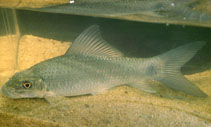 Labeo coubie
Juvenile Afbeelding van Mody, K.
Afbeeldingen | Google afbeelding
Juvenile Afbeelding van Mody, K.
Classificatie / Namen Lokale namen | Synoniemen | Catalog of Fishes(Genus, Soort(en)) | ITIS | CoL | WoRMS | Cloffa
> Cypriniformes (Carps) > Cyprinidae (Minnows or carps) > Labeoninae
Etymology: Labeo: Latin, labeo = one who has large lips (Ref. 45335); coubie: Named after the vernacular name of the specimens in Cairo (Egypt), which were used for the original description (Ref. 26192).
More on author: Rüppell.
Etymology: Labeo: Latin, labeo = one who has large lips (Ref. 45335); coubie: Named after the vernacular name of the specimens in Cairo (Egypt), which were used for the original description (Ref. 26192).
More on author: Rüppell.
Milieu: milieu / Klimaatzone / Diepte / verspreidingsgebied Ecologie
; zoet water benthopelagisch; potamodroom (Ref. 51243). Tropical; 6°N - 6°S
Verspreiding Gebieden | FAO regio's | Ecosystemen | Voorkomen | Verspreidingskaart | Introducties | Faunafri
Africa: very widespread, within the drainage basin of the Nile (Ref. 1440, 2801, 28714), Chad, Niger-Bénoué, Volta, Senegal and Gambia basins, as well as Cross River (Ref. 1440, 2940, 81282). Report from Cameroon coastal rivers (Ref. 1440) unconfirmed in Ref 81639. Not reliable known from the Congo River basin (Ref. 1440) and one controversial record from the East coast of Africa (Ref. 1440). Ref. 2801 reports presence in Warri (Nigeria) and Kingani (Tanzania).
Lengte bij maturiteit / Grootte / Gewicht / Leeftijd
Maturiteit: Lm 22.0, range 22 - ? cm
Max length : 75.0 cm SL mannelijk / geslacht onbekend; (Ref. 2801); max. gepubliceerd gewicht: 5.0 kg (Ref. 3799)
Max length : 75.0 cm SL mannelijk / geslacht onbekend; (Ref. 2801); max. gepubliceerd gewicht: 5.0 kg (Ref. 3799)
Korte beschrijving Determinatiesleutels | Morfologie | Morfometrie
Dorsale zachte stralen (totaal) : 15 - 19; Anale zachte stralen: 8 - 11; Wervels: 31 - 33. Diagnosis: dorsal profile straight to slightly arched; body dark and dull; rostral lobe poorly developed, its free margin smooth (Ref. 2940, 81282). Distal margin of dorsal fin straight or convex; inner surface of lips with 4-10 transverse folds or costae (Ref. 2940, 28714, 81282). Inferior mouth with well-developed lips forming a sucker-like ring enclosing the jaws; snout typically swollen, as long as or much longer than the postocular part of the head (Ref. 28714). Body not cylindriform, its depth 27-39% of SL (Ref. 28714) or 2.3-3.3 times in SL (Ref. 2940, 81282). Depth of caudal peduncle 0.7-1.3x its length; 26-46 (50-150mm) and 37-47 (150-250mm) gill rakers; scale formula 5.5-7.5/36-40/6.5-7.5; 4.5 scales between lateral line and pelvic-fin base; 16 (18) scales around caudal peduncle (Ref. 2940, 81282). 11-14 dorsal fin branched rays (Ref. 2940, 28714, 81282).
Body shape (shape guide): fusiform / normal; Cross section: compressed.
Body shape (shape guide): fusiform / normal; Cross section: compressed.
Inhabit rivers (Ref. 4967).
Levenscyclus en paargedrag Maturiteit | Voortplanting | Paaien | Eieren | Fecunditeit | Larven
Hoofdreferentie
Upload uw referenties | Referenties | Coördinator | Medewerkers
Tshibwabwa, S.M., 1997. Systématique des espèces africaines du genre Labeo (Teleostei, Cyprinidae) dans les régions ichtyogéographiques de Basse-Guinée et du Congo. II. Presses Universitaires de Namur, Namur, Belgique. 227 p. (Ref. 26192)
Status op de Rode Lijst van het IUCN (Ref. 130435: Version 2025-2 (Global))
Niet bedreigd (LC) ; Date assessed: 26 March 2020
CITES
Not Evaluated
Gevaar voor de mens
Harmless
Gebruik door de mens
Visserij: commercieel; Aquarium: Publieke aquaria
FAO - Publication: search | FishSource |
Meer informatie
Trofische ecologie
Voedsel (prooien)
Dieetsamenstelling
Voedselconsumptie
Voedselrantsoenen
Predatoren
Voedsel (prooien)
Dieetsamenstelling
Voedselconsumptie
Voedselrantsoenen
Predatoren
Populatiedynamica
Groeiparameters
Max. leeftijden / maten
Lengte-gewicht rel.
Lengte-lengte rel.
Lengtefrequenties
Massaconversie
Rekrutering
Abundantie
Groeiparameters
Max. leeftijden / maten
Lengte-gewicht rel.
Lengte-lengte rel.
Lengtefrequenties
Massaconversie
Rekrutering
Abundantie
Levenscyclus
Voortplanting
Maturiteit
Rijpheid/kieuwen rel.
Fecunditeit
Paaien
Paaibestanden
Eieren
Ontwikkeling van de eieren
Larven
Larvale populatiedynamiek
Voortplanting
Maturiteit
Rijpheid/kieuwen rel.
Fecunditeit
Paaien
Paaibestanden
Eieren
Ontwikkeling van de eieren
Larven
Larvale populatiedynamiek
Anatomie
Kieuwoppervlak
Hersenen
Otoliet
Kieuwoppervlak
Hersenen
Otoliet
Fysiologie
Lichaamssamenstelling
Voedingsstoffen
Zuurstofverbruik
Type zwemmen
Zwemsnelheid
Visuele pigmenten
Vis geluid
Ziekten en parasieten
Toxiciteit (LC50)
Lichaamssamenstelling
Voedingsstoffen
Zuurstofverbruik
Type zwemmen
Zwemsnelheid
Visuele pigmenten
Vis geluid
Ziekten en parasieten
Toxiciteit (LC50)
Genetica
genoom
Genetica
Heterozygositeit
Erfelijkheid
Genetische diversiteit
genoom
Genetica
Heterozygositeit
Erfelijkheid
Genetische diversiteit
Menselijk gerelateerd
Aquacultuursystemen
Aquacultuurprofielen
Kweeklijnen
Ciguatera gevallen
Postzegels, munten, diversen.
Aquacultuursystemen
Aquacultuurprofielen
Kweeklijnen
Ciguatera gevallen
Postzegels, munten, diversen.
Tools
E-boek | Veldgids | Determinatiesleutels | Lengtefrequentie Tool | Levenscyclus tool | Verspreidingskaart |
Vangst-MSY |
Speciale rapporten
Bekijk gegevens voor het houden in een aquarium | Bekijk Fact Sheets voor de soort | Bekijk Aquacultuur Fact Sheets
Download XML
Internetbronnen
AFORO (otoliths) | Aquatic Commons | BHL | Cloffa | Websites from users | Bekijk FishWatcher | CISTI | Catalog of Fishes: Genus, Soort(en) | DiscoverLife | ECOTOX | FAO - Publication: search | Faunafri | Fishipedia | Fishtrace | GloBI | Google Books | Google Scholar | Google | IGFA World Record | OneZoom | Open Tree of Life | Otolith Atlas of Taiwan Fishes | PubMed | Reef Life Survey | Socotra Atlas | TreeBase | Tree of Life | Wikipedia: ga naar, zoek | World Records Freshwater Fishing | Zoobank | Zoological Record
Schattingen op basis van modellen
Fylogenetische diversiteitsindex (Ref. 82804): PD50 = 0.5000 [Uniqueness, from 0.5 = low to 2.0 = high].
Bayesian length-weight: a=0.00955 (0.00771 - 0.01183), b=3.05 (3.01 - 3.09), in cm total length, based on LWR estimates for this species (Ref. 93245).
Generation time: 5.5 ( na - na) years. Estimated as median ln(3)/K based on 2 growth studies.
Weerstandsvermogen (Ref. 120179): laag, minimale populatieverdubbelingstijd 4,5-14 jaar (K=0.12-0.26; tmax=5; Fec > 10,000).
Voedingsstoffen (Ref. 124155): Calcium = 143 [40, 249] mg/100g; Iron = 0.881 [0.539, 1.555] mg/100g; Protein = 16.5 [15.7, 17.4] %; Omega3 = 0.388 [0.153, 1.012] g/100g; Selenium = 382 [148, 1,055] μg/100g; VitaminA = 11.9 [4.7, 31.4] μg/100g; Zinc = 1.32 [0.71, 2.58] mg/100g (wet weight);