



Oncorhynchus keta (Walbaum, 1792)
Chum salmon
Ajouter votre observation dans Fish Watcher
| Native range | All suitable habitat | Point map | Year 2050 |

|
| This map was computer-generated and has not yet been reviewed. |
| Oncorhynchus keta AquaMaps Data sources: GBIF OBIS |
Envoyez vos Photos et vidéos
Images | vidéos | Timbres, pièces de monnaie, divers | Images Google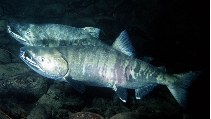 Oncorhynchus keta
Male Photo de Keeley, E.R.
Images | vidéos | Timbres, pièces de monnaie, divers | Images Google
Male Photo de Keeley, E.R.
Classification / Noms Noms communs | Synonymes | Catalog of Fishes(Genre, Espèce) | ITIS | CoL | WoRMS | Cloffa
> Salmoniformes (Salmons) > Salmonidae (Salmonids) > Salmoninae
Etymology: Oncorhynchus: Greek, onyx, -ychos = nail + Greek, rhyngchos = snout (Ref. 45335).
More on author: Walbaum.
Etymology: Oncorhynchus: Greek, onyx, -ychos = nail + Greek, rhyngchos = snout (Ref. 45335).
More on author: Walbaum.
Environnement : milieu / zone climatique / profondeur / gamme de distribution Écologie
marin; eau douce; saumâtre benthopélagique; anadrome (Ref. 132363); profondeur 0 - 250 m (Ref. 50550), usually ? - 61 m (Ref. 96339). Temperate; 0°C - 24°C (Ref. 35682); 67°N - 24°N, 130°E - 110°W (Ref. 117423)
Distribution Territoires | Zones FAO | Écosystèmes | Occurrences | Carte par point | Introductions | Faunafri
North Pacific: Korea , Japan, Okhotsk and Bering Sea (Ref. 1998), Arctic Alaska south to San Diego, California, USA. Asia: Iran (Ref. 39702).
Longueur à la première maturité / Taille / Poids / Âge
Maturité: Lm 70.0 range ? - ? cm
Max length : 100.0 cm FL mâle / non sexé; (Ref. 559); common length : 58.0 cm TL mâle / non sexé; (Ref. 3561); poids max. publié: 18.1 kg (Ref. 56631); âge max. reporté: 7 années (Ref. 1998)
Max length : 100.0 cm FL mâle / non sexé; (Ref. 559); common length : 58.0 cm TL mâle / non sexé; (Ref. 3561); poids max. publié: 18.1 kg (Ref. 56631); âge max. reporté: 7 années (Ref. 1998)
Description synthétique Clés d'identification | Morphologie | Morphométrie
Épines dorsales (Total) : 0; Rayons mous dorsaux (Total) : 10 - 14; Épines anales: 0; Rayons mous anaux: 13 - 17; Vertèbres: 59 - 71. Distinguished by the lack of distinct black spots on the back and tail and by the presence of 18 to 28 short, stout, smooth gill rakers on the first arch (Ref. 27547). Pelvic fins with axillary process; caudal truncate to slightly emarginate (Ref. 27547). Large individuals are steel-blue dorsally, with speckles of black; silver on the sides; silvery to white ventrally. Males have tinges of black on the tips of its caudal, anal and pectoral fins. Spawning males are dark olive to black dorsally; grey-red with green vertical bars on the sides; dark grey ventrally; anal and pelvic fins with white tips. Spawning females resemble spawning males but less distinctly marked.
Body shape (shape guide): fusiform / normal; Cross section: compressed.
Body shape (shape guide): fusiform / normal; Cross section: compressed.
Inhabits ocean and coastal streams (Ref. 86798). Migrating fry form schools in estuaries, remain close to shore for a few months and finally disperse to enter the sea (Ref. 1998). Epipelagic (Ref. 58426). Juveniles and adults feed mainly on copepods, tunicates and euphausiids but also on pteropods, squid and small fishes (Ref. 1998). Adults cease feeding in freshwater (Ref. 1998). Males and females die after spawning. The catch is mostly canned but also sold fresh, dried-salted, smoked, and frozen. Eaten steamed, fried, broiled, boiled, microwaved, and baked (Ref. 9988). Utilized for caviar.
Cycle de vie et comportement reproducteur Maturité | Reproduction | Frai | Œufs | Fécondité | Larves
Enters freshwater during advanced stage of sexual development and spawning occurs almost immediately (Ref. 1998). Spawning occurs at depths of ~3 meters, current speeds of ~20cm/sec. near the head waters over sand and pebbles at 4-11° C water temperature. At spawning time the female excavates a hole of around 1 meter diameter and 50 cm depth before spawning can occur (Ref. 12218). Nest building is done by the female by lying on one side and lashing its tail to displace the sand and silt on the river bed. The pair then settles in the nest, mouths gape, and with rapid vibration of the pair, eggs and milt are released. The female then covers the nest. Males are aggressive and may spawn with different females; females likewise may spawn with other males and therefore builds different nests. Adults die after a week (Ref. 1998). A fish spawns 700-7,000 eggs in two to three egg releases. Eggs are ~300-3,500 per spawn. Egg size is ~6.7 mm, water temp. is 8-10°C at 60 days before hatching. Larva size is around 16 mm. Come springtime the juveniles go to the ocean and come back 3-4 years later to their exact birthplace. This fish reaches maturity in 2-4 years. Larvae are found around the spawning site, Juveniles are found around the coast. Juveniles migrate to the ocean at ~27-45 mm during February at water temperatures around 4° C (Ref. 12218).
Reproductive strategy: synchronous ovarian organization, determinate fecundity (Ref. 51846).
Référence principale
Téléchargez vos références | Références | Coordinateur | Collaborateurs
Page, L.M. and B.M. Burr, 2011. A field guide to freshwater fishes of North America north of Mexico. Boston : Houghton Mifflin Harcourt, 663p. (Ref. 86798)
Statut dans la liste rouge de l'IUCN (Ref. 130435: Version 2025-2 (Global))
Préoccupation mineure (LC) ; Date assessed: 23 July 2020
CITES
Not Evaluated
Menace pour l'homme
Harmless
Utilisations par l'homme
Pêcheries: hautement commercial; Aquaculture: commercial; pêche sportive: oui; Aquarium: Aquariums publics
FAO - Systèmes d'aquaculture: production searchpêcheries: Résumé espèce, landings search; Publication: search | FishSource | Sea Around Us
Plus d'informations
Écologie trophique
Aliments (proies)
Composition du régime alimentaire
Consommation alimentaire
Rations alimentaires
Prédateurs
Aliments (proies)
Composition du régime alimentaire
Consommation alimentaire
Rations alimentaires
Prédateurs
Dynamique des populations
Paramètres de croissance
Âges / tailles maximales
Longueur-poids rel.
Rel. longueur-longueur.
Fréquences de longueurs
Conversion de masse
Recrutement
Abondance
Paramètres de croissance
Âges / tailles maximales
Longueur-poids rel.
Rel. longueur-longueur.
Fréquences de longueurs
Conversion de masse
Recrutement
Abondance
Anatomie
Surface branchiale
Cerveau
Otolithe
Surface branchiale
Cerveau
Otolithe
Physiologie
Composition corporelle
Nutriments
Consommation d'oxygène
Type de natation
Vitesse de nage
Pigments visuels
Son de poisson
Maladies et parasites
Toxicité (CL50)
Composition corporelle
Nutriments
Consommation d'oxygène
Type de natation
Vitesse de nage
Pigments visuels
Son de poisson
Maladies et parasites
Toxicité (CL50)
Liées à l'homme
Systèmes d'aquaculture
Profils d'aquaculture
Souches
Cas de ciguatera
Timbres, pièces de monnaie, divers
Systèmes d'aquaculture
Profils d'aquaculture
Souches
Cas de ciguatera
Timbres, pièces de monnaie, divers
Outils
Quiz bio | E-book | Guide de terrain | Clés d'identification | Générateur de fréquences de longueur | Outil de dynamique de population | Carte par point |
Capture-MSY |
Articles particuliers
Télécharger en XML
Sources Internet
AFORO (otoliths) | Alien/Invasive Species database | Aquatic Commons | BHL | Cloffa | Websites from users | FishWatcher | CISTI | Catalog of Fishes: Genre, Espèce | DiscoverLife | ECOTOX | FAO - Systèmes d'aquaculture: production searchpêcheries: Résumé espèce, landings search; Publication: search | Faunafri | Fishipedia | Fishtrace | GloBI | Google Books | Google Scholar | Google | IGFA World Record | Bases de données nationales | OceanAdapt | OneZoom | Open Tree of Life | Otolith Atlas of Taiwan Fishes | Aquariums publics | PubMed | Reef Life Survey | Socotra Atlas | TreeBase | Arbre de Vie | Wikipedia: aller à, chercher | | Zoological Record
Estimations basées sur des modèles
|
Indice de diversité phylogénétique (Réf. 82804) |
PD50 = 0.5000 [Uniqueness, from 0.5 = low to 2.0 = high]. |
| Bayesian length-weight | a=0.01445 (0.00748 - 0.02794), b=3.10 (2.94 - 3.26), in cm total length, based on LWR estimates for this species & Genus-body shape (Ref. 93245). |
|
Niveau trophique (Réf. 69278) |
3.7 ±0.2 se; based on diet studies. |
|
Résilience (Réf. 120179) |
Milieu, temps minimum de doublement de population : 1,4 à 4,4 années (K=0.27-0.45; tm=2-5; tmax=6). |
| Rate of population increase | Prior r = 0.32, 95% CL = 0.21 - 0.48, Based on 8 full stock assessments. |
|
Vulnérabilité de la pêche (Ref. 59153) |
Moderate to high vulnerability (49 of 100). 🛈 |
|
Vulnérabilité climatique (Ref. 125649) |
High to very high vulnerability (71 of 100). 🛈 |
|
Catégorie de prix (Ref. 80766) |
Medium. |
|
Nutriments (Ref. 124155) |
Calcium = 15.6 [4.4, 41.3] mg/100g; Iron = 0.337 [0.168, 0.758] mg/100g; Protein = 18.4 [17.2, 19.5] %; Omega3 = 1.71 [0.78, 3.77] g/100g; Selenium = 110 [32, 369] μg/100g; VitaminA = 13.3 [4.6, 41.2] μg/100g; Zinc = 0.424 [0.266, 0.821] mg/100g (wet weight); |