



Rubricatochromis bimaculatus (Gill, 1862)
Jewelfish
Sube tu fotos y Vídeos
Imágenes | Sellos, monedas, varios | Google image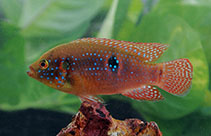 Rubricatochromis bimaculatus
Foto de Ramani Shirantha
Imágenes | Sellos, monedas, varios | Google image
Foto de Ramani Shirantha
Clasificación / Nombres Nombres comunes | Sinónimos | Catalog of Fishes(Género, Especie) | ITIS | CoL | WoRMS | Cloffa
> Cichliformes (Cichlids, convict blennies) > Cichlidae (Cichlids) > Pseudocrenilabrinae
Etymology: Rubricatochromis: Name from rubricatus, Latin for red coloured, refers to the bright red colouration on body of most species when in dominance or broodcare; and chromis, a common ending for African cichlid fishes (Ref. 128620).
More on author: Gill.
Etymology: Rubricatochromis: Name from rubricatus, Latin for red coloured, refers to the bright red colouration on body of most species when in dominance or broodcare; and chromis, a common ending for African cichlid fishes (Ref. 128620).
More on author: Gill.
Taxonomic Remarks
Hemichromis cristatus Loiselle, 1979 is a valid species ad Rubricatochromis cristatus (Loiselle, 1979) after Lamboj & Koblmüller (2022; Ref. 128620). Species summary page to be created.
Entorno: milieu / zona climática / rango de profundidad / gama de distribución Ecología
; agua dulce; salobre bentopelágico; pH range: 6.5 - 7.5; dH range: 4 - 16; potamodromo (Ref. 51243). Tropical; 21°C - 23°C (Ref. 1672); 11°N - 4°N
Distribución Territorios | Áreas FAO | Ecosistemas | Ocurrencias, apariciones | Mapa de puntos | Introducciones | Faunafri
Africa: widely distributed in West Africa, where it is known from most hydrographic basins (Ref. 53405), associated with forested biotopes (Ref. 5644, 52307). Also reported from coastal basins of Cameroon, Democratic Republic of the Congo and Nile basin (Ref. 7378), but at least its presence in Cameroon is unconfirmed in Ref. 81260. Ref. 52307 limits this species to Guinea, Sierra Leone and Liberia. Species boundaries in the genus Hemichromis remain unclear (Ref. 81260).
Tamaño / Peso / Edad
Madurez: Lm ? range ? - ? cm
Max length : 13.6 cm SL macho / no sexado; (Ref. 8992); common length : 7.5 cm TL macho / no sexado; (Ref. 12193); peso máximo publicado: 10.00 g (Ref. 3799)
Max length : 13.6 cm SL macho / no sexado; (Ref. 8992); common length : 7.5 cm TL macho / no sexado; (Ref. 12193); peso máximo publicado: 10.00 g (Ref. 3799)
Descripción breve Claves de identificación | Morfología | Morfometría
Espinas dorsales (total) : 14 - 15; Radios blandos dorsales (total) : 10 - 12; Espinas anales: 3; Radios blandos anales: 8 - 9. Diagnosis: 3 black blotches on sides, the first on opercle, the second at midpoint of body, the third on caudal-fin base; upper profile of snout convex or straight (Ref. 53405).
Body shape (shape guide): fusiform / normal.
Body shape (shape guide): fusiform / normal.
Occurs in mud-bottomed and sand-bottomed canals (Ref. 5723); some distance inland from the coast, associated with areas of intact or recently disturbed forest cover. Considered the true 'jewel fish' of aquarists, this species is also used as an experimental animal by physiologists and ethologists (Ref. 5644). Attains a maximum of 12 cm in captivity. Aquarium keeping: aggressive; in pairs; minimum aquarium size 100 cm (Ref. 51539).
Ciclo vital y comportamiento de apareamiento Madurez | Reproducción | Puesta | Huevos | Fecundidad | Larva
Referencia principal
Suba sus referencias | Referencias | Coordinador : Kullander, Sven O. | Colaboradores
Lamboj, A. and S. Koblmüller, 2022. Molecular phylogeny and taxonomic revision of the cichlid genus Hemichromis (Teleostei, Cichliformes, Cichlidae), with description of a new genus and revalidation of H. angolensis. Hydrobiologia (2022):1-22. (Ref. 128620)
Situación en la Lista Roja de la UICN (Ref. 130435: Version 2025-2 (Global))
Least Concern (LC) ; Date assessed: 01 January 2020
CITES
Not Evaluated
Amenaza para el ser humano
Harmless
Usos humanos
Pesquerías: sin interés
FAO - Publication: search | FishSource |
Más información
Ecología Trófica
Alimentos (presas)
Composición de la dieta
consumo de alimento
Raciones de comida
Despredadores
Alimentos (presas)
Composición de la dieta
consumo de alimento
Raciones de comida
Despredadores
Dinámica de la población
Coeficiente del crecimiento para
Edades / tallas máximas
Longitud-peso rel.
Longitud-longitud rel.
Longitud-frecuencias
Conversión de masas
Reclutamiento
Abundancia
Coeficiente del crecimiento para
Edades / tallas máximas
Longitud-peso rel.
Longitud-longitud rel.
Longitud-frecuencias
Conversión de masas
Reclutamiento
Abundancia
Ciclo de vida
Reproducción
Madurez
Madurez/Gills rel.
Fecundidad
Puesta
Agregaciones de desove
Huevos
Desarrollo de los huevos
Larva
Dinámica larvaria
Reproducción
Madurez
Madurez/Gills rel.
Fecundidad
Puesta
Agregaciones de desove
Huevos
Desarrollo de los huevos
Larva
Dinámica larvaria
Distribución
Territorios
Áreas FAO
Ecosistemas
Ocurrencias, apariciones
Introducciones
BRUVS - Vídeos
Territorios
Áreas FAO
Ecosistemas
Ocurrencias, apariciones
Introducciones
BRUVS - Vídeos
Fisiología
Composición corporal
Nutrientes
Consumo del oxígeno
Tipo de natación
Velocidad de natación
Pigmentos visuales
Sonido de peces
Enfermedades y parásitos
Toxicidad (CL50)
Composición corporal
Nutrientes
Consumo del oxígeno
Tipo de natación
Velocidad de natación
Pigmentos visuales
Sonido de peces
Enfermedades y parásitos
Toxicidad (CL50)
Relacionados con el ser humano
Sistemas de acuicultura
Perfiles de acuicultura
Razas
Ciguatera cases
Sellos, monedas, varios
Sistemas de acuicultura
Perfiles de acuicultura
Razas
Ciguatera cases
Sellos, monedas, varios
Herramientas
Cuestionario orgánico | Libro electrónico | Guía de campo | Claves de identificación | Asistente para frecuencias de tallas | Herramienta de ciclo de vida | Mapa de puntos |
Catch-MSY |
Informes especiales
Comprobar el mantenimiento del acuario | Buscar fichas sobre especies | Consulte las hojas informativas sobre acuicultura
Descargar XML
Fuentes de Internet
AFORO (otoliths) | Alien/Invasive Species database | Aquatic Commons | BHL | Cloffa | Websites from users | Check FishWatcher | CISTI | Catalog of Fishes: Género, Especie | DiscoverLife | ECOTOX | FAO - Publication: search | Faunafri | Fishipedia | Fishtrace | GloBI | Google Books | Google Scholar | Google | IGFA World Record | OneZoom | Open Tree of Life | Otolith Atlas of Taiwan Fishes | Acuarios públicos | PubMed | Reef Life Survey | Socotra Atlas | TreeBase | Árbol de la vida | Wikipedia: Go, búsqueda | World Records Freshwater Fishing | Expediente Zoológico
Estimaciones basadas en modelos
Índice de diversidad filogenética (Referencia 82804): PD50 = 0.5020 [Uniqueness, from 0.5 = low to 2.0 = high].
Bayesian length-weight: a=0.01514 (0.01284 - 0.01785), b=2.98 (2.94 - 3.02), in cm total length, based on LWR estimates for this species (Ref. 93245).
Nivel trófico (Referencia 69278): 3.9 ±0.64 se; based on food items.
Resiliencia (Referencia 120179): Alto, población duplicada en un tiempo mínimo inferior a 15 meses (Assuming tm<1 and multiple annual spawning; Fec = 713 mean fec).