



Protopterus annectens (Owen, 1839)
West African lungfish
Adicionar o seu Fotografias e vídeos
Fotografias | Selos, moedas, diversos. | Imagem do Google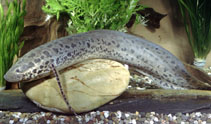 Protopterus annectens
Fotografia de Hippocampus-Bildarchiv
Fotografias | Selos, moedas, diversos. | Imagem do Google
Fotografia de Hippocampus-Bildarchiv
Classificação / Nomes Nomes comuns | Sinónimos | Catalog of Fishes(Género, Espécies) | ITIS | CoL | WoRMS | Cloffa
> Ceratodontiformes (Australian lungfishes) > Protopteridae (African lungfishes)
Etymology: Protopterus: Greek, pro = first, in front of + Greek, pteron = wing, fin (Ref. 45335).
Etymology: Protopterus: Greek, pro = first, in front of + Greek, pteron = wing, fin (Ref. 45335).
Ambiente: milieu / zona climática / intervalo de profundidade / gama de distribuição Ecologia
Distribuição Territórios | Áreas FAO | Ecossistemas | Ocorrências | Mapa dos pontos | Introduções | Faunafri
Africa: large Sahelian basins, Comoé River, Bandama River and some basins of Sierra Leone and Guinea (Protopterus annectens annectens) (Ref. 2834, 81261), upper Congo River, middle and lower Zambezi basin and all east coast rivers south to the Limpopo River (Ref. 3498, Ref. 13337), and Lake Rukwa (Ref. 13337) (Protopterus annectens brieni). Reports from the upper Cubango and Okavango system (Ref. 11970) unconfirmed (Ref. 52193, 120641).
Tamanho / Peso / Idade
Maturidade: Lm ? range ? - ? cm
Max length : 100.0 cm TL macho/indeterminado; (Ref. 3799); peso máx. Publicado: 4.0 kg (Ref. 3069)
Max length : 100.0 cm TL macho/indeterminado; (Ref. 3799); peso máx. Publicado: 4.0 kg (Ref. 3069)
Descrição breve Chaves de identificação | Morfologia | Morfometria
Diagnosis: Protopterus annectens annectens has an elongate body and paired fins are long and filamentous (Ref. 81261). The trunk, with 34-37 ribs, is a bit longer and the tail a bit shorter compared to Protopterus annectens brieni (Ref. 40587).
Body shape (shape guide): elongated; Cross section: circular.
Body shape (shape guide): elongated; Cross section: circular.
Obligate air-breathing (Ref. 126274); Obligate air-breathing (Ref. 126274). Found in marginal swamps and backwaters of rivers and lakes (Ref. 30488). Carnivorous, food includes molluscs (Ref. 30488), but also frogs, fish and seed (Ref. 13851). In Kenya it feeds mostly on plant material, like roots (Ref. 30558). Strongly associated with life of aquatic plants in terms of breeding and feeding ecologies; nests are made in weedy areas (Ref. 30558). Normally lives on flood plains and secretes, when these dry up during the dry season, a thin slime around itself which dries into a fragile cocoon; normally hibernates from the end of one wet season to the start of the next, buut can live in its cocoon for over a year (Ref. 3023, 30558). For hibernating the fish literally chews its way into the substrate ejecting mud out of its gill openings, reaching a depth of 3-25 cm below the surface depending on the length of the fish; the lungfish wriggles around, thereby hollowing out a bulb-shaped chamber and coming to rest with its nose pointing upward; they breathe air at the mouth of the chamber's tube and then sink back into the expanded part of the chamber (Ref. 36739). As the water disappears the respiratory trips cease; air reaches the fish via the tube to the surface (Ref. 36739). Under aquatic conditions this lungfish can survive more than three and half years of starvation, showing the same behavior - no motion and same body posture - as an aestivating specimen (Ref. 51339).
Ciclo de vida e comportamento de acasalamento Maturidade | Reprodução | Desova | Ovos | Fecundidade | Larvas
Lungfish spawn in the swamps during the wet season, building a nest in which the eggs, white in colour and about 4 mm diameter, are laid; young are cared for by the males (Ref. 13851). Larvae hatch in eight days, and leave the nest in twenty days (Ref. 41544). Males of Protopterus annectens brieni excavate an U-shaped burrow to a depth of nearly 60 cm for spawning purposes; nest is usually placed amongst roots of aquatic vegetation where the male will attend to several females during the breeding season; males aerate the eggs with body and fin movements and provide protection to the young for some time after incubation (Ref. 13337).
Referência principal
Carregar as suas referências | Referências | Coordenador | Colaboradores
Teugels, G.G., C. Lévêque, D. Paugy and K. Traoré, 1988. État des connaissances sur la faune ichtyologique des bassins côtiers de Côte d'Ivoire et de l'ouest du Ghana. Rev. Hydrobiol. Trop. 21(3):221-237. (Ref. 272)
Categoria na Lista Vermelha da IUCN (Ref. 130435: Version 2025-2 (Global))
Preocupação menor (LC) ; Date assessed: 25 October 2019
CITES
Not Evaluated
Ameaça para o homem
Harmless
Utilização humana
Pescarias: pouco comercial; Aquacultura: espécies comerciais
FAO - Publication: search | FishSource |
Mais informação
Ecologia Trófica
Produtos alimentares (presas)
Composição da dieta
Consumo alimentar
Rações alimentares
Predadores
Produtos alimentares (presas)
Composição da dieta
Consumo alimentar
Rações alimentares
Predadores
Dinâmica das populações
Parâmetros de crescimento
Idades / tamanhos máximos
Comprimento-peso rel.
Comprimento-comprimento rel.
Frequência de comprimento
Conversão de massa
Recrutamento
Abundância
Parâmetros de crescimento
Idades / tamanhos máximos
Comprimento-peso rel.
Comprimento-comprimento rel.
Frequência de comprimento
Conversão de massa
Recrutamento
Abundância
Ciclo de vida
Reprodução
Maturidade
Maturidade/Rel. das guelras
Fecundidade
Desova
Agregações de desova
Ovos
Desenvolvimento dos ovos
Larvas
Dinâmica larvar
Reprodução
Maturidade
Maturidade/Rel. das guelras
Fecundidade
Desova
Agregações de desova
Ovos
Desenvolvimento dos ovos
Larvas
Dinâmica larvar
Fisiologia
Composição corporal
Nutrientes
Consumo de oxigénio
Tipo de natação
Velocidade de natação
Pigmentos visuais
Som de peixe
Doenças e Parasitas
Toxicidade (LC50s)
Composição corporal
Nutrientes
Consumo de oxigénio
Tipo de natação
Velocidade de natação
Pigmentos visuais
Som de peixe
Doenças e Parasitas
Toxicidade (LC50s)
Relacionado com o ser humano
Sistemas de aquacultura
Perfis para aquacultura
Estirpes
Casos de Ciguatera
Selos, moedas, diversos.
Sistemas de aquacultura
Perfis para aquacultura
Estirpes
Casos de Ciguatera
Selos, moedas, diversos.
Ferramentas
Questionário orgânico | E-book | Guia de campo | Chaves de identificação | Ferramenta auxiliar de frequências de comprimento | Ferramenta sobre a história de vida | Mapa dos pontos |
Captura-MSY |
Relatórios especiais
Descarregue XML
Fontes da internet
AFORO (otoliths) | Aquatic Commons | BHL | Cloffa | Websites from users | Consultar FishWatcher | CISTI | Catalog of Fishes: Género, Espécies | DiscoverLife | ECOTOX | FAO - Publication: search | Faunafri | Fishipedia | Fishtrace | GloBI | Google Books | Google Scholar | Google | IGFA World Record | OneZoom | Open Tree of Life | Otolith Atlas of Taiwan Fishes | Aquários públicos | PubMed | Reef Life Survey | Socotra Atlas | TreeBase | Árvore da vida | Wikipedia: ir para, procurar | World Records Freshwater Fishing | Registo zoológico
Estimativas baseadas em modelos
Índice de diversidade filogenética (Ref. 82804): PD50 = 0.6562 [Uniqueness, from 0.5 = low to 2.0 = high].
Bayesian length-weight: a=0.00380 (0.00151 - 0.00959), b=3.10 (2.88 - 3.32), in cm total length, based on LWR estimates for this (Sub)family-body shape (Ref. 93245).
Nível Trófico (Ref. 69278): 3.8 ±0.64 se; based on food items.
Resiliência (Ref. 120179): Baixo, tempo mínimo de duplicação da população 4,5 - 14 anos (tmax = 23 (in captivity); Fec < 1,000).