



Chlidichthys bibulus (Smith, 1954)
Nosey dottyback
Add your observation in Fish Watcher
| Native range | All suitable habitat | Point map | Year 2050 |

|
| This map was computer-generated and has not yet been reviewed. |
| Chlidichthys bibulus AquaMaps Data sources: GBIF OBIS |
Upload your photos and videos
Pictures | Google image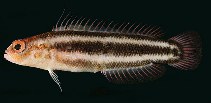 Chlidichthys bibulus
Picture by Randall, J.E.
Pictures | Google image
Picture by Randall, J.E.
Classification / Names Common names | Synonyms | Catalog of Fishes(genus, species) | ITIS | CoL | WoRMS | Cloffa
Teleostei (teleosts) > Ovalentaria/misc (Various families in series Ovalentaria) > Pseudochromidae (Dottybacks) > Pseudoplesiopinae
Etymology: Chlidichthys: Greek, chlidos, -eos, ous = collar, bracelet, adornment + Greek, ichthys = fish (Ref. 45335).
More on author: Smith.
Etymology: Chlidichthys: Greek, chlidos, -eos, ous = collar, bracelet, adornment + Greek, ichthys = fish (Ref. 45335).
More on author: Smith.
Environment: milieu / climate zone / depth range / distribution range Ecology
Marine; reef-associated; depth range 8 - 11 m (Ref. 88695). Tropical; 3°S -
Distribution Territories | FAO areas | Ecosystems | Occurrences | Point map | Introductions | Faunafri
Western Indian Ocean: Kenya to Mozambique, Aldabra I. and Socotra Archipelago.
Size / Weight / Age
Short description Identification keys | Morphology | Morphometrics
Dorsal spines (total): 2; Dorsal soft rays (total): 23 - 25; Anal spines: 3; Anal soft rays: 14 - 15.
Body shape (shape guide): elongated.
Body shape (shape guide): elongated.
Found among corals and seagrasses (Ref. 9710); and around a large boulder in a macroalgae dominated biotope, mixed with large sponges and sparse encrusting hard corals on rock platform (Ref. 88695).
Life cycle and mating behavior Maturity | Reproduction | Spawning | Eggs | Fecundity | Larvae
Main reference
Upload your references | References | Coordinator | Collaborators
Smith, M.M., 1986. Pseudochromidae. p. 539-541. In M.M. Smith and P.C. Heemstra (eds.) Smiths' sea fishes. Springer-Verlag, Berlin. (Ref. 5471)
IUCN Red List Status (Ref. 130435: Version 2025-2 (Global))
Least Concern (LC) ; Date assessed: 19 July 2017
CITES
Not Evaluated
Threat to humans
Harmless
Human uses
FAO - Publication: search | FishSource |
More information
Trophic ecology
Food items (preys)
Diet composition
Food consumption
Food rations
Predators
Food items (preys)
Diet composition
Food consumption
Food rations
Predators
Ecology
Ecology
Ecology
Population dynamics
Growth parameters
Max. ages / sizes
Length-weight rel.
Length-length rel.
Length-frequencies
Mass conversion
Recruitment
Abundance
Growth parameters
Max. ages / sizes
Length-weight rel.
Length-length rel.
Length-frequencies
Mass conversion
Recruitment
Abundance
Life cycle
Reproduction
Maturity
Maturity/Gills rel.
Fecundity
Spawning
Spawning aggregations
Eggs
Egg development
Larvae
Larval dynamics
Reproduction
Maturity
Maturity/Gills rel.
Fecundity
Spawning
Spawning aggregations
Eggs
Egg development
Larvae
Larval dynamics
Anatomy
Gill area
Brain
Otolith
Gill area
Brain
Otolith
Physiology
Body composition
Nutrients
Oxygen consumption
Swimming type
Swimming speed
Visual pigments
Fish sound
Diseases & Parasites
Toxicity (LC50s)
Body composition
Nutrients
Oxygen consumption
Swimming type
Swimming speed
Visual pigments
Fish sound
Diseases & Parasites
Toxicity (LC50s)
Genetics
Genome
Genetics
Heterozygosity
Heritability
Genetic Diversity
Genome
Genetics
Heterozygosity
Heritability
Genetic Diversity
Human related
Aquaculture systems
Aquaculture profiles
Strains
Ciguatera cases
Stamps, coins, misc.
Aquaculture systems
Aquaculture profiles
Strains
Ciguatera cases
Stamps, coins, misc.