



Coregonus clupeaformis (Mitchill, 1818)
Lake whitefish
Envoyez vos Photos et vidéos
Images | vidéos | Images Google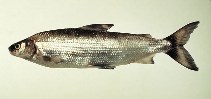 Coregonus clupeaformis
Photo de Scarola, J.F.
Images | vidéos | Images Google
Photo de Scarola, J.F.
Classification / Noms Noms communs | Synonymes | Catalog of Fishes(Genre, Espèce) | ITIS | CoL | WoRMS | Cloffa
> Salmoniformes (Salmons) > Salmonidae (Salmonids) > Coregoninae
Etymology: Coregonus: Greek, kore = pupils of the eye + Greek, gonia = angle (Ref. 45335); clupeaformis: clupeaformis meaning herring-shaped (Ref. 1998).
More on author: Mitchill.
Etymology: Coregonus: Greek, kore = pupils of the eye + Greek, gonia = angle (Ref. 45335); clupeaformis: clupeaformis meaning herring-shaped (Ref. 1998).
More on author: Mitchill.
Environnement : milieu / zone climatique / profondeur / gamme de distribution Écologie
; eau douce; saumâtre benthopélagique; anadrome (Ref. 120291); profondeur 8 - 128 m (Ref. 3849). Temperate; 8°C - 14°C (Ref. 1998); 72°N - 41°N, 149°W - 61°W (Ref. 86798)
Distribution Territoires | Zones FAO | Écosystèmes | Occurrences | Carte par point | Introductions | Faunafri
North America: Atlantic, Arctic and Pacific basins throughout most of Canada south into New England, the Great Lakes basin, and central Minnesota, USA; Copper and Susitna river drainages in Alaska. Introduced in northwestern USA (Ref. 86798). This species was stocked into high Andean lakes in two countries in southern Latin America (Ref. 1739). Probably conspecific with Coregonus lavaretus (Ref. 7506). Belongs to Coregonus clupeaformis complex (Ref. 27547).
Longueur à la première maturité / Taille / Poids / Âge
Maturité: Lm ? range ? - ? cm
Max length : 100.0 cm TL mâle / non sexé; (Ref. 9988); common length : 54.1 cm TL mâle / non sexé; (Ref. 12193); poids max. publié: 19.0 kg (Ref. 28850); âge max. reporté: 50 années (Ref. 3494)
Max length : 100.0 cm TL mâle / non sexé; (Ref. 9988); common length : 54.1 cm TL mâle / non sexé; (Ref. 12193); poids max. publié: 19.0 kg (Ref. 28850); âge max. reporté: 50 années (Ref. 3494)
Description synthétique Clés d'identification | Morphologie | Morphométrie
Épines dorsales (Total) : 0; Rayons mous dorsaux (Total) : 11 - 13; Épines anales: 0; Rayons mous anaux: 10 - 14; Vertèbres: 55 - 64. Adipose fin well developed, often larger in males; axillary process present in pelvic fins (Ref. 27547). Dark brown to midnight blue above fading to silver on sides and wide beneath; no parr marks in young (Ref. 27547).
Body shape (shape guide): fusiform / normal; Cross section: oval.
Body shape (shape guide): fusiform / normal; Cross section: oval.
Inhabits large lakes and large rivers and enters brackish water (Ref. 86798). Primarily a lake dweller (Ref. 27547). Nerito-pelagic (Ref. 58426). Appears to be rather sedentary, at least in the Great Lakes (Ref. 27547). Movement in large lakes generally consists of 4 stages: movement from deep to shallow water in the spring; movement back to deep water in the summer as the shoal water warms; migration to shallow-water spawning areas in the fall and early winter; and post-spawning movement back to deeper water (Ref. 27547). Forms separate populations in large lakes (Ref. 27547). Adults feed mainly on aquatic insect larvae, mollusks and amphipods (Ref. 1091, 3849); also other fishes and fish eggs, including their own (Ref. 1998). Extensive hatchery programs for the propagation have been carried out on the Great Lakes and other areas for years (Ref. 3746, 3849). Valued for its meat as well as for its roe, which is made into an excellent caviar; utilized fresh, smoked, and frozen; eaten steamed, fried, broiled, boiled, microwaved, and baked (Ref. 9988).
Cycle de vie et comportement reproducteur Maturité | Reproduction | Frai | Œufs | Fécondité | Larves
Spawning occurs at night (Ref. 10242, 10344, 28849). A female and one or more males rise to the surface, release eggs and milt and descend separately toward the bottom (Ref. 27547). Spawning fish are very active and may leap completely out of the water (Ref. 1998). Breeds annually in the southern parts of the range, but only every other year or even every third year in the arctic and sub-arctic regions (Ref. 3757).
Référence principale
Téléchargez vos références | Références | Coordinateur | Collaborateurs
Page, L.M. and B.M. Burr, 2011. A field guide to freshwater fishes of North America north of Mexico. Boston : Houghton Mifflin Harcourt, 663p. (Ref. 86798)
Statut dans la liste rouge de l'IUCN (Ref. 130435: Version 2025-2 (Global))
Préoccupation mineure (LC) ; Date assessed: 27 July 2016
CITES
Not Evaluated
Menace pour l'homme
Harmless
Utilisations par l'homme
Pêcheries: commercial; pêche sportive: oui; Aquarium: Aquariums publics
FAO - pêcheries: débarquements, Résumé espèce; Publication: search | FishSource |
Plus d'informations
Écologie trophique
Aliments (proies)
Composition du régime alimentaire
Consommation alimentaire
Rations alimentaires
Prédateurs
Aliments (proies)
Composition du régime alimentaire
Consommation alimentaire
Rations alimentaires
Prédateurs
Dynamique des populations
Paramètres de croissance
Âges / tailles maximales
Longueur-poids rel.
Rel. longueur-longueur.
Fréquences de longueurs
Conversion de masse
Recrutement
Abondance
Paramètres de croissance
Âges / tailles maximales
Longueur-poids rel.
Rel. longueur-longueur.
Fréquences de longueurs
Conversion de masse
Recrutement
Abondance
Cycle de vie
Reproduction
Maturité
Maturité/épines rel.
Fécondité
Frai
Agrégats de frai
Œufs
Développement de l'œuf
Larves
Dynamique des populations larvaires
Reproduction
Maturité
Maturité/épines rel.
Fécondité
Frai
Agrégats de frai
Œufs
Développement de l'œuf
Larves
Dynamique des populations larvaires
Physiologie
Composition corporelle
Nutriments
Consommation d'oxygène
Type de natation
Vitesse de nage
Pigments visuels
Son de poisson
Maladies et parasites
Toxicité (CL50)
Composition corporelle
Nutriments
Consommation d'oxygène
Type de natation
Vitesse de nage
Pigments visuels
Son de poisson
Maladies et parasites
Toxicité (CL50)
Liées à l'homme
Systèmes d'aquaculture
Profils d'aquaculture
Souches
Cas de ciguatera
Timbres, pièces de monnaie, divers
Systèmes d'aquaculture
Profils d'aquaculture
Souches
Cas de ciguatera
Timbres, pièces de monnaie, divers
Outils
E-book | Guide de terrain | Clés d'identification | Générateur de fréquences de longueur | Outil de dynamique de population | Carte par point |
Capture-MSY |
Articles particuliers
Télécharger en XML
Sources Internet
AFORO (otoliths) | Alien/Invasive Species database | Aquatic Commons | BHL | Cloffa | Websites from users | FishWatcher | CISTI | Catalog of Fishes: Genre, Espèce | DiscoverLife | ECOTOX | FAO - pêcheries: débarquements, Résumé espèce; Publication: search | Faunafri | Fishipedia | Fishtrace | GloBI | Google Books | Google Scholar | Google | IGFA World Record | Bases de données nationales | OneZoom | Open Tree of Life | Otolith Atlas of Taiwan Fishes | PubMed | Reef Life Survey | Socotra Atlas | TreeBase | Arbre de Vie | Wikipedia: aller à, chercher | World Records Freshwater Fishing | Zoological Record
Estimations basées sur des modèles
Indice de diversité phylogénétique (Réf. 82804): PD50 = 0.5000 [Uniqueness, from 0.5 = low to 2.0 = high].
Bayesian length-weight: a=0.00550 (0.00475 - 0.00636), b=3.23 (3.19 - 3.27), in cm total length, based on LWR estimates for this species (Ref. 93245).
Niveau trophique (Réf. 69278): 3.2 ±0.2 se; based on diet studies.
Generation time: 4.4 (3.9 - 5.5) years. Estimated as median ln(3)/K based on 59 growth studies.
Résilience (Réf. 120179): Faible, temps minimum de doublement de population : 4,5 à 14 années (K=0.06-0.19; tmax=50).
Nutriments (Ref. 124155): Calcium = 11.6 [7.5, 20.7] mg/100g; Iron = 0.279 [0.200, 0.389] mg/100g; Protein = 17.7 [16.5, 18.8] %; Omega3 = 0.96 [0.41, 2.48] g/100g; Selenium = 20.8 [10.7, 46.0] μg/100g; VitaminA = 12.2 [4.7, 31.8] μg/100g; Zinc = 0.538 [0.439, 0.650] mg/100g (wet weight); based on nutrient studies.