



Hochladen Photos und videos
Bilder | Google Bild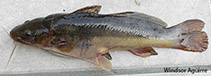 Rhamdia quelen
Photo von Aguirre, W.
Bilder | Google Bild
Photo von Aguirre, W.
Klassifizierung / Names Namen | Synonyme | Catalog of Fishes(Gattung, Arten) | ITIS | CoL | WoRMS | Cloffa
> Siluriformes (Catfishes) > Heptapteridae (Three-barbeled catfishes)
Etymology: Rhamdia: Brazilian vernacular name, Nhamdia/Jamdia (Ref. 45335).
Eponymy: Abbé Florentin-Louis de Quélen de la Villeglée (d: 1762) was the chaplain on board the ‘Uranie’ circumnavigation expedition (1817–1820) commanded by Freycinet (q. [...] (Ref. 128868), visit book page.
More on authors: Quoy & Gaimard.
Etymology: Rhamdia: Brazilian vernacular name, Nhamdia/Jamdia (Ref. 45335).
Eponymy: Abbé Florentin-Louis de Quélen de la Villeglée (d: 1762) was the chaplain on board the ‘Uranie’ circumnavigation expedition (1817–1820) commanded by Freycinet (q. [...] (Ref. 128868), visit book page.
More on authors: Quoy & Gaimard.
Taxonomic Remarks
Junior synonym Rhamdia wagneri (Günther, 1868) is considered as a synonym of Rhamdia guatemalensis (Günther, 1864) in Ref. 108688:575; 108948.
Umwelt: Milieu / Klimazone / Tiefenbereich / Verbreitungsgebiet Ökologie
; süßwasser benthopelagisch; pH range: ? - 7.0; tiefenbereich 0 - 3 m (Ref. 35381). Tropical; 22°C - 28°C (Ref. 2060)
Verbreitung Territorien | FAO Gebiete | Ökosysteme | Vorkommen | Punkt Karte | Einführungen | Faunafri
Central and South America: Mexico to central Argentina.
Größe / Gewicht / Alter
Geschlechtsreife: Lm ? range ? - ? cm
Max length : 61.0 cm TL Männchen/unbestimmt; (Ref. 40637); max. veröff. Gewicht: 4.0 kg (Ref. 40637)
Max length : 61.0 cm TL Männchen/unbestimmt; (Ref. 40637); max. veröff. Gewicht: 4.0 kg (Ref. 40637)
Kurzbeschreibung Bestimmungsschlüssel | Morphologie | Morphometrie
Body shape (shape guide): elongated.
Occurs in littoral creeks, over sandy bottoms covered with dead leaves (Ref. 27188). Inhabits also lakes and rivers, but seems to prefer rivers with a very slight current (Ref. 6868). Prefers a muddy bottom covered with leaves and decaying wood, the latter providing for hiding places during the day (Ref. 35381). Feeds on fish and insects (Ref. 27188), benthic zooplankton and crustaceans (Ref. 35381). Omnivorous (Ref. 79585). Mainly nocturnal (Ref. 11225). Possesses poisonous spiny rays. Its sex ratio is 2:1 in favor of females. The male's reproductive apparatus includes multi-lobed testicles and accessory organs for secretion and storage. Fertilization is external. Non-sticking demersal eggs (1.1 to 2.8 mm diameter) are laid down, hatching after about 48 hours at 22°C. Ten days later, the larvae weigh approximately 100 mg but growth is slow (0.5 to 1.15 g per day).
Lebenszyklus und Paarungsverhalten Geschlechtsreife | Fortpflanzung | Ablaichen | Eier | Fruchtbarkeit | Larven
Hauptreferenz
Laden Sie Ihre Referenzen hoch | Referenzen | Koordinator : Bockmann, Flavio | Partner
Hernández, C.L., A. Ortega-Lara, G.C. Sánchez-Garcés, M.H. Alford, 2015. Genetic and morphometric evidence for the recognition of several recently synonymized species of Trans-Andean Rhamdia (Pisces: Siluriformes: Heptapteridae). Copeia 103(3):563-579. (Ref. 108688)
IUCN Rote Liste Status (Ref. 130435: Version 2025-2 (Global))
nicht bedroht (LC) ; Date assessed: 19 March 2018
CITES
Not Evaluated
Bedrohung für Menschen
Harmless
Nutzung durch Menschen
Fischereien: weniger kommerziell; Aquakultur: kommerziell
FAO - Publication: search | FishSource |
Mehr Information
Trophische Ökologie
Lebensmittel (Beutetiere)
Nahrungszusammensetzung
Nahrungsaufnahme
Lebensmittelrationen
Räuber
Lebensmittel (Beutetiere)
Nahrungszusammensetzung
Nahrungsaufnahme
Lebensmittelrationen
Räuber
Populationsdynamik
Wachstumsparameter
Max. Alter/Größen
Länge-Gewicht-Rel.
Länge-Länge-Verhältnis.
Längenhäufigkeiten
Massenkonvertierung
Rekrutierung
Dichte
Wachstumsparameter
Max. Alter/Größen
Länge-Gewicht-Rel.
Länge-Länge-Verhältnis.
Längenhäufigkeiten
Massenkonvertierung
Rekrutierung
Dichte
Lebenszyklus
Fortpflanzung
Geschlechtsreife
Reifung/Kiemen rel.
Fruchtbarkeit
Ablaichen
Laichaggregationen
Eier
Eientwicklung
Larven
Larven Pop.Dyn.
Fortpflanzung
Geschlechtsreife
Reifung/Kiemen rel.
Fruchtbarkeit
Ablaichen
Laichaggregationen
Eier
Eientwicklung
Larven
Larven Pop.Dyn.
Anatomie
Kiemenoberfläche
Gehirn
Otolith
Kiemenoberfläche
Gehirn
Otolith
Physiologie
Körperliche Zusammensetzung
Nährstoffe
Sauerstoffverbrauch
Schwimmart
Schwimmgeschwindigkeit
Visuelle Pigmente
Fischgeräusche
Krankheiten und Parasiten
Toxizität (LC50s)
Körperliche Zusammensetzung
Nährstoffe
Sauerstoffverbrauch
Schwimmart
Schwimmgeschwindigkeit
Visuelle Pigmente
Fischgeräusche
Krankheiten und Parasiten
Toxizität (LC50s)
Menschenbezogen
Aquakultur-Systeme
Aquakultur Profile
Zuchtlinien
Ciguatera-Fälle
Briefmarken, Münzen, Verschiedenes.
Aquakultur-Systeme
Aquakultur Profile
Zuchtlinien
Ciguatera-Fälle
Briefmarken, Münzen, Verschiedenes.
Tools
Bio-Quiz | E-Book | Feldführer | Längenhäufigkeits Tool | Lebensdaten Tool | Punkt Karte |
Catch-MSY |
Zusatzinformationen
Download XML
Zusammenfassung | Punktdaten | Namen | Photos
Internet Quellen
AFORO (otoliths) | Alien/Invasive Species database | Aquatic Commons | BHL | Cloffa | Websites from users | FishWatcher Einträge suchen | CISTI | Catalog of Fishes: Gattung, Arten | DiscoverLife | ECOTOX | FAO - Publication: search | Faunafri | Fishipedia | Fishtrace | GloBI | Google Books | Google Scholar | Google | IGFA World Record | Nationale Datenbanken | OneZoom | Open Tree of Life | Otolith Atlas of Taiwan Fishes | PubMed | Reef Life Survey | Socotra Atlas | TreeBase | Tree of Life | Wikipedia: Gehe zu, Suchen | World Records Freshwater Fishing | Zoologischer Rekord
Schätzungen auf der Grundlage von Modellen
Phylogenetischer Diversitätsindex (Ref. 82804): PD50 = 0.5000 [Uniqueness, from 0.5 = low to 2.0 = high].
Bayesian length-weight: a=0.00912 (0.00783 - 0.01062), b=3.02 (2.98 - 3.06), in cm total length, based on LWR estimates for this species (Ref. 93245).
Trophische Ebene (Ref. 69278): 3.9 ±0.3 se; based on diet studies.
Widerstandsfähigkeit (Ref. 120179): hoch, Verdopplung der Population dauert weniger als 15 Monate. (Fec=41,334).
Nährstoffe (Ref. 124155): Calcium = 91.5 [50.5, 198.1] mg/100g; Iron = 1.02 [0.58, 1.80] mg/100g; Protein = 16.5 [15.4, 17.6] %; Omega3 = 0.239 [0.098, 0.592] g/100g; Selenium = 51.7 [20.4, 122.1] μg/100g; VitaminA = 55.8 [19.4, 147.0] μg/100g; Zinc = 1.55 [1.06, 2.24] mg/100g (wet weight);