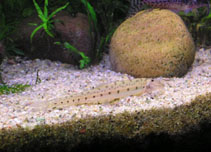
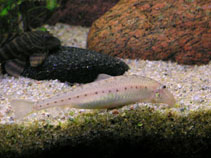
Acantopsis dialuzona : fisheries, aquarium

Acantopsis dialuzona Van Hasselt, 1823

Hochladen Photos und videos
Bilder | Google Bild

Klassifizierung / Names Namen | Synonyme | Catalog of Fishes(Gattung, Arten) | ITIS | CoL | WoRMS | Cloffa

> Cypriniformes (Carps) > Cobitidae (Spined loaches)
Etymology: Acantopsis: Greek, akantha = thorn + Greek, ops = similar (Ref. 45335).

Umwelt: Milieu / Klimazone / Tiefenbereich / Verbreitungsgebiet Ökologie

; süßwasser demersal; pH range: 6.0 - 6.5; dH range: ? - 10. Tropical; 25°C - 28°C (Ref. 1672)

Verbreitung Territorien | FAO Gebiete | Ökosysteme | Vorkommen | Punkt Karte | Einführungen | Faunafri

Asia: Java, Borneo, Sumatra, and the Malay Peninsula as far north as southern Thailand. Reported from areas of Southeast Asia outside its range, including as Acantopsis. Choirorhynchos because of the lack of taxonomic resolution in Acantopsis.

Größe / Gewicht / Alter

Geschlechtsreife: Lm ?  range ? - ? cm
Max length : 25.0 cm SL Männchen/unbestimmt; (Ref. 7050); max. veröff. Gewicht: 50.00 g (Ref. 124153)

Kurzbeschreibung Bestimmungsschlüssel | Morphologie | Morphometrie

Rückenflossenweichstrahlen (insgesamt) : 9 - 11; Wirbelzahl: 42 - 44. Acantopsis dialuzona is distinguished from all congeners by combination of the following characters: usually 3 pairs of labial barbels; well developed ocellus on upper margin of caudal-fin base; 0-1 row of large spots on side of head; absence of large black spots on dorsal or caudal fins; rarely black specks beneath midlateral row of black spots; dorsal fin usually with 10½ branched and pectoral fin with 10 rays; 11-17 dark saddles along dorsal midline; 7-13 black spots along side of body; 42-43 total vertebrae; and body depth 8.9-11.9% SL, body width 6.4-9.1% SL, caudal-peduncle length 12.5-16.2% SL (Ref. 116755).
Body shape (shape guide): elongated.

Biologie     Fachlexikon (Englisch) (z.B. epibenthic)

Inhabits rivers where they feed on small animals in the bottom sediments. Occurs in swift, clear streams with sandy or gravelly bottom; also found in large rivers (Ref. 4832).

Lebenszyklus und Paarungsverhalten Geschlechtsreife | Fortpflanzung | Ablaichen | Eier | Fruchtbarkeit | Larven

Hauptreferenz Laden Sie Ihre Referenzen hoch | Referenzen | Koordinator | Partner

Boyd, D.A., P. Nithirojpakdee, G. Deein, C. Vidthayanon, C. Grudpan, W. Tangjitjaroen, J.M. Pfeiffer, Z.S. Randall, T. Srisombat and L.M. Page, 2017. Revision of the horseface loaches (Cobitidae, Acantopsis), with description of three new species from Southeast Asia. Zootaxa 4341(2):151-192. (Ref. 116755)

IUCN Rote Liste Status (Ref. 130435: Version 2025-2 (Global))

  nicht bedroht (LC) ; Date assessed: 27 November 2019

CITES

Not Evaluated

CMS (Ref. 116361)

Not Evaluated

Bedrohung für Menschen

  Harmless


Nutzung durch Menschen

Fischereien: kommerziell; Aquarium: Kommerziell
FAO - Publication: search | FishSource |

Mehr Information

Trophische Ökologie
Lebensmittel (Beutetiere)
Nahrungszusammensetzung
Nahrungsaufnahme
Lebensmittelrationen
Räuber
Ökologie
Ökologie
Populationsdynamik
Wachstumsparameter
Max. Alter/Größen
Länge-Gewicht-Rel.
Länge-Länge-Verhältnis.
Längenhäufigkeiten
Massenkonvertierung
Rekrutierung
Dichte
Lebenszyklus
Fortpflanzung
Geschlechtsreife
Reifung/Kiemen rel.
Fruchtbarkeit
Ablaichen
Laichaggregationen
Eier
Eientwicklung
Larven
Larven Pop.Dyn.
Verbreitung
Territorien
FAO Gebiete
Ökosysteme
Vorkommen
Einführungen
BRUVS - Videos
Anatomie
Kiemenoberfläche
Gehirn
Otolith
Physiologie
Körperliche Zusammensetzung
Nährstoffe
Sauerstoffverbrauch
Schwimmart
Schwimmgeschwindigkeit
Visuelle Pigmente
Fischgeräusche
Krankheiten und Parasiten
Toxizität (LC50s)
Genetik
Genom
Genetik
Heterozygotie
Vererbbarkeit
Genetische Vielfalt
Menschenbezogen
Aquakultur-Systeme
Aquakultur Profile
Zuchtlinien
Ciguatera-Fälle
Briefmarken, Münzen, Verschiedenes.
Aufsuchen
Partner
Referenzen
Referenzen

Tools

Zusatzinformationen

Download XML

Internet Quellen

AFORO (otoliths) | Aquatic Commons | BHL | Cloffa | Websites from users | FishWatcher Einträge suchen | CISTI | Catalog of Fishes: Gattung, Arten | DiscoverLife | ECOTOX | FAO - Publication: search | Faunafri | Fishipedia | Fishtrace | GloBI | Google Books | Google Scholar | Google | IGFA World Record | OneZoom | Open Tree of Life | Otolith Atlas of Taiwan Fishes | PubMed | Reef Life Survey | Socotra Atlas | TreeBase | Tree of Life | Wikipedia: Gehe zu, Suchen | World Records Freshwater Fishing | Zoobank | Zoologischer Rekord

Schätzungen auf der Grundlage von Modellen

Phylogenetischer Diversitätsindex (Ref. 82804):  PD50 = 0.5039   [Uniqueness, from 0.5 = low to 2.0 = high].
Bayesian length-weight: a=0.00407 (0.00230 - 0.00723), b=2.96 (2.81 - 3.11), in cm total length, based on LWR estimates for this species & (Sub)family-body (Ref. 93245).
Trophische Ebene (Ref. 69278):  3.5   ±0.37 se; based on food items.
Widerstandsfähigkeit (Ref. 120179):  mittel, Verdopplung der Population dauert 1,4 - 4,4 Jahre. (Preliminary K or Fecundity.).
Anfälligkeit der Fischerei (Ref. 59153):  Low vulnerability (21 of 100). 🛈
Preiskategorie (Ref. 80766):   Unknown.