



Beobachtung melden im Fish Watcher
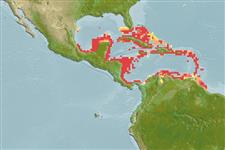
| Native range | All suitable habitat | Point map | Year 2050 |
|
| This map was computer-generated and has not yet been reviewed. |
| Albula vulpes AquaMaps Data sources: GBIF OBIS |
Hochladen Photos und videos
Bilder | videos | Laute | Briefmarken, Münzen, Verschiedenes. | Google Bild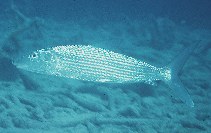 Albula vulpes
Photo von Randall, J.E.
Bilder | videos | Laute | Briefmarken, Münzen, Verschiedenes. | Google Bild
Photo von Randall, J.E.
Klassifizierung / Names Namen | Synonyme | Catalog of Fishes(Gattung, Arten) | ITIS | CoL | WoRMS | Cloffa
> Albuliformes (Bonefishes) > Albulidae (Bonefishes) > Albulinae
Etymology: Albula: Latin, albus = white (Ref. 45335).
More on author: Linnaeus.
Etymology: Albula: Latin, albus = white (Ref. 45335).
More on author: Linnaeus.
Umwelt: Milieu / Klimazone / Tiefenbereich / Verbreitungsgebiet Ökologie
seewasser; brackwasser riff-verbunden; amphidrom (Ref. 126106); tiefenbereich 0 - 84 m (Ref. 13608), usually 1 - 15 m (Ref. 9268). Subtropical; 26°N - 7°N, 97°W - 58°W (Ref. 118624)
Verbreitung Territorien | FAO Gebiete | Ökosysteme | Vorkommen | Punkt Karte | Einführungen | Faunafri
Worldwide in warm seas. Hawaiian species have been verified by electrophoretic analysis (Ref. 5577), hence, Albula vulpes might be further split. Eastern Pacific: California, USA to Peru (Ref. 2850). Western Atlantic: North Carolina, USA to Florida, Bahamas, Gulf of Mexico, Antilles and Caribbean to Brazil (Ref. 26938). Northwest Atlantic: Canada (Ref. 5951). The West African form is Albula goreensis, Valenciennes, 1846.
Länge bei der ersten Reifung / Größe / Gewicht / Alter
Geschlechtsreife: Lm 37.5, range 21 - 36 cm
Max length : 104 cm TL Männchen/unbestimmt; (Ref. 7251); max. veröff. Gewicht: 10.0 kg (Ref. 37955)
Max length : 104 cm TL Männchen/unbestimmt; (Ref. 7251); max. veröff. Gewicht: 10.0 kg (Ref. 37955)
Kurzbeschreibung Bestimmungsschlüssel | Morphologie | Morphometrie
Rückenflossenstacheln (insgesamt) : 0; Rückenflossenweichstrahlen (insgesamt) : 15 - 19; Afterflossenstacheln: 0; Afterflossenweichstrahlen: 7 - 9; Wirbelzahl: 69 - 74. Branchiostegal rays 12-14 (Ref. 4639). Silvery with dusky fins; base of pectorals yellow (Ref. 3970). Body elongate and fusiform (Ref. 4832). Last ray of dorsal and anal fins not prolonged; head region naked; spot and band absent on head; margin of nasal pore not black (Ref. 13608). Bluntly conical snout extends beyond inferior mouth (Ref. 26938). Pectoral and pelvic axillary scales present; a single long scale on each side of membrane between each ray of dorsal and anal fins (Ref. 4832).
Body shape (shape guide): fusiform / normal.
Body shape (shape guide): fusiform / normal.
Adults inhabit shallow coastal waters, estuaries and bays, over sand and mud bottoms (Ref. 3237). Often in schools, except large individuals which are solitary (Ref. 7251). Dorsal fin may show above surface (Ref. 42064). More or less pelagic but feed on benthic worms, crustaceans, and mollusks (Ref. 2850); that are picked from mud and sand bottoms (Ref. 27549). They can tolerate oxygen poor water by inhaling air into a lung-like airbladder (Ref. 9710). Flesh is bony and not esteemed (Ref. 9268). One of the most important game fishes worldwide (Ref. 26938).
Lebenszyklus und Paarungsverhalten Geschlechtsreife | Fortpflanzung | Ablaichen | Eier | Fruchtbarkeit | Larven
Spawning occurs in open waters. Eggs are pelagic (Ref. 205).
Hauptreferenz
Laden Sie Ihre Referenzen hoch | Referenzen | Koordinator | Partner
Whitehead, P.J.P., 1990. Albulidae. p. 122-124. In J.C. Quero, J.C. Hureau, C. Karrer, A. Post and L. Saldanha (eds.) Check-list of the fishes of the eastern tropical Atlantic (CLOFETA). JNICT, Lisbon; SEI, Paris; and UNESCO, Paris, Vol. 1. (Ref. 4447)
IUCN Rote Liste Status (Ref. 130435: Version 2025-2 (Global))
Gefährdung zunehmend (NT) ; Date assessed: 29 March 2011
CITES
Not Evaluated
Bedrohung für Menschen
Reports of ciguatera poisoning (Ref. 4690)
Nutzung durch Menschen
Fischereien: weniger kommerziell; Sportfisch: ja; Köder: usually
FAO - Fischereien: landings search; Publication: search | FishSource | Das Meer um uns herum
Mehr Information
Trophische Ökologie
Lebensmittel (Beutetiere)
Nahrungszusammensetzung
Nahrungsaufnahme
Lebensmittelrationen
Räuber
Lebensmittel (Beutetiere)
Nahrungszusammensetzung
Nahrungsaufnahme
Lebensmittelrationen
Räuber
Populationsdynamik
Wachstumsparameter
Max. Alter/Größen
Länge-Gewicht-Rel.
Länge-Länge-Verhältnis.
Längenhäufigkeiten
Massenkonvertierung
Rekrutierung
Dichte
Wachstumsparameter
Max. Alter/Größen
Länge-Gewicht-Rel.
Länge-Länge-Verhältnis.
Längenhäufigkeiten
Massenkonvertierung
Rekrutierung
Dichte
Lebenszyklus
Fortpflanzung
Geschlechtsreife
Reifung/Kiemen rel.
Fruchtbarkeit
Ablaichen
Laichaggregationen
Eier
Eientwicklung
Larven
Larven Pop.Dyn.
Fortpflanzung
Geschlechtsreife
Reifung/Kiemen rel.
Fruchtbarkeit
Ablaichen
Laichaggregationen
Eier
Eientwicklung
Larven
Larven Pop.Dyn.
Anatomie
Kiemenoberfläche
Gehirn
Otolith
Kiemenoberfläche
Gehirn
Otolith
Physiologie
Körperliche Zusammensetzung
Nährstoffe
Sauerstoffverbrauch
Schwimmart
Schwimmgeschwindigkeit
Visuelle Pigmente
Fischgeräusche
Krankheiten und Parasiten
Toxizität (LC50s)
Körperliche Zusammensetzung
Nährstoffe
Sauerstoffverbrauch
Schwimmart
Schwimmgeschwindigkeit
Visuelle Pigmente
Fischgeräusche
Krankheiten und Parasiten
Toxizität (LC50s)
Genetik
Genom
Genetik
Heterozygotie
Vererbbarkeit
Genetische Vielfalt
Genom
Genetik
Heterozygotie
Vererbbarkeit
Genetische Vielfalt
Menschenbezogen
Aquakultur-Systeme
Aquakultur Profile
Zuchtlinien
Ciguatera-Fälle
Briefmarken, Münzen, Verschiedenes.
Aquakultur-Systeme
Aquakultur Profile
Zuchtlinien
Ciguatera-Fälle
Briefmarken, Münzen, Verschiedenes.
Tools
Bio-Quiz | E-Book | Feldführer | Bestimmungsschlüssel | Längenhäufigkeits Tool | Lebensdaten Tool | Punkt Karte |
Catch-MSY |
Zusatzinformationen
Download XML
Zusammenfassung | Punktdaten | Namen | Photos
Internet Quellen
AFORO (otoliths) | Alien/Invasive Species database | Aquatic Commons | BHL | Cloffa | Websites from users | FishWatcher Einträge suchen | CISTI | Catalog of Fishes: Gattung, Arten | DiscoverLife | ECOTOX | FAO - Fischereien: landings search; Publication: search | Faunafri | Fishipedia | Fishtrace | GloBI | GoMexSI (interaction data) | Google Books | Google Scholar | Google | IGFA World Record | Nationale Datenbanken | OneZoom | Open Tree of Life | Otolith Atlas of Taiwan Fishes | PubMed | Reef Life Survey | Socotra Atlas | TreeBase | Tree of Life | Wikipedia: Gehe zu, Suchen | | Zoologischer Rekord
Schätzungen auf der Grundlage von Modellen
|
Phylogenetischer Diversitätsindex (Ref. 82804) |
PD50 = 0.5007 [Uniqueness, from 0.5 = low to 2.0 = high]. |
| Bayesian length-weight | a=0.01230 (0.00893 - 0.01695), b=3.02 (2.93 - 3.11), in cm total length, based on LWR estimates for this species (Ref. 93245). |
|
Trophische Ebene (Ref. 69278) |
3.7 ±0.3 se; based on diet studies. |
|
Widerstandsfähigkeit (Ref. 120179) |
niedrig, Verdopplung der Population dauert 4,5 - 14 Jahre. (K=0.3; tm=2; tmax=20). |
|
Anfälligkeit der Fischerei (Ref. 59153) |
Moderate vulnerability (40 of 100). 🛈 |
|
Klimaanfälligkeit (Ref. 125649) |
High to very high vulnerability (66 of 100). 🛈 |
|
Preiskategorie (Ref. 80766) |
High. |
|
Nährstoffe (Ref. 124155) |
Calcium = 16.1 [8.5, 47.7] mg/100g; Iron = 0.503 [0.283, 0.890] mg/100g; Protein = 19.8 [18.7, 20.9] %; Omega3 = 0.258 [0.146, 0.453] g/100g; Selenium = 21 [11, 40] μg/100g; VitaminA = 23.8 [7.7, 79.0] μg/100g; Zinc = 0.641 [0.446, 0.942] mg/100g (wet weight); |