



Uploaden van uw Foto's en video's
Afbeeldingen | Postzegels, munten, diversen. | Google afbeelding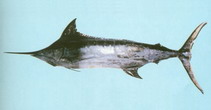 Makaira mazara
Afbeelding van CAFS
Afbeeldingen | Postzegels, munten, diversen. | Google afbeelding
Afbeelding van CAFS
Classificatie / Namen Lokale namen | Synoniemen | Catalog of Fishes(Genus, Soort(en)) | ITIS | CoL | WoRMS | Cloffa
> Carangiformes (Jacks) > Istiophoridae (Billfishes)
Etymology: Makaira: Greek,makaira, -as = happy, rich (Ref. 45335).
More on authors: Jordan & Snyder.
Etymology: Makaira: Greek,makaira, -as = happy, rich (Ref. 45335).
More on authors: Jordan & Snyder.
Taxonomic Remarks
Uncertain as Makaira mazara (Jordan & Snyder 1901). Istiophoridae. Distribution: Tropical and temperate Indo-Pacific [if valid]. ECoF ver. 15 Aug 2025.
Milieu: milieu / Klimaatzone / Diepte / verspreidingsgebied Ecologie
marien pelagic-oceanic; oceanodroom (Ref. 71039); diepte 0 - 200 m (Ref. 43), usually 100 - ? m (Ref. 6390). Subtropical; 21°C - ? (Ref. 30368); 44°N - 40°S, 30°E - 74°W (Ref. 43)
Verspreiding Gebieden | FAO regio's | Ecosystemen | Voorkomen | Verspreidingskaart | Introducties | Faunafri
Indo-Pacific: in tropical, subtropical and sometimes temperate waters (Ref. 9692). It is the most tropical billfish species and is common in equatorial waters. However, many scientists do not view Makaira mazara and Makaira nigricans as distinct species, and that the latter species has been considered as a single pantropical species occurring in the Atlantic, Pacific and Indian Oceans. Highly migratory species.
Lengte bij maturiteit / Grootte / Gewicht / Leeftijd
Maturiteit: Lm ? range ? - ? cm
Max length : 500 cm TL mannelijk / geslacht onbekend; (Ref. 30874); common length : 350 cm TL mannelijk / geslacht onbekend; (Ref. 9308); max. gepubliceerd gewicht: 170.0 kg (Ref. 6390); max. gepubliceerd gewicht: 170.0 kg; max. gerapporteerde leeftijd: 28 Jaren (Ref. 30371)
Max length : 500 cm TL mannelijk / geslacht onbekend; (Ref. 30874); common length : 350 cm TL mannelijk / geslacht onbekend; (Ref. 9308); max. gepubliceerd gewicht: 170.0 kg (Ref. 6390); max. gepubliceerd gewicht: 170.0 kg; max. gerapporteerde leeftijd: 28 Jaren (Ref. 30371)
Korte beschrijving Determinatiesleutels | Morfologie | Morfometrie
Dorsale zachte stralen (totaal) : 40 - 45; Anale zachte stralen: 18 - 24; Wervels: 24. Body elongated and not very compressed; upper jaw produced into a robust but not very long beak; two dorsal fins, the height of the first less then the greatest body depth, short anteriorly, taller in the middle, then becoming shorter posteriorly; pectoral fins falcate and flexible, with 21 to 23 rays; body densely covered with small, embedded scales with 1 or 2 sharp points; back dark blue, with 15 bluish bars across the flanks; belly pale silver; membrane of first dorsal fin blue black, with dark spots (Ref. 55763). Dark blue above, silvery white below; sometimes with light blue vertical stripes; 1st dorsal fin blackish to dark blue, other fins dark brown with tinges of dark blue in some specimens. Body blue-black dorsally and silvery white ventrally, with about 25 pale, cobalt-colored stripes, each consisting of round dots or narrow bars (may not always be visible especially in preserved specimens). Bill long, extremely stout and round in cross section. Nape conspicuously elevated. Right and left branchiostegal membranes completely united together, but free from isthmus. No gill rakers. Body densely covered with elongate, thick, bony scales, each often with 1 or 2, sometimes 3, posterior points. Caudal peduncle with strong double keels on each side and a shallow notch on both the dorsal and ventral surfaces.
Body shape (shape guide): elongated; Cross section: oval.
Body shape (shape guide): elongated; Cross section: oval.
Epipelagic and oceanic species mostly confined to the waters on the warmer side of the 24°C surface isotherm and known to effect seasonal north-south migrations. Not usually seen close to land masses or islands, unless there is a deep drop-off of the shelf. Remain mostly within the upper 37 m. Believed to form small-scale schools of at most 10 individuals. Larger fish tend to swim solitarily (Ref. 43) but smaller ones form schools of about 10 individuals (Ref. 9987). Feed on squids, tuna-like fishes, crustaceans and cephalopods (Ref. 9308). Also caught with troll lines (Ref. 9308). The flesh is of good quality and is marketed frozen and prepared as sashimi and sausages in Japan (Ref. 9308); also utilized fresh (Ref. 9987). Also Ref. 9692.
Levenscyclus en paargedrag Maturiteit | Voortplanting | Paaien | Eieren | Fecunditeit | Larven
Spawning probably takes place year-round in equatorial waters to 10° latitude (although 1 study has suggested this needs verification) and during summer periods in both hemispheres to 30° latitude, in both the Indian and Pacific oceans (Ref. 6390).
In the southern hemisphere, concentrations of spawning fish probably occur around French Polynesia (Ref. 30354).
Hoofdreferentie
Upload uw referenties | Referenties | Coördinator | Medewerkers
Nakamura, I., 1985. FAO species catalogue. Vol. 5. Billfishes of the world. An annotated and illustrated catalogue of marlins, sailfishes, spearfishes and swordfishes known to date. FAO Fish. Synop. 125(5):65p. Rome: FAO. (Ref. 43)
CITES
Not Evaluated
Gevaar voor de mens
Harmless
Gebruik door de mens
Visserij: commercieel; sportvis: ja
FAO - Publication: search | FishSource | Sea Around Us
Meer informatie
Trofische ecologie
Voedsel (prooien)
Dieetsamenstelling
Voedselconsumptie
Voedselrantsoenen
Predatoren
Voedsel (prooien)
Dieetsamenstelling
Voedselconsumptie
Voedselrantsoenen
Predatoren
Populatiedynamica
Groeiparameters
Max. leeftijden / maten
Lengte-gewicht rel.
Lengte-lengte rel.
Lengtefrequenties
Massaconversie
Rekrutering
Abundantie
Groeiparameters
Max. leeftijden / maten
Lengte-gewicht rel.
Lengte-lengte rel.
Lengtefrequenties
Massaconversie
Rekrutering
Abundantie
Levenscyclus
Voortplanting
Maturiteit
Rijpheid/kieuwen rel.
Fecunditeit
Paaien
Paaibestanden
Eieren
Ontwikkeling van de eieren
Larven
Larvale populatiedynamiek
Voortplanting
Maturiteit
Rijpheid/kieuwen rel.
Fecunditeit
Paaien
Paaibestanden
Eieren
Ontwikkeling van de eieren
Larven
Larvale populatiedynamiek
Fysiologie
Lichaamssamenstelling
Voedingsstoffen
Zuurstofverbruik
Type zwemmen
Zwemsnelheid
Visuele pigmenten
Vis geluid
Ziekten en parasieten
Toxiciteit (LC50)
Lichaamssamenstelling
Voedingsstoffen
Zuurstofverbruik
Type zwemmen
Zwemsnelheid
Visuele pigmenten
Vis geluid
Ziekten en parasieten
Toxiciteit (LC50)
Menselijk gerelateerd
Aquacultuursystemen
Aquacultuurprofielen
Kweeklijnen
Ciguatera gevallen
Postzegels, munten, diversen.
Aquacultuursystemen
Aquacultuurprofielen
Kweeklijnen
Ciguatera gevallen
Postzegels, munten, diversen.
Tools
E-boek | Veldgids | Determinatiesleutels | Lengtefrequentie Tool | Levenscyclus tool | Verspreidingskaart |
Vangst-MSY |
Speciale rapporten
Bekijk gegevens voor het houden in een aquarium | Bekijk Fact Sheets voor de soort | Bekijk Aquacultuur Fact Sheets
Download XML
Internetbronnen
AFORO (otoliths) | Aquatic Commons | BHL | Cloffa | Websites from users | Bekijk FishWatcher | CISTI | Catalog of Fishes: Genus, Soort(en) | DiscoverLife | ECOTOX | FAO - Publication: search | Faunafri | Fishipedia | Fishtrace | GloBI | Google Books | Google Scholar | Google | IGFA World Record | Nationale databanken | OneZoom | Open Tree of Life | Otolith Atlas of Taiwan Fishes | PubMed | Reef Life Survey | Socotra Atlas | TreeBase | Tree of Life | Wikipedia: ga naar, zoek | World Records Freshwater Fishing | Zoological Record
Schattingen op basis van modellen
Gewenste temperatuur (Ref. 123201): 13.6 - 25.2, mean 19.3 °C (based on 408 cells).
Fylogenetische diversiteitsindex (Ref. 82804): PD50 = 0.7505 [Uniqueness, from 0.5 = low to 2.0 = high].
Bayesian length-weight: a=0.00447 (0.00195 - 0.01025), b=3.14 (2.94 - 3.34), in cm total length, based on LWR estimates for this (Sub)family-body shape (Ref. 93245).
Trofisch niveau (Ref. 69278): 4.5 ±0.89 se; based on food items.
Generation time: 9.5 ( na - na) years. Estimated as median ln(3)/K based on 1 growth studies.
Weerstandsvermogen (Ref. 120179): laag, minimale populatieverdubbelingstijd 4,5-14 jaar (rm=0.104; K=0.12-0.29; tm=4; tmax=28; Fec=31 million).
Voedingsstoffen (Ref. 124155): Calcium = 21.5 [10.2, 35.8] mg/100g; Iron = 0.804 [0.465, 1.353] mg/100g; Protein = 19.6 [18.5, 20.7] %; Omega3 = 0.197 [0.102, 0.367] g/100g; Selenium = 49.6 [25.5, 95.2] μg/100g; VitaminA = 5.18 [1.68, 16.00] μg/100g; Zinc = 0.331 [0.229, 0.481] mg/100g (wet weight);