



Oreochromis upembae (Thys van den Audenaerde, 1964)
Envoyez vos Photos et vidéos
Images Google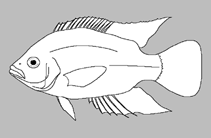 No image available for this species;
drawing shows typical species in Cichlidae.
Images Google
drawing shows typical species in Cichlidae.
Classification / Noms Noms communs | Synonymes | Catalog of Fishes(Genre, Espèce) | ITIS | CoL | WoRMS | Cloffa
> Cichliformes (Cichlids, convict blennies) > Cichlidae (Cichlids) > Pseudocrenilabrinae
Etymology: Oreochromis: Latin, aurum = gold + Greek, chromis = a fish, perhaps a perch (Ref. 45335).
Etymology: Oreochromis: Latin, aurum = gold + Greek, chromis = a fish, perhaps a perch (Ref. 45335).
Environnement : milieu / zone climatique / profondeur / gamme de distribution Écologie
; eau douce benthopélagique. Tropical
Distribution Territoires | Zones FAO | Écosystèmes | Occurrences | Carte par point | Introductions | Faunafri
Africa: upper parts of the Congo River (Ref. 54847, 55074), mainly the Upemba region and the Lualaba River to Yangambi and Isangi in the Democratic Republic of Congo (Ref. 5166, 52307).
Taille / Poids / Âge
Description synthétique Clés d'identification | Morphologie | Morphométrie
Épines dorsales (Total) : 14 - 16; Rayons mous dorsaux (Total) : 11 - 13; Épines anales: 3; Rayons mous anaux: 9 - 12; Vertèbres: 29 - 30. Diagnosis: Oreochromis upembae is a deep-bodied species with a short head, which looks very similar to O. malagarasi (Ref. 52307). It is distinguished by following characters: mature males with a bifid and tuberculate genital papilla, prolonged into a cream-coloured tassel in breeding males, in which the edges of the dorsal and caudal fins are orange-coloured or red; two to four dark blotches mid-laterally from operculum to caudal peduncle and a blotch on top of caudal peduncle, distinctive in that the blotches are rather large and vaguely outlined and persist in adults; caudal fin with dark, narrow, vertical stripes or series of spots, only a little less regular than in O. niloticus; caudal rays rather densely scaled to near edge; caudal peduncle deep; vertebrae 29-30; scales in lateral line series 28-31; dorsal spines XIV-XVI, soft rays 11-13; outer teeth bicuspid, in some fishes becoming unicuspid by wear; lower pharyngeal teeth fine, the tooth area with rounded lateral lobes, the blade 1.15-1.5 times the medial length of the toothed area; lower gill-rakers 20-25; and interorbital width 38.8-43.3% length of head (Ref. 2). Among the tasselled tilapias this most resembles O. malagarasi, which differs in having a less scaly caudal fin, the scales usually confined to the basal parts of the rays, and in lacking the regular dark stripes or series of spots on the caudal; and in O. malagarasi the range of dorsal spines is higher, XVI-XVII (Ref. 2).
Body shape (shape guide): short and / or deep; Cross section: compressed.
Body shape (shape guide): short and / or deep; Cross section: compressed.
A maternal mouthbrooder (Ref. 52307).
Cycle de vie et comportement reproducteur Maturité | Reproduction | Frai | Œufs | Fécondité | Larves
The female broods the young and eggs in the mouth in the shelter of sandbanks in the Congo River at Yangambi (Ref. 2).
Référence principale
Téléchargez vos références | Références | Coordinateur : Kullander, Sven O. | Collaborateurs
Trewavas, E., 1983. Tilapiine fishes of the genera Sarotherodon, Oreochromis and Danakilia. British Mus. Nat. Hist., London, UK. 583 p. (Ref. 2)
Statut dans la liste rouge de l'IUCN (Ref. 130435: Version 2025-2 (Global))
Préoccupation mineure (LC) ; Date assessed: 01 May 2009
CITES
Not Evaluated
Menace pour l'homme
Harmless
Utilisations par l'homme
FAO - Publication: search | FishSource |
Plus d'informations
Écologie trophique
Aliments (proies)
Composition du régime alimentaire
Consommation alimentaire
Rations alimentaires
Prédateurs
Aliments (proies)
Composition du régime alimentaire
Consommation alimentaire
Rations alimentaires
Prédateurs
Dynamique des populations
Paramètres de croissance
Âges / tailles maximales
Longueur-poids rel.
Rel. longueur-longueur.
Fréquences de longueurs
Conversion de masse
Recrutement
Abondance
Paramètres de croissance
Âges / tailles maximales
Longueur-poids rel.
Rel. longueur-longueur.
Fréquences de longueurs
Conversion de masse
Recrutement
Abondance
Cycle de vie
Reproduction
Maturité
Maturité/épines rel.
Fécondité
Frai
Agrégats de frai
Œufs
Développement de l'œuf
Larves
Dynamique des populations larvaires
Reproduction
Maturité
Maturité/épines rel.
Fécondité
Frai
Agrégats de frai
Œufs
Développement de l'œuf
Larves
Dynamique des populations larvaires
Anatomie
Surface branchiale
Cerveau
Otolithe
Surface branchiale
Cerveau
Otolithe
Physiologie
Composition corporelle
Nutriments
Consommation d'oxygène
Type de natation
Vitesse de nage
Pigments visuels
Son de poisson
Maladies et parasites
Toxicité (CL50)
Composition corporelle
Nutriments
Consommation d'oxygène
Type de natation
Vitesse de nage
Pigments visuels
Son de poisson
Maladies et parasites
Toxicité (CL50)
Génétique
génôme
Génétique
Hétérozygotie
Héritabilité
Diversité génétique
génôme
Génétique
Hétérozygotie
Héritabilité
Diversité génétique
Liées à l'homme
Systèmes d'aquaculture
Profils d'aquaculture
Souches
Cas de ciguatera
Timbres, pièces de monnaie, divers
Systèmes d'aquaculture
Profils d'aquaculture
Souches
Cas de ciguatera
Timbres, pièces de monnaie, divers
Outils
E-book | Guide de terrain | Générateur de fréquences de longueur | Outil de dynamique de population | Carte par point |
Capture-MSY |
Articles particuliers
Télécharger en XML
Sources Internet
AFORO (otoliths) | Aquatic Commons | BHL | Cloffa | Websites from users | FishWatcher | CISTI | Catalog of Fishes: Genre, Espèce | DiscoverLife | ECOTOX | FAO - Publication: search | Faunafri | Fishipedia | Fishtrace | GloBI | Google Books | Google Scholar | Google | IGFA World Record | OneZoom | Open Tree of Life | Otolith Atlas of Taiwan Fishes | PubMed | Reef Life Survey | Socotra Atlas | TreeBase | Arbre de Vie | Wikipedia: aller à, chercher | World Records Freshwater Fishing | Zoological Record
Estimations basées sur des modèles
Indice de diversité phylogénétique (Réf. 82804): PD50 = 0.5000 [Uniqueness, from 0.5 = low to 2.0 = high].
Bayesian length-weight: a=0.01905 (0.00846 - 0.04293), b=3.01 (2.82 - 3.20), in cm total length, based on LWR estimates for this (Sub)family-body shape (Ref. 93245).
Niveau trophique (Réf. 69278): 2.5 ±0.24 se; based on food items.
Résilience (Réf. 120179): Haut, temps minimum de doublement de population inférieur à 15 mois (Preliminary K or Fecundity.).