



Oreochromis amphimelas (Hilgendorf, 1905)
Manyara tilapia
Envoyez vos Photos et vidéos
Images | Images Google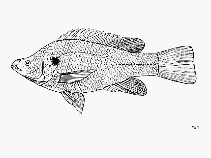 Oreochromis amphimelas
Photo de FAO
Images | Images Google
Photo de FAO
Classification / Noms Noms communs | Synonymes | Catalog of Fishes(Genre, Espèce) | ITIS | CoL | WoRMS | Cloffa
> Cichliformes (Cichlids, convict blennies) > Cichlidae (Cichlids) > Pseudocrenilabrinae
Etymology: Oreochromis: Latin, aurum = gold + Greek, chromis = a fish, perhaps a perch (Ref. 45335).
More on author: Hilgendorf.
Etymology: Oreochromis: Latin, aurum = gold + Greek, chromis = a fish, perhaps a perch (Ref. 45335).
More on author: Hilgendorf.
Environnement : milieu / zone climatique / profondeur / gamme de distribution Écologie
; eau douce; saumâtre benthopélagique. Tropical; 3°N - 5°S
Distribution Territoires | Zones FAO | Écosystèmes | Occurrences | Carte par point | Introductions | Faunafri
Africa: several shallow saline lakes in central Tanzania (Ref. 118630), like lakes Manyara, Eyasi, Kitangiri, Singida and Sulungali (Ref. 5166, 118638).
Longueur à la première maturité / Taille / Poids / Âge
Description synthétique Clés d'identification | Morphologie | Morphométrie
Épines dorsales (Total) : 12 - 14; Rayons mous dorsaux (Total) : 10 - 12; Épines anales: 3; Rayons mous anaux: 8 - 11; Vertèbres: 30 - 32. Diagnosis: Slender bodied tilapia, characterised by its small eye and slender head profile with terminal mouth (Ref. 118638); further a narrow preorbital bone and scales of nape, dorsum and belly are very small, the transition from flank to belly scales abrupt, along a curve from base of pectoral fin to vent (Ref. 2). The upper profile of the head is nearly horizontal and in specimens larger than 130 mm total length there is a steep rise from the occiput to the dorsal fin; the caudal peduncle is long and dorsal and anal fins do not reach its posterior end when adpressed (Ref. 2). Live territorial males have jet black dorsal fins and are black underneath but are pinkish-red on flank and caudal fin; under stress, such as following capture, the flanks darken and the whole fish appear dark grey, apart from the reddish tailfin; females and non-territorial males grey/silver with pale ventral region (Ref. 118638).
Body shape (shape guide): short and / or deep; Cross section: compressed.
Body shape (shape guide): short and / or deep; Cross section: compressed.
Found in lakes (Ref. 4967); small bodied forms are present in Lake Eyasi, Lake Manyara and Lake Sulungali, while large bodied forms can be found in Lake Kitangiri and Lake Singida (Ref. 4967, 118638). It is microphagous (Ref. 54840). A maternal mouthbrooder (Ref. 2, 118638). Limited potential as an aquaculture species, it comprises a high proportion of the catch in lakes where it is found (Ref. 118638). IUCN conservation status is endangered, due to restricted distribution, drought and overfishing (Ref. 118638). There is some indication of hybridization with Oreochromis niloticus and O. esculentus (Ref. 118638).
Cycle de vie et comportement reproducteur Maturité | Reproduction | Frai | Œufs | Fécondité | Larves
A maternal mouthbrooder (Ref. 118638). Breeding cycle of about 7 weeks; there is evidence of biparental mouthbrooding (Ref. 2).
Référence principale
Téléchargez vos références | Références | Coordinateur : Kullander, Sven O. | Collaborateurs
Trewavas, E., 1983. Tilapiine fishes of the genera Sarotherodon, Oreochromis and Danakilia. British Mus. Nat. Hist., London, UK. 583 p. (Ref. 2)
Statut dans la liste rouge de l'IUCN (Ref. 130435: Version 2025-2 (Global))
Menacé (EN) (B1ab(i,iii,v)); Date assessed: 31 January 2006
CITES
Not Evaluated
Menace pour l'homme
Harmless
Utilisations par l'homme
FAO - Publication: search | FishSource |
Plus d'informations
Écologie trophique
Aliments (proies)
Composition du régime alimentaire
Consommation alimentaire
Rations alimentaires
Prédateurs
Aliments (proies)
Composition du régime alimentaire
Consommation alimentaire
Rations alimentaires
Prédateurs
Dynamique des populations
Paramètres de croissance
Âges / tailles maximales
Longueur-poids rel.
Rel. longueur-longueur.
Fréquences de longueurs
Conversion de masse
Recrutement
Abondance
Paramètres de croissance
Âges / tailles maximales
Longueur-poids rel.
Rel. longueur-longueur.
Fréquences de longueurs
Conversion de masse
Recrutement
Abondance
Cycle de vie
Reproduction
Maturité
Maturité/épines rel.
Fécondité
Frai
Agrégats de frai
Œufs
Développement de l'œuf
Larves
Dynamique des populations larvaires
Reproduction
Maturité
Maturité/épines rel.
Fécondité
Frai
Agrégats de frai
Œufs
Développement de l'œuf
Larves
Dynamique des populations larvaires
Anatomie
Surface branchiale
Cerveau
Otolithe
Surface branchiale
Cerveau
Otolithe
Physiologie
Composition corporelle
Nutriments
Consommation d'oxygène
Type de natation
Vitesse de nage
Pigments visuels
Son de poisson
Maladies et parasites
Toxicité (CL50)
Composition corporelle
Nutriments
Consommation d'oxygène
Type de natation
Vitesse de nage
Pigments visuels
Son de poisson
Maladies et parasites
Toxicité (CL50)
Génétique
génôme
Génétique
Hétérozygotie
Héritabilité
Diversité génétique
génôme
Génétique
Hétérozygotie
Héritabilité
Diversité génétique
Liées à l'homme
Systèmes d'aquaculture
Profils d'aquaculture
Souches
Cas de ciguatera
Timbres, pièces de monnaie, divers
Systèmes d'aquaculture
Profils d'aquaculture
Souches
Cas de ciguatera
Timbres, pièces de monnaie, divers
Outils
E-book | Guide de terrain | Générateur de fréquences de longueur | Outil de dynamique de population | Carte par point |
Capture-MSY |
Articles particuliers
Télécharger en XML
Sources Internet
AFORO (otoliths) | Aquatic Commons | BHL | Cloffa | Websites from users | FishWatcher | CISTI | Catalog of Fishes: Genre, Espèce | DiscoverLife | ECOTOX | FAO - Publication: search | Faunafri | Fishipedia | Fishtrace | GloBI | Google Books | Google Scholar | Google | IGFA World Record | OneZoom | Open Tree of Life | Otolith Atlas of Taiwan Fishes | PubMed | Reef Life Survey | Socotra Atlas | TreeBase | Arbre de Vie | Wikipedia: aller à, chercher | World Records Freshwater Fishing | Zoological Record
Estimations basées sur des modèles
Indice de diversité phylogénétique (Réf. 82804): PD50 = 0.5000 [Uniqueness, from 0.5 = low to 2.0 = high].
Bayesian length-weight: a=0.01905 (0.00846 - 0.04293), b=3.01 (2.82 - 3.20), in cm total length, based on LWR estimates for this (Sub)family-body shape (Ref. 93245).
Résilience (Réf. 120179): Milieu, temps minimum de doublement de population : 1,4 à 4,4 années (Preliminary K or Fecundity.).
Nutriments (Ref. 124155): Calcium = 24.3 [9.2, 128.7] mg/100g; Iron = 1.05 [0.48, 2.47] mg/100g; Protein = 17.3 [15.5, 19.1] %; Omega3 = 0.174 [0.085, 0.377] g/100g; Selenium = 51.6 [24.6, 109.1] μg/100g; VitaminA = 8.8 [1.7, 41.7] μg/100g; Zinc = 1.73 [0.95, 4.05] mg/100g (wet weight);