



Clarias gariepinus (Burchell, 1822)
North African catfish
Sube tu fotos y Vídeos
Imágenes | Sellos, monedas, varios | Google image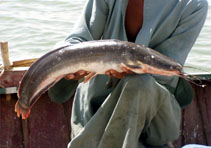 Clarias gariepinus
Foto de Larsen, J.H.
Imágenes | Sellos, monedas, varios | Google image
Foto de Larsen, J.H.
Clasificación / Nombres Nombres comunes | Sinónimos | Catalog of Fishes(Género, Especie) | ITIS | CoL | WoRMS | Cloffa
> Siluriformes (Catfishes) > Clariidae (Airbreathing catfishes)
Etymology: Clarias: Greek, chlaros = lively, in reference to the ability of the fish to live for a long time out of water; gariepinus: Named after its type locality, the Gariep river, the Hottentot name for the Orange river, South Africa.
Etymology: Clarias: Greek, chlaros = lively, in reference to the ability of the fish to live for a long time out of water; gariepinus: Named after its type locality, the Gariep river, the Hottentot name for the Orange river, South Africa.
Entorno: milieu / zona climática / rango de profundidad / gama de distribución Ecología
; agua dulce bentopelágico; pH range: 6.5 - 8.0; dH range: 5 - 28; potamodromo (Ref. 51243); rango de profundidad 0 - 80 m (Ref. 34291). Subtropical; 8°C - 35°C (Ref. 6465); 42°N - 28°S, 17°W - 51°E
Distribución Territorios | Áreas FAO | Ecosistemas | Ocurrencias, apariciones | Mapa de puntos | Introducciones | Faunafri
Africa: almost Pan-African (Ref. 107916), absent from Maghreb, the Upper and (most of the) Lower Guinea and the Cape province and probably also Nogal province. Asia: Jordan, Israel, Lebanon, Syria and southern Turkey. Widely introduced to other parts of Africa, Europe and Asia. Several countries report adverse ecological impact after introduction.
Longitud en la primera madurez / Tamaño / Peso / Edad
Madurez: Lm 30.8, range 34 - ? cm
Max length : 170 cm TL macho / no sexado; (Ref. 40637); common length : 90.0 cm NG macho / no sexado; (Ref. 34290); peso máximo publicado: 60.0 kg (Ref. 4537); edad máxima reportada: 15 años (Ref. 94815)
Max length : 170 cm TL macho / no sexado; (Ref. 40637); common length : 90.0 cm NG macho / no sexado; (Ref. 34290); peso máximo publicado: 60.0 kg (Ref. 4537); edad máxima reportada: 15 años (Ref. 94815)
Descripción breve Claves de identificación | Morfología | Morfometría
Espinas dorsales (total) : 0; Radios blandos dorsales (total) : 61 - 80; Espinas anales: 0; Radios blandos anales: 45 - 65; Vértebra: 56 - 63. Diagnosis: body depth 6-8 times in standard length, head 3-3,5 times in SL (Ref. 34290) or 30-37% SL (Ref. 28714). Head somewhat between rectangular and pointed in dorsal outline; snout broadly rounded; eyes supero-lateral and relatively small (Ref. 248). Teeth on premaxilla and lower jaw small, fine and arranged in several rows; nasal barbels 1/5-1/2 times as long as head in fishes longer than 12 cm, and 1/2-4/5 of head length in smaller individuals; maxillary barbels rarely shorter than head, usually somewhat longer and reaching to a point midway between origin of dorsal fin and insertion of pelvic fins; outer mandibular barbel longer than inner pair (Ref. 34290). Postorbital bones in contact; lower part of head with 2 black, lateral bands (Ref. 81644). Contrary to other Clarias species, Clarias gariepinus has a high number of gill rakers varying from 24-110 (Ref. 248, 34290, 81644, 101841), the number increasing with size of the fish; gill rakers long, slender and closely set (Ref. 248, 34290). Distance between occipital process and base of dorsal fin is short; dorsal fin almost reaches caudal fin; anal fin origin closer to caudal fin base than to snout, nearly reaching caudal fin (Ref. 248). Pelvic fin closer to snout than to caudal fin base (Ref. 248) or about midway (Ref. 28714). Pectoral fin extends from operculum to below 1st dorsal fin rays (Ref. 248). Pectoral spine robust (Ref. 248), serrated only on its outer face (Ref. 248, 81644), the number of serrations increasing with age (Ref. 248). Lateral line appears as a small, white line from posterior end of head to middle of caudal fin base; openings to secondary sensory canals clearly marked (Ref. 248).
Body shape (shape guide): elongated; Cross section: oval.
Body shape (shape guide): elongated; Cross section: oval.
Facultative air-breathing (Ref. 126274); Adults occur mainly in quiet waters, (vegetated fringes of) rivers and lakes, (isolated) pools (Ref. 248, 28714), irrigation and sewage effluent canals (Ref. 28714), and prefer rather shallow and swampy areas with a soft muddy substrate and calmer water (Ref. 78218). They may also occur in fast flowing rivers and in rapids (Ref. 248, 78218). Recorded as having been or being farmed in rice fields (Ref. 119549). The two known colour types appear to correlate with water turbidity and substrate type (Ref. 81644). Widely tolerant of extreme environmental conditions (Ref. 6465). Water parameters appear to play only a very minor role (Ref. 78218). The presence of an accessory breathing organ enables this species to breath air when very active or under very dry conditions. They remain in the muddy substrates of ponds and occasionally gulp air through the mouth (Ref. 6465). Can leave the water at night using its strong pectoral fins and spines in search of land-based food or can move into the breeding areas through very shallow pathways (Ref. 6868). Omnivorous bottom feeders which occasionally feed at the surface (Ref. 248), but essentially a predator feeding on crustaceans, insects and fish (Ref. 28714). Feed at night on a wide variety of prey (Ref. 6868) like insects, plankton, invertebrates and fish but also take in young birds, rotting flesh and plants (Ref. 6465). Migrate to rivers and temporary streams to spawn (Ref. 34291), and a major floodplain migrant, spawning throughout the flood season, in the Sudd (Sudan) (Ref. 28714). Also caught with dragnets. During intra-specific aggressive interactions, this species was noted to generate electric organ discharges that were monophasic, head-positive and lasting from 5-260 ms (Ref. 10479). Known as sharptooth catfish in aquaculture, a highly recommended food fish in Africa (Ref. 52863). Marketed fresh and frozen; eaten broiled, fried and baked (Ref. 9987).
Ciclo vital y comportamiento de apareamiento Madurez | Reproducción | Puesta | Huevos | Fecundidad | Larva
Oviparous. Spawning takes place during the rainy season in flooded deltas. The fishes make a lateral migration towards the inundated plains to breed and return to the river or lake soon afterwards while the juveniles remain in the inundated area. Juveniles return to the lake or river when they are between 1.5 and 2.5 cm long (Ref. 34291). First sexual maturity occurs when females are between 40-45 cm and males between 35-40 cm. Eggs are greenish. Incubations lasts little (about 33 hours at 25°C).
Referencia principal
Suba sus referencias | Referencias | Coordinador | Colaboradores
Teugels, G.G., 1986. A systematic revision of the African species of the genus Clarias (Pisces; Clariidae). Ann. Mus. R. Afr. Centr., Sci. Zool., 247:199 p. (Ref. 248)
Situación en la Lista Roja de la UICN (Ref. 130435: Version 2025-2 (Global))
Least Concern (LC) ; Date assessed: 20 June 2018
CITES
Not Evaluated
Amenaza para el ser humano
Potential pest (Ref. 4537)
Usos humanos
Pesquerías: escaso valor comercial; Acuicultura: comercial; pesca deportiva: si
FAO - Sistemas de acuicultura: producción; pesquerías: desembarques, perfil de la especie; Publication: search | FishSource |
Más información
Ecología Trófica
Alimentos (presas)
Composición de la dieta
consumo de alimento
Raciones de comida
Despredadores
Alimentos (presas)
Composición de la dieta
consumo de alimento
Raciones de comida
Despredadores
Dinámica de la población
Coeficiente del crecimiento para
Edades / tallas máximas
Longitud-peso rel.
Longitud-longitud rel.
Longitud-frecuencias
Conversión de masas
Reclutamiento
Abundancia
Coeficiente del crecimiento para
Edades / tallas máximas
Longitud-peso rel.
Longitud-longitud rel.
Longitud-frecuencias
Conversión de masas
Reclutamiento
Abundancia
Ciclo de vida
Reproducción
Madurez
Madurez/Gills rel.
Fecundidad
Puesta
Agregaciones de desove
Huevos
Desarrollo de los huevos
Larva
Dinámica larvaria
Reproducción
Madurez
Madurez/Gills rel.
Fecundidad
Puesta
Agregaciones de desove
Huevos
Desarrollo de los huevos
Larva
Dinámica larvaria
Distribución
Territorios
Áreas FAO
Ecosistemas
Ocurrencias, apariciones
Introducciones
BRUVS - Vídeos
Territorios
Áreas FAO
Ecosistemas
Ocurrencias, apariciones
Introducciones
BRUVS - Vídeos
Anatomía
Superficie branquial
Cerebro
Otolito
Superficie branquial
Cerebro
Otolito
Fisiología
Composición corporal
Nutrientes
Consumo del oxígeno
Tipo de natación
Velocidad de natación
Pigmentos visuales
Sonido de peces
Enfermedades y parásitos
Toxicidad (CL50)
Composición corporal
Nutrientes
Consumo del oxígeno
Tipo de natación
Velocidad de natación
Pigmentos visuales
Sonido de peces
Enfermedades y parásitos
Toxicidad (CL50)
Relacionados con el ser humano
Sistemas de acuicultura
Perfiles de acuicultura
Razas
Ciguatera cases
Sellos, monedas, varios
Sistemas de acuicultura
Perfiles de acuicultura
Razas
Ciguatera cases
Sellos, monedas, varios
Herramientas
Cuestionario orgánico | Libro electrónico | Guía de campo | Claves de identificación | Asistente para frecuencias de tallas | Herramienta de ciclo de vida | Mapa de puntos |
Catch-MSY |
Informes especiales
Comprobar el mantenimiento del acuario | Buscar fichas sobre especies | Consulte las hojas informativas sobre acuicultura
Descargar XML
Fuentes de Internet
AFORO (otoliths) | Alien/Invasive Species database | Aquatic Commons | BHL | Cloffa | Websites from users | Check FishWatcher | CISTI | Catalog of Fishes: Género, Especie | DiscoverLife | ECOTOX | FAO - Sistemas de acuicultura: producción; pesquerías: desembarques, perfil de la especie; Publication: search | Faunafri | Fishipedia | Fishtrace | GloBI | Google Books | Google Scholar | Google | IGFA World Record | Bases de datos nacionales | OneZoom | Open Tree of Life | Otolith Atlas of Taiwan Fishes | Acuarios públicos | PubMed | Reef Life Survey | Socotra Atlas | TreeBase | Árbol de la vida | Wikipedia: Go, búsqueda | World Records Freshwater Fishing | Expediente Zoológico
Estimaciones basadas en modelos
Índice de diversidad filogenética (Referencia 82804): PD50 = 0.5000 [Uniqueness, from 0.5 = low to 2.0 = high].
Bayesian length-weight: a=0.00776 (0.00664 - 0.00908), b=2.97 (2.93 - 3.01), in cm total length, based on LWR estimates for this species (Ref. 93245).
Nivel trófico (Referencia 69278): 3.8 ±0.4 se; based on diet studies.
Generation time: 8.5 (5.5 - 12.2) years. Estimated as median ln(3)/K based on 25 growth studies.
Resiliencia (Referencia 120179): Medio, población duplicada en un tiempo mínimo de 1.4-4.4 años (K=0.06-0.19; tm=2; Fec > 10,000).
Nutrientes (Ref. 124155): Calcium = 6.69 [3.48, 35.37] mg/100g; Iron = 0.989 [0.530, 1.675] mg/100g; Protein = 17.2 [16.2, 18.3] %; Omega3 = 0.291 [0.094, 0.905] g/100g; Selenium = 81.1 [23.6, 249.3] μg/100g; VitaminA = 23.9 [6.3, 90.4] μg/100g; Zinc = 0.371 [0.257, 0.553] mg/100g (wet weight); based on nutrient studies.