This website uses cookies to enhance your browsing experience and ensure the functionality of our site. For more detailed information about the types of cookies we use and how we protect your privacy, please visit our Privacy Information page.
×
Cookie Settings
This website uses different types of cookies to enhance your experience. Please select your preferences below:
> Carangiformes (Jacks) > Carangidae (Jacks and pompanos) > Caranginae
Etymology: Atropus:The name of the Parcae, fates of Roman mythology (Ref. 45335). Eponymy: In Greek mythology, Atropos -known as the ‘inflexible’ or ‘inevitable’ -was the oldest of the Three Fates. (Ref. 128868), visit book page.
Entorno: milieu / zona climática / rango de profundidad / gama de distribución Ecología
marino; salobre asociado a arrecife; rango de profundidad 1 - 59 m (Ref. 99978). Tropical; 32°N - 30°S, 33°E - 134°E
Indo-West Pacific: Red Sea, Gulf of Oman and along the African coast (to East London in South Africa, Ref. 3197) and the west coast of Madagascar to southern India and Sri Lanka. There are reliable reports from the Gulf of Thailand, Hong Kong, Okinawa and Japan.
Tamaño / Peso / Edad
Madurez: Lm? range ? - ? cm Max length : 58.0 cm TL macho / no sexado; (Ref. 90102); common length : 30.0 cm TL macho / no sexado; (Ref. 5450); peso máximo publicado: 3.5 kg (Ref. 4883)
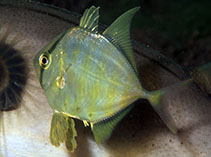
Adults are found in coastal waters near corals and rocks, also in shallow lagoons (Ref. 30573). Solitary species on inshore reefs (Ref. 48635). Small groups frequently patrol perimeter of reefs (Ref. 90102). Juveniles may enter estuaries (Ref. 5213). Behaviour of shadowing a larger fish was observed, expected to be more common for juvenies (B. Hazes, pers. comm. 3/2023).
Ciclo vital y comportamiento de apareamiento Madurez | Reproducción | Puesta | Huevos | Fecundidad | Larva
Smith-Vaniz, W.F., 1984. Carangidae. In W. Fischer and G. Bianchi (eds.) FAO species identification sheets for fishery purposes. Western Indian Ocean fishing area 51. Vol. 1. [pag. var.]. FAO, Rome. (Ref. 3287)
Situación en la Lista Roja de la UICN (Ref. 130435: Version 2025-2 (Global))
Temperatura preferida (Referencia 123201): 24.7 - 29.2, mean 28.4 °C (based on 1300 cells).
Índice de diversidad filogenética (Referencia 82804): PD50 = 0.5312 [Uniqueness, from 0.5 = low to 2.0 = high].
Bayesian length-weight: a=0.01905 (0.01197 - 0.03033), b=2.96 (2.83 - 3.09), in cm total length, based on LWR estimates for this species & (Sub)family-body (Ref. 93245).
Nivel trófico (Referencia 69278): 4.2 ±0.53 se; based on food items.
Resiliencia (Referencia 120179): Medio, población duplicada en un tiempo mínimo de 1.4-4.4 años (Assumed K=0.3 and tm=2).
Vulnerabilidad pesquera (Ref. 59153): Moderate vulnerability (43 of 100). 🛈