



Luvarus imperialis Rafinesque, 1810
Luvar
Beobachtung melden im Fish Watcher
| Native range | All suitable habitat | Point map | Year 2050 |

|
| This map was computer-generated and has not yet been reviewed. |
| Luvarus imperialis AquaMaps Data sources: GBIF OBIS |
Hochladen Photos und videos
Bilder | Google Bild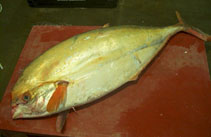 Luvarus imperialis
Photo von Sacristan, C.
Bilder | Google Bild
Photo von Sacristan, C.
Klassifizierung / Names Namen | Synonyme | Catalog of Fishes(Gattung, Arten) | ITIS | CoL | WoRMS | Cloffa
> Acanthuriformes (Surgeonfishes) > Luvaridae (Louvar)
Etymology: Luvarus: Sicilian name, luvaru, for a fish (Ref. 45335).
More on author: Rafinesque.
Etymology: Luvarus: Sicilian name, luvaru, for a fish (Ref. 45335).
More on author: Rafinesque.
Umwelt: Milieu / Klimazone / Tiefenbereich / Verbreitungsgebiet Ökologie
seewasser pelagic-oceanic; ozeanodrom (Ref. 51243); tiefenbereich 0 - 200 m (Ref. 6517). Subtropical; 60°N - 25°S, 180°W - 180°E
Verbreitung Territorien | FAO Gebiete | Ökosysteme | Vorkommen | Punkt Karte | Einführungen | Faunafri
Atlantic, Indian and Pacific: in temperate and tropical waters (Ref. 47377). Western Atlantic: USA and eastern Gulf of Mexico (Ref. 7251). Eastern Atlantic: Bergen, Norway to Madeira and near the Azores, including western Mediterranean; west of Cape Point, South Africa (Ref. 6657). Western Pacific: Japan, Australia, and New Zealand (Ref. 5755). Eastern Pacific: Oregon, USA to Chile (Ref. 2850).
Größe / Gewicht / Alter
Geschlechtsreife: Lm ? range ? - ? cm
Max length : 200 cm TL Männchen/unbestimmt; (Ref. 9314); common length : 152 cm SL Männchen/unbestimmt; (Ref. 6517); max. veröff. Gewicht: 150.0 kg (Ref. 47377)
Max length : 200 cm TL Männchen/unbestimmt; (Ref. 9314); common length : 152 cm SL Männchen/unbestimmt; (Ref. 6517); max. veröff. Gewicht: 150.0 kg (Ref. 47377)
Kurzbeschreibung Bestimmungsschlüssel | Morphologie | Morphometrie
Rückenflossenweichstrahlen (insgesamt) : 20; Afterflossenstacheln: 0; Afterflossenweichstrahlen: 18; Wirbelzahl: 22. Absence of dorsal and anal spines and of pelvic fins contribute to streamlining of the body, as does the flat and relatively consolidated opercular spines (Ref. 11017, p. 74).
Body shape (shape guide): fusiform / normal; Cross section: compressed.
Body shape (shape guide): fusiform / normal; Cross section: compressed.
Oceanic and epipelagic; found near surface or in deep water (Ref. 10821). Apparently solitary (Ref. 9314). Feed mainly on jellyfishes, ctenophores, and other gelatinous planktonic animals (Ref. 2850, 6885). Spawning starts at the end of spring and during the summer (Ref. 9314). Juveniles unlike adults in that the median fins are longer and further forward, the mouth toothed and the body and fins black-spotted (Ref. 6517). Rarely found in markets (Ref. 9314).
Lebenszyklus und Paarungsverhalten Geschlechtsreife | Fortpflanzung | Ablaichen | Eier | Fruchtbarkeit | Larven
Hauptreferenz
Laden Sie Ihre Referenzen hoch | Referenzen | Koordinator | Partner
Tyler, J.C., G.D. Johnson, I. Nakamura and B.B. Collette, 1989. Morphology of Luvarus imperialis (Luvaridae), with a phylogenetic analysis of the Acanthuridae (Pisces). Smithsonian Contributions to Zoology, No. 485. Smithsonian Inst. Press, Washington, D.C. 78 p. (Ref. 11017)
IUCN Rote Liste Status (Ref. 130435: Version 2025-2 (Global))
nicht bedroht (LC) ; Date assessed: 13 July 2012
CITES
Not Evaluated
Bedrohung für Menschen
Harmless
Nutzung durch Menschen
Fischereien: weniger kommerziell
FAO - Publication: search | FishSource |
Mehr Information
Trophische Ökologie
Lebensmittel (Beutetiere)
Nahrungszusammensetzung
Nahrungsaufnahme
Lebensmittelrationen
Räuber
Lebensmittel (Beutetiere)
Nahrungszusammensetzung
Nahrungsaufnahme
Lebensmittelrationen
Räuber
Populationsdynamik
Wachstumsparameter
Max. Alter/Größen
Länge-Gewicht-Rel.
Länge-Länge-Verhältnis.
Längenhäufigkeiten
Massenkonvertierung
Rekrutierung
Dichte
Wachstumsparameter
Max. Alter/Größen
Länge-Gewicht-Rel.
Länge-Länge-Verhältnis.
Längenhäufigkeiten
Massenkonvertierung
Rekrutierung
Dichte
Anatomie
Kiemenoberfläche
Gehirn
Otolith
Kiemenoberfläche
Gehirn
Otolith
Physiologie
Körperliche Zusammensetzung
Nährstoffe
Sauerstoffverbrauch
Schwimmart
Schwimmgeschwindigkeit
Visuelle Pigmente
Fischgeräusche
Krankheiten und Parasiten
Toxizität (LC50s)
Körperliche Zusammensetzung
Nährstoffe
Sauerstoffverbrauch
Schwimmart
Schwimmgeschwindigkeit
Visuelle Pigmente
Fischgeräusche
Krankheiten und Parasiten
Toxizität (LC50s)
Genetik
Genom
Genetik
Heterozygotie
Vererbbarkeit
Genetische Vielfalt
Genom
Genetik
Heterozygotie
Vererbbarkeit
Genetische Vielfalt
Menschenbezogen
Aquakultur-Systeme
Aquakultur Profile
Zuchtlinien
Ciguatera-Fälle
Briefmarken, Münzen, Verschiedenes.
Aquakultur-Systeme
Aquakultur Profile
Zuchtlinien
Ciguatera-Fälle
Briefmarken, Münzen, Verschiedenes.
Tools
Zusatzinformationen
Download XML
Zusammenfassung | Punktdaten | Namen | Photos
Internet Quellen
AFORO (otoliths) | Aquatic Commons | BHL | Cloffa | Websites from users | FishWatcher Einträge suchen | CISTI | Catalog of Fishes: Gattung, Arten | DiscoverLife | ECOTOX | FAO - Publication: search | Faunafri | Fishipedia | Fishtrace | GloBI | Google Books | Google Scholar | Google | IGFA World Record | Nationale Datenbanken | OneZoom | Open Tree of Life | Otolith Atlas of Taiwan Fishes | PubMed | Reef Life Survey | Socotra Atlas | TreeBase | Tree of Life | Wikipedia: Gehe zu, Suchen | World Records Freshwater Fishing | Zoobank | Zoologischer Rekord
Schätzungen auf der Grundlage von Modellen
Bevorzugte Temperatur (Ref. 123201): 10.1 - 28.2, mean 24.6 °C (based on 1668 cells).
Phylogenetischer Diversitätsindex (Ref. 82804): PD50 = 1.5000 [Uniqueness, from 0.5 = low to 2.0 = high].
Bayesian length-weight: a=0.01122 (0.00514 - 0.02450), b=3.04 (2.87 - 3.21), in cm total length, based on all LWR estimates for this body shape (Ref. 93245).
Trophische Ebene (Ref. 69278): 3.8 ±0.46 se; based on food items.
Nährstoffe (Ref. 124155): Calcium = 34.8 [20.5, 57.3] mg/100g; Iron = 1.14 [0.70, 1.78] mg/100g; Protein = 19.7 [18.7, 20.6] %; Omega3 = 0.338 [0.212, 0.543] g/100g; Selenium = 37.7 [21.8, 70.6] μg/100g; VitaminA = 6.98 [2.64, 18.68] μg/100g; Zinc = 0.468 [0.336, 0.653] mg/100g (wet weight);