



Lägg till din observation i Fish Watcher
| Native range | All suitable habitat | Point map | Year 2050 |

|
| This map was computer-generated and has not yet been reviewed. |
| Myxine garmani AquaMaps Data sources: GBIF OBIS |
Ladda upp din foton och Videor
Google image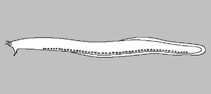 No image available for this species;
drawing shows typical species in Myxinidae.
Google image
drawing shows typical species in Myxinidae.
Klassificering / Namn Populärnamn | synonymer | Catalog of Fishes(Släkte, Arter) | ITIS | CoL | WoRMS | Cloffa
Myxini (pirålar) (hagfishes) > Myxiniformes (Hagfishes) > Myxinidae (Hagfishes) > Myxininae
Etymology: Myxine: Ancient Greek word for a slimy fish: myxa, slime; -inus, one who, referring to copious amounts of slime produced by M. glutinosa (See ETYFish); garmani: In honor of American ichthyologist-herpetologist Samuel Garman (1843-1927), Harvard University, for his “excellent work” on Myxine (See ETYFish).
Eponymy: Dr Samuel Trevor Walton Garman (1843–1927) was an American naturalist, most noted as an ichthyologist and herpetologist. [...] (Ref. 128868), visit book page.
More on authors: Jordan & Snyder.
Etymology: Myxine: Ancient Greek word for a slimy fish: myxa, slime; -inus, one who, referring to copious amounts of slime produced by M. glutinosa (See ETYFish); garmani: In honor of American ichthyologist-herpetologist Samuel Garman (1843-1927), Harvard University, for his “excellent work” on Myxine (See ETYFish).
Eponymy: Dr Samuel Trevor Walton Garman (1843–1927) was an American naturalist, most noted as an ichthyologist and herpetologist. [...] (Ref. 128868), visit book page.
More on authors: Jordan & Snyder.
Miljö: miljö / Klimatzon / djupintervall / distributionsområde Ekologi
marina djupbottenlevande; ej vandrande; djupintervall 500 - 800 m (Ref. 31276). Deep-water
Utbredning Territorier | FAO områden | Ekosystem | Förekomster | Prickkarta | Utplanteringar | Faunafri
Northwest Pacific: Japan.
Storlek / Vikt / Ålder
Kort beskrivning Bestämningsnycklar | Morfologi | Morfometri
Six gill pouches. Ventral finfold well developed. Fused cusps 3/2, total cusps 42-46. Total slime pores 95-101. Anterior part of head lighter color than body (Ref. 51420).
Body shape (shape guide): eel-like.
Body shape (shape guide): eel-like.
Livscykel och parningsbeteende Könsmognad | Reproduktion | Lek | Ägg | Fekunditet | Larver
Copulatory organ absent. The gonads of hagfishes are situated in the peritoneal cavity. The ovary is found in the anterior portion of the gonad, and the testis is found in the posterior part. The animal becomes female if the cranial part of the gonad develops or male if the caudal part undergoes differentiation. If none develops, then the animal becomes sterile. If both anterior and posterior parts develop, then the animal becomes a functional hermaphrodite. However, hermaphroditism being characterised as functional needs to be validated by more reproduction studies (Ref. 51361 ).
Huvudreferens
Ladda upp dina referenser | referenser | Koordinator | Medarbetare
Fernholm, B., 1998. Hagfish systematics. p. 33-44. In J.M. Jørgensen, J.P. Lomholt, R.E. Weber and H. Malte (eds.) The biology of hagfishes. Chapman & Hall, London. 578 p. (Ref. 31276)
Status på IUCN:s rödlista (Ref. 130435: Version 2025-2 (Global))
Sårbar (VU) (A2bd); Date assessed: 13 November 2009
CITES
Not Evaluated
Hot mot människor
Harmless
Mänskliga användningsområden
FAO - Publication: search | FishSource |
Ytterligare information
Trofisk ekologi
Livsmedelsartiklar (preys)
Födosammansättning
Födointag
Matransoner
Predatorer
Livsmedelsartiklar (preys)
Födosammansättning
Födointag
Matransoner
Predatorer
Ekologi
Ekologi
Ekologi
Populationsdynamik
Tillväxtparametrar
Max. åldrar / storlekar
Längd-vikt rel.
Längd-längd rel.
Längd-frekvenser
Massakonvertering
Rekrytering
Abundans
Tillväxtparametrar
Max. åldrar / storlekar
Längd-vikt rel.
Längd-längd rel.
Längd-frekvenser
Massakonvertering
Rekrytering
Abundans
Livscykel
Reproduktion
Könsmognad
Mognad/Gills rel.
Fekunditet
Lek
Lekande aggregat
Ägg
Utveckling av ägg
Larver
Larvdynamik
Reproduktion
Könsmognad
Mognad/Gills rel.
Fekunditet
Lek
Lekande aggregat
Ägg
Utveckling av ägg
Larver
Larvdynamik
Anatomi
Gälyta
Hjärna
Otolit
Gälyta
Hjärna
Otolit
Fysiologi
Kroppssammansättning
Näringsämnen
Syreförbrukning
Typ av simning
Simhastighet
Visuella pigment
Ljud från fisk
Sjukdomar & Parasiter
Toxicitet (LC50)
Kroppssammansättning
Näringsämnen
Syreförbrukning
Typ av simning
Simhastighet
Visuella pigment
Ljud från fisk
Sjukdomar & Parasiter
Toxicitet (LC50)
Genetik
Genom
Genetik
Heterozygositet
Ärftlighet
Genetisk mångfald
Genom
Genetik
Heterozygositet
Ärftlighet
Genetisk mångfald
Människorelaterad
Vattenbrukssystem
Vattenbruksprofiler
Avelslinjer
Ciguatera-fall
Frimärken, mynt, diverse.
Vattenbrukssystem
Vattenbruksprofiler
Avelslinjer
Ciguatera-fall
Frimärken, mynt, diverse.
Verktyg
Särskilda rapporter
Kontrollera för underhåll av akvarium | Kontrollera om det finns faktablad om arter | Kontrollera om det finns faktablad om vattenbruk
Ladda ner XML
Internet-källor
AFORO (otoliths) | Aquatic Commons | BHL | Cloffa | Websites from users | Check FishWatcher | CISTI | Catalog of Fishes: Släkte, Arter | DiscoverLife | ECOTOX | FAO - Publication: search | Faunafri | Fishipedia | Fishtrace | GloBI | Google Books | Google Scholar | Google | IGFA World Record | OneZoom | Open Tree of Life | Otolith Atlas of Taiwan Fishes | PubMed | Reef Life Survey | Socotra Atlas | TreeBase | Tree of Life | Wikipedia: Go, sök | World Records Freshwater Fishing | Zoobank | Zoologiskt register
Uppskattningar baserade på modeller
Önskad temperatur (Ref. 123201): 5.3 - 9.7, mean 7.6 °C (based on 11 cells).
Index för fylogenetisk mångfald (Ref. 82804): PD50 = 0.5000 [Uniqueness, from 0.5 = low to 2.0 = high].
Bayesian length-weight: a=0.00115 (0.00045 - 0.00294), b=3.03 (2.81 - 3.25), in cm total length, based on LWR estimates for this (Sub)family-body shape (Ref. 93245).
Trofisk nivå (Ref. 69278): 3.4 ±0.6 se; based on size and trophs of closest relatives
Resiliens (Ref. 120179): Låg, lägsta populationsfördubblingstid 4,5-14 år (Fec assumed to be <100).