



Beobachtung melden im Fish Watcher
| Native range | All suitable habitat | Point map | Year 2050 |

|
| This map was computer-generated and has not yet been reviewed. |
| Salaria pavo AquaMaps Data sources: GBIF OBIS |
Hochladen Photos und videos
Bilder | Briefmarken, Münzen, Verschiedenes. | Google Bild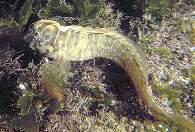 Salaria pavo
Photo von Patzner, R.
Bilder | Briefmarken, Münzen, Verschiedenes. | Google Bild
Photo von Patzner, R.
Klassifizierung / Names Namen | Synonyme | Catalog of Fishes(Gattung, Arten) | ITIS | CoL | WoRMS | Cloffa
> Blenniiformes (Blennies) > Blenniidae (Combtooth blennies) > Salariinae
Etymology: Salaria: Latin, salar, salaris = trout (Ref. 45335).
More on author: Risso.
Etymology: Salaria: Latin, salar, salaris = trout (Ref. 45335).
More on author: Risso.
Umwelt: Milieu / Klimazone / Tiefenbereich / Verbreitungsgebiet Ökologie
seewasser; brackwasser demersal. Subtropical; 46°N - 33°N, 10°W - 42°E
Verbreitung Territorien | FAO Gebiete | Ökosysteme | Vorkommen | Punkt Karte | Einführungen | Faunafri
Eastern Atlantic: Atlantic coast from France to Morocco; also in the Mediterranean and Black seas and in the Suez Canal.
Größe / Gewicht / Alter
Kurzbeschreibung Bestimmungsschlüssel | Morphologie | Morphometrie
Rückenflossenstacheln (insgesamt) : 11 - 13; Rückenflossenweichstrahlen (insgesamt) : 22 - 25; Afterflossenstacheln: 2; Afterflossenweichstrahlen: 23 - 26. Diagnosis: Mature males with well-developed head-crest and anal gland in the first two anal-fin rays; sneaker males much smaller than nesting males and do not display male secondary sexual characters (Ref. 94108).
Body shape (shape guide): fusiform / normal.
Body shape (shape guide): fusiform / normal.
Facultative air-breathing (Ref. 126274); Adults occur in the intertidal zone and shallow bottoms, on rocks or sand between pebbles and vegetation (Ref. 5981). Often in brackish waters down to 5 ppt (Ref. 5981). Inhabit crevices or piddock holes, males remain in cavities above water-level during low tide (Ref. 5981). Feed on benthic invertebrates, mainly mollusks, also algae (Ref. 5981). Also ingest large amounts of aquatic insects and pupae (Ref. 94105). Oviparous (Ref. 205). Mature males adopt a passive role during courtship, rarely court females, do not defend nest territory, but provide parental care to eggs. Sneaker males assume a female-like behavior in order to approach the nests of nesting males and parasitically fertilize the eggs (Ref. 94113). Eggs are demersal and adhesive (Ref. 205). Has been reared in captivity (Ref. 35421).
Lebenszyklus und Paarungsverhalten Geschlechtsreife | Fortpflanzung | Ablaichen | Eier | Fruchtbarkeit | Larven
Males court by nodding and undulating movements and drive females to spawning place by biting and butting (Ref. 5981) though this event is rarely done by the males, more or less adopting a passive role in the courtship (Ref 94113). Additionally, males don't defend a territory around the nest (Ref. 94113) though they guard eggs from several females (Ref. 5981, 94113).
Hauptreferenz
Laden Sie Ihre Referenzen hoch | Referenzen | Koordinator : Williams, Jeffrey T. | Partner
Zander, C.D., 1986. Blenniidae. p. 1096-1112. In P.J.P. Whitehead, M.-L. Bauchot, J.-C. Hureau, J. Nielsen and E. Tortonese (eds.) Fishes of the North-eastern Atlantic and the Mediterranean, volume 3. UNESCO, Paris. (Ref. 5981)
IUCN Rote Liste Status (Ref. 130435: Version 2025-2 (Global))
nicht bedroht (LC) ; Date assessed: 14 November 2007
CITES
Not Evaluated
Bedrohung für Menschen
Harmless
Nutzung durch Menschen
Fischereien: kleinfischerei
FAO - Publication: search | FishSource |
Mehr Information
Trophische Ökologie
Lebensmittel (Beutetiere)
Nahrungszusammensetzung
Nahrungsaufnahme
Lebensmittelrationen
Räuber
Lebensmittel (Beutetiere)
Nahrungszusammensetzung
Nahrungsaufnahme
Lebensmittelrationen
Räuber
Populationsdynamik
Wachstumsparameter
Max. Alter/Größen
Länge-Gewicht-Rel.
Länge-Länge-Verhältnis.
Längenhäufigkeiten
Massenkonvertierung
Rekrutierung
Dichte
Wachstumsparameter
Max. Alter/Größen
Länge-Gewicht-Rel.
Länge-Länge-Verhältnis.
Längenhäufigkeiten
Massenkonvertierung
Rekrutierung
Dichte
Lebenszyklus
Fortpflanzung
Geschlechtsreife
Reifung/Kiemen rel.
Fruchtbarkeit
Ablaichen
Laichaggregationen
Eier
Eientwicklung
Larven
Larven Pop.Dyn.
Fortpflanzung
Geschlechtsreife
Reifung/Kiemen rel.
Fruchtbarkeit
Ablaichen
Laichaggregationen
Eier
Eientwicklung
Larven
Larven Pop.Dyn.
Anatomie
Kiemenoberfläche
Gehirn
Otolith
Kiemenoberfläche
Gehirn
Otolith
Physiologie
Körperliche Zusammensetzung
Nährstoffe
Sauerstoffverbrauch
Schwimmart
Schwimmgeschwindigkeit
Visuelle Pigmente
Fischgeräusche
Krankheiten und Parasiten
Toxizität (LC50s)
Körperliche Zusammensetzung
Nährstoffe
Sauerstoffverbrauch
Schwimmart
Schwimmgeschwindigkeit
Visuelle Pigmente
Fischgeräusche
Krankheiten und Parasiten
Toxizität (LC50s)
Menschenbezogen
Aquakultur-Systeme
Aquakultur Profile
Zuchtlinien
Ciguatera-Fälle
Briefmarken, Münzen, Verschiedenes.
Aquakultur-Systeme
Aquakultur Profile
Zuchtlinien
Ciguatera-Fälle
Briefmarken, Münzen, Verschiedenes.
Tools
Bio-Quiz | E-Book | Feldführer | Bestimmungsschlüssel | Längenhäufigkeits Tool | Lebensdaten Tool | Punkt Karte |
Catch-MSY |
Zusatzinformationen
Download XML
Zusammenfassung | Punktdaten | Namen | Photos
Internet Quellen
AFORO (otoliths) | Aquatic Commons | BHL | Cloffa | Websites from users | FishWatcher Einträge suchen | CISTI | Catalog of Fishes: Gattung, Arten | DiscoverLife | DORIS | ECOTOX | FAO - Publication: search | Faunafri | Fishipedia | Fishtrace | GloBI | Google Books | Google Scholar | Google | IGFA World Record | Nationale Datenbanken | OneZoom | Open Tree of Life | Otolith Atlas of Taiwan Fishes | Öffentliche Aquarien | PubMed | Reef Life Survey | Socotra Atlas | TreeBase | Tree of Life | Wikipedia: Gehe zu, Suchen | World Records Freshwater Fishing | Zoologischer Rekord
Schätzungen auf der Grundlage von Modellen
Bevorzugte Temperatur (Ref. 123201): 15 - 21.2, mean 18.8 °C (based on 615 cells).
Phylogenetischer Diversitätsindex (Ref. 82804): PD50 = 0.7500 [Uniqueness, from 0.5 = low to 2.0 = high].
Bayesian length-weight: a=0.01096 (0.00854 - 0.01407), b=3.01 (2.94 - 3.08), in cm total length, based on LWR estimates for this species (Ref. 93245).
Trophische Ebene (Ref. 69278): 3.6 ±0.0 se; based on diet studies.
Generation time: 2.2 ( na - na) years. Estimated as median ln(3)/K based on 1 growth studies.
Widerstandsfähigkeit (Ref. 120179): hoch, Verdopplung der Population dauert weniger als 15 Monate. (K=0.50).
Nährstoffe (Ref. 124155): Calcium = 127 [21, 405] mg/100g; Iron = 1.39 [0.52, 4.55] mg/100g; Protein = 4.16 [0.45, 7.88] %; Omega3 = 0.443 [0.183, 1.088] g/100g; Selenium = 8.2 [1.8, 25.0] μg/100g; VitaminA = 25.1 [8.9, 69.6] μg/100g; Zinc = 1.24 [0.59, 2.46] mg/100g (wet weight);