



अपना अवलोकन जोड़ें Fish Watcher
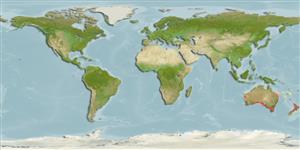
| Native range | All suitable habitat | Point map | Year 2050 |
|
| This map was computer-generated and has not yet been reviewed. |
| Engraulis australis AquaMaps Data sources: GBIF OBIS |
अपना अपलोड करें तस्वीरें और वीडियो
तस्वीरे | Google image Engraulis australis
चित्र स्रोत: AP Smith, B.
तस्वीरे | Google image
चित्र स्रोत: AP Smith, B.
वर्गीकरण / नाम आम नाम | उपशब्द | Catalog of Fishes(वर्ग, प्रजाति) | ITIS | CoL | WoRMS | Cloffa
> Clupeiformes (Herrings) > Engraulidae (Anchovies) > Engraulinae
Etymology: Engraulis: Greek, eggraulis, -eos = anchovy (Ref. 45335).
Etymology: Engraulis: Greek, eggraulis, -eos = anchovy (Ref. 45335).
पर्यावरण: पर्यावरण / जलवायु क्षेत्र / गहराई सीमा / वितरण सीमा पारिस्थितिकी
समुद्री; खारा pelagic-neritic; गहराई सीमा 31 - 70 m (Ref. 58489). Subtropical; 20°S - 47°S, 109°E - 177°W (Ref. 189)
वितरण प्रदेशों | ऐफ ऐ ओ क्षेत्र | पारिस्थितिकी प्रणालियों | संयोग | बिन्दु नक्शा | भूमिका | Faunafri
Southwest Pacific: Australia (from Queensland at about Cape Capricorn south to southern Tasmania; entire southern coast of Australia, except for Great Australian Bight, and north to Shark Bay, Western Australia), including Lord Howe Island and Norfolk Island; and New Zealand (most of the North Island and all but the southeast coast of the South Island).
प्रथम परिपक्वता पर लंबाई / आकार / वज़न / आयु
परिपक्व अवधि: Lm 6.5, range 6 - 7 cm
Max length : 15.0 cm SL पुल्लिंग / अलिंग; (Ref. 33832); common length : 12.0 cm SL पुल्लिंग / अलिंग; (Ref. 9822); अधिकतम सूचित उम्र: 6 वर्षो (Ref. 6390)
Max length : 15.0 cm SL पुल्लिंग / अलिंग; (Ref. 33832); common length : 12.0 cm SL पुल्लिंग / अलिंग; (Ref. 9822); अधिकतम सूचित उम्र: 6 वर्षो (Ref. 6390)
संक्षिप्त वर्णन पहचान कुंजी | आकृति विज्ञान | मौरफोमैटरिक्स
पृष्ठीय रीढ़ (सम्पूर्ण) : 0; पृष्ठीय सौफट रेज़ (सम्पूर्ण) : 13 - 18; गुदा कांटा: 0; ऐनल सौफट रेज़: 17 - 19; जानवरों की रीड़ का जोड़: 40 - 48. Hardly differs from the European anchovy (E. encrasicolus) and can be identified from that description. For most of its range it is the only anchovy present, but in the extreme north it may overlap with species of Encrasicholina or Stolephorus, which have small needle-like scutes before the pelvic fins; species of Thryssa have compressed bodies and a keel of scutes along the belly.
Body shape (shape guide): elongated; Cross section: circular.
Body shape (shape guide): elongated; Cross section: circular.
Found mostly inshore: chiefly in bays, inlets and estuaries, sometimes in low salinities. Older individuals tend to move out to sea in winter and back in the spring. Forms compact schools much preyed upon by larger fishes, common dolphins and birds. Feeds on plankton. Spawns in inlets, bays and also estuaries, probably throughout the year but mainly in late spring to early autumn and especially about November to February. The eggs are ellipsoidal. Utilized as fish paste.
जीवन चक्र और संभोग व्यवहार परिपक्व अवधि | पुनरुत्पत्ति | मछलीऔ का अंडे देना | अंडे | उपजाऊपन | लार्वा
Spawns in inlets, bays and estuaries.
मुख्य संदर्भ
अपने संदर्भ अपलोड करें | संदर्भ | संयोजक | सहयोगीयो
Whitehead, P.J.P., G.J. Nelson and T. Wongratana, 1988. FAO Species Catalogue. Vol. 7. Clupeoid fishes of the world (Suborder Clupeoidei). An annotated and illustrated catalogue of the herrings, sardines, pilchards, sprats, shads, anchovies and wolf-herrings. FAO Fish. Synop. 125(7/2):305-579. Rome: FAO. (Ref. 189)
आईयूसीएन रेड लिस्ट स्थिति (Ref. 130435: Version 2025-2 (Global))
Least Concern (LC) ; Date assessed: 18 July 2018
CITES
Not Evaluated
मनुष्यों के लिए ख़तरा
Harmless
मानव उपयोग
मात्स्यिकी: लघु वाणिज्य; ठहराव / प्रलोभन: usually
FAO - Publication: search | FishSource |
अधिक जानकारी
जनसंख्या गतिशीलता
विकास मापदंड
अधिकतम आयु/आकार
लंबाई-वजन संबंध
लंबाई-लंबाई संबंध
लंबाई-आवृत्तियाँ
सामूहिक रूपांतरण
भर्ती
बहुतायत
विकास मापदंड
अधिकतम आयु/आकार
लंबाई-वजन संबंध
लंबाई-लंबाई संबंध
लंबाई-आवृत्तियाँ
सामूहिक रूपांतरण
भर्ती
बहुतायत
जीवन चक्र
पुनरुत्पत्ति
परिपक्व अवधि
परिपक्वता/गिल्स संबंध
उपजाऊपन
मछलीऔ का अंडे देना
स्पॉनिंग एकत्रीकरण
अंडे
अंडे का विकास
लार्वा
लारवल गतिकी
पुनरुत्पत्ति
परिपक्व अवधि
परिपक्वता/गिल्स संबंध
उपजाऊपन
मछलीऔ का अंडे देना
स्पॉनिंग एकत्रीकरण
अंडे
अंडे का विकास
लार्वा
लारवल गतिकी
शरीर रचना
गिल क्षेत्र
दिमाग
ओटोलिथ
गिल क्षेत्र
दिमाग
ओटोलिथ
फिजियोलॉजी
शारीरिक संरचना
पोषक तत्व
प्राणवायु की खपत
तैराकी का प्रकार
तैराकी की गति
दृश्य वर्णक
मछली की आवाज
रोग एवं परजीवी
विषाक्तता (LC50s)
शारीरिक संरचना
पोषक तत्व
प्राणवायु की खपत
तैराकी का प्रकार
तैराकी की गति
दृश्य वर्णक
मछली की आवाज
रोग एवं परजीवी
विषाक्तता (LC50s)
आनुवंशिकी
जीनोम
आनुवंशिकी
विषमयुग्मजी
हैरेटिबिलटी
आनुवंशिक विविधता
जीनोम
आनुवंशिकी
विषमयुग्मजी
हैरेटिबिलटी
आनुवंशिक विविधता
मानव संबंधी
जलकृषि प्रणालियाँ
जलीयकृषि रूपरेखाऐ
खींच
सिगुएटेरा के मामले
टिकट, सिक्के, विविध.
जलकृषि प्रणालियाँ
जलीयकृषि रूपरेखाऐ
खींच
सिगुएटेरा के मामले
टिकट, सिक्के, विविध.
साधन
ई-पुस्तक | कार्यक्षेत्र पथप्रदर्शक | पहचान कुंजी | लंबाई आवृति इंद्रजालिक | जीवन-इतिहास उपकरण | बिन्दु नक्शा |
कैच-एमएसवाई |
विशेष रिपोर्ट
एक्वेरियम के रखरखाव की जांच करें | प्रजातियों के तथ्य पत्रक की जाँच करें | जलीय कृषि तथ्य पत्रक की जाँच करें
XML डाउनलोड करें
सारांश पृष्ठ | बिंदु डेटा | आम नाम | तस्वीरें
इंटरनेट स्रोत
AFORO (otoliths) | Aquatic Commons | BHL | Cloffa | Websites from users | Check FishWatcher | CISTI | Catalog of Fishes: वर्ग, प्रजाति | DiscoverLife | ECOTOX | FAO - Publication: search | Faunafri | Fishipedia | Fishtrace | GloBI | Google Books | Google Scholar | Google | IGFA World Record | OneZoom | Open Tree of Life | Otolith Atlas of Taiwan Fishes | PubMed | Reef Life Survey | Socotra Atlas | TreeBase | Tree of Life | Wikipedia: Go, खोज | World Records Freshwater Fishing | प्राणीशास्त्रीय अभिलेख
मॉडल पर आधारित अनुमान
पसंदीदा तापमान (संदर्भ 123201): 14.3 - 24, mean 17.1 °C (based on 72 cells).
जातिवृति विविधता सूचकांक (संदर्भ 82804): PD50 = 0.5020 [Uniqueness, from 0.5 = low to 2.0 = high].
Bayesian length-weight: a=0.00457 (0.00211 - 0.00989), b=3.13 (2.96 - 3.30), in cm total length, based on LWR estimates for this Genus-body shape (Ref. 93245).
ट्रॉफिक स्तर (संदर्भ 69278): 3.0 ±0.00 se; based on food items.
Generation time: 2.8 ( na - na) years. Estimated as median ln(3)/K based on 2 growth studies.
लौटाव (संदर्भ 120179): ऊंचा, न्यूनतम जनसंख्या दुगनी समय अवलागत 15 महीने। (K=0.39; tm=1; tmax=6).
पोषक तत्व (Ref. 124155): Calcium = 213 [100, 489] mg/100g; Iron = 1.3 [0.6, 3.0] mg/100g; Protein = 18.7 [17.5, 19.9] %; Omega3 = 0.838 [0.500, 1.399] g/100g; Selenium = 12.4 [5.6, 24.6] μg/100g; VitaminA = 19.9 [5.6, 69.1] μg/100g; Zinc = 1.47 [0.94, 2.25] mg/100g (wet weight);