



Lägg till din observation i Fish Watcher
| Native range | All suitable habitat | Point map | Year 2050 |

|
| This map was computer-generated and has not yet been reviewed. |
| Ethmalosa fimbriata AquaMaps Data sources: GBIF OBIS |
Ladda upp din foton och Videor
Bilder | Google image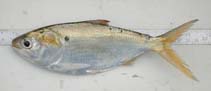 Ethmalosa fimbriata
Bild av Durand, J.-D.
Bilder | Google image
Bild av Durand, J.-D.
Klassificering / Namn Populärnamn | synonymer | Catalog of Fishes(Släkte, Arter) | ITIS | CoL | WoRMS | Cloffa
> Clupeiformes (Herrings) > Dorosomatidae (Gizzard shads and sardinellas)
Etymology: Ethmalosa: Greek, ethmos, -ou = sieve, also the ethmoides bone + Latin, alausa = a fish cited by Ausonius and Latin, halec = pickle, dealing with the Greek word hals = salt; it is also the old Saxon name for shad = "alli" ; 1591 (Ref. 45335).
Etymology: Ethmalosa: Greek, ethmos, -ou = sieve, also the ethmoides bone + Latin, alausa = a fish cited by Ausonius and Latin, halec = pickle, dealing with the Greek word hals = salt; it is also the old Saxon name for shad = "alli" ; 1591 (Ref. 45335).
Miljö: miljö / Klimatzon / djupintervall / distributionsområde Ekologi
marina; sötvatten; brackvatten pelagic-neritic; katadrom (Ref. 138280); djupintervall 0 - 50 m (Ref. 54436), usually 0 - 50 m (Ref. 54436). Tropical; 25°N - 8°S, 17°W - 14°E (Ref. 54436)
Utbredning Territorier | FAO områden | Ekosystem | Förekomster | Prickkarta | Utplanteringar | Faunafri
Atlantic Ocean: Eastern central Atlantic Ocean, from Dakhla in Western Sahara southward to Lobito Bay in Angola (Ref. 188, 5286, 81269, 81631), occasionally entering freshwater (Ref. 3509). Reports from Cape Verde Islands are based on an erroneous type locality for Clupea fimbriata by Bowdich (1825), which was later rectified as probably Gambia (Ref. 188, 5286, 94080).
Längd vid första mognad / Storlek / Vikt / Ålder
Könsmognad: Lm 17.0 range ? - 18.5 cm
Max length : 46.0 cm TL hane/ej könsbestämd; (Ref. 1989); common length : 25.0 cm TL hane/ej könsbestämd; (Ref. 187); publicerad maxvikt: 1.0 kg (Ref. 1989)
Max length : 46.0 cm TL hane/ej könsbestämd; (Ref. 1989); common length : 25.0 cm TL hane/ej könsbestämd; (Ref. 187); publicerad maxvikt: 1.0 kg (Ref. 1989)
Kort beskrivning Bestämningsnycklar | Morfologi | Morfometri
Taggstrålar i ryggfenan (totalt) : 0; Mjukstrålar i ryggfenan (totalt) : 16 - 19; Taggstrålar i analfenan: 0; Mjukstrålar i analfenan: 19 - 25; Ryggkotor: 40 - 44. Diagnosis: Body fairly deep, compressed, scutes present along belly; upper jaw with distinct notch, into which tip of lower jaw fits; lower gillrakers long, fine and numerous, about 3 times as long as gill filaments, upper gillrakers bent sharply upward, V-shaped; pelvic fin rays with 1 unbranched and 7 branched rays; caudal fin tips long and pointed (Ref. 188). A faint dark spot behind gill cover, sometimes followed by others; dorsal fin tip black; caudal fin deep chrome yellow; golden tints on body (Ref. 188, 81269). Ethmalosa fimbriata resembles Sardinella aurita, Sardinella rouxi and especially Sardinella maderensis, but these are more slender, have a rounded upper jaw which is not notched and the upper gillrakers are not bent upward like an elbow (Ref. 188).
Body shape (shape guide): fusiform / normal; Cross section: compressed.
Body shape (shape guide): fusiform / normal; Cross section: compressed.
Ethmalosa fimbriata is found in fairly shallow coastal waters, lagoons and estuaries, and sometimes also in lower courses of coastal rivers, even more than 300 km up rivers (Ref. 187, 188, 81269, 81631). It feeds principally on phytoplankton, chiefly diatoms, filtered by the very fine gillraker sieve (Ref. 187, 188, 3166). It breeds throughout the year in waters of salinities 3.5-38 ppt, but with peaks in at least some areas; spawns in the sea, in estuaries and in rivers (Ref. 188). The largest fisheries are in Senegal, Sierra Leone, Ivory Coast, Nigeria and Cameroon, mainly in the dry season (Ref. 188).
Livscykel och parningsbeteende Könsmognad | Reproduktion | Lek | Ägg | Fekunditet | Larver
Breeds all year in waters of salinities 3.5 to 38 ppt, but with peaks in at least some areas, becoming progressively later to south. Spawns in the sea, in estuaries and in rivers.
Huvudreferens
Ladda upp dina referenser | referenser | Koordinator | Medarbetare
Whitehead, P.J.P., 1985. FAO Species Catalogue. Vol. 7. Clupeoid fishes of the world (suborder Clupeoidei). An annotated and illustrated catalogue of the herrings, sardines, pilchards, sprats, shads, anchovies and wolf-herrings. FAO Fish. Synop. 125(7/1):1-303. Rome: FAO. (Ref. 188)
Status på IUCN:s rödlista (Ref. 130435: Version 2025-2 (Global))
Least Concern (LC) ; Date assessed: 30 April 2019
CITES
Not Evaluated
Hot mot människor
Harmless
Mänskliga användningsområden
Fiskeri: kommersiellt viktig; Vattenbruk: experimentell
FAO - fiskeri: landningar, artprofil; Publication: search | FIRMS - Stock assessments | FishSource | Havet omkring oss
Ytterligare information
Populationsdynamik
Tillväxtparametrar
Max. åldrar / storlekar
Längd-vikt rel.
Längd-längd rel.
Längd-frekvenser
Massakonvertering
Rekrytering
Abundans
Tillväxtparametrar
Max. åldrar / storlekar
Längd-vikt rel.
Längd-längd rel.
Längd-frekvenser
Massakonvertering
Rekrytering
Abundans
Livscykel
Reproduktion
Könsmognad
Mognad/Gills rel.
Fekunditet
Lek
Lekande aggregat
Ägg
Utveckling av ägg
Larver
Larvdynamik
Reproduktion
Könsmognad
Mognad/Gills rel.
Fekunditet
Lek
Lekande aggregat
Ägg
Utveckling av ägg
Larver
Larvdynamik
Anatomi
Gälyta
Hjärna
Otolit
Gälyta
Hjärna
Otolit
Fysiologi
Kroppssammansättning
Näringsämnen
Syreförbrukning
Typ av simning
Simhastighet
Visuella pigment
Ljud från fisk
Sjukdomar & Parasiter
Toxicitet (LC50)
Kroppssammansättning
Näringsämnen
Syreförbrukning
Typ av simning
Simhastighet
Visuella pigment
Ljud från fisk
Sjukdomar & Parasiter
Toxicitet (LC50)
Genetik
Genom
Genetik
Heterozygositet
Ärftlighet
Genetisk mångfald
Genom
Genetik
Heterozygositet
Ärftlighet
Genetisk mångfald
Människorelaterad
Vattenbrukssystem
Vattenbruksprofiler
Avelslinjer
Ciguatera-fall
Frimärken, mynt, diverse.
Vattenbrukssystem
Vattenbruksprofiler
Avelslinjer
Ciguatera-fall
Frimärken, mynt, diverse.
Verktyg
E-bok | Fälthandbok | Bestämningsnycklar | Längdfördelnings-verktyg | Livshistorie-verktyg | Prickkarta |
Fångst-MSY |
Särskilda rapporter
Kontrollera för underhåll av akvarium | Kontrollera om det finns faktablad om arter | Kontrollera om det finns faktablad om vattenbruk
Ladda ner XML
Internet-källor
AFORO (otoliths) | Aquatic Commons | BHL | Cloffa | Websites from users | Check FishWatcher | CISTI | Catalog of Fishes: Släkte, Arter | DiscoverLife | ECOTOX | FAO - fiskeri: landningar, artprofil; Publication: search | Faunafri | Fishipedia | Fishtrace | GloBI | Google Books | Google Scholar | Google | IGFA World Record | OneZoom | Open Tree of Life | Otolith Atlas of Taiwan Fishes | PubMed | Reef Life Survey | Socotra Atlas | TreeBase | Tree of Life | Wikipedia: Go, sök | World Records Freshwater Fishing | Zoologiskt register
Uppskattningar baserade på modeller
Önskad temperatur (Ref. 123201): 20.2 - 27.9, mean 26.4 °C (based on 180 cells).
Index för fylogenetisk mångfald (Ref. 82804): PD50 = 1.0000 [Uniqueness, from 0.5 = low to 2.0 = high].
Bayesian length-weight: a=0.00871 (0.00764 - 0.00993), b=3.06 (3.02 - 3.10), in cm total length, based on LWR estimates for this species (Ref. 93245).
Trofisk nivå (Ref. 69278): 2.5 ±0.25 se; based on food items.
Resiliens (Ref. 120179): Hög, lägsta populationsfördubblingstid mindre än 15 månader (K=0.25-0.36; tm=1; Fec=16,000).
Prior r = 0.23, 95% CL = 0.15 - 0.34, Based on 1 full stock assessment.
Näringsämnen (Ref. 124155): Calcium = 181 [96, 321] mg/100g; Iron = 1.91 [1.04, 3.19] mg/100g; Protein = 19 [17, 21] %; Omega3 = 0.374 [0.211, 0.670] g/100g; Selenium = 65.7 [32.1, 137.4] μg/100g; VitaminA = 8.42 [3.24, 21.22] μg/100g; Zinc = 1.75 [1.23, 2.59] mg/100g (wet weight); based on nutrient studies.