



Careproctus reinhardti (Krøyer, 1862)
Sea tadpole
Beobachtung melden im Fish Watcher
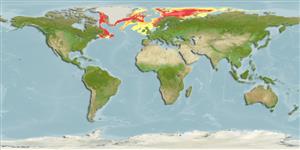
| Native range | All suitable habitat | Point map | Year 2050 |
|
| This map was computer-generated and has not yet been reviewed. |
| Careproctus reinhardti AquaMaps Data sources: GBIF OBIS |
Hochladen Photos und videos
Bilder | Google Bild Careproctus reinhardti
Photo von DESCNA
Bilder | Google Bild
Photo von DESCNA
Klassifizierung / Names Namen | Synonyme | Catalog of Fishes(Gattung, Arten) | ITIS | CoL | WoRMS | Cloffa
> Perciformes/Cottoidei (Sculpins) > Liparidae (Snailfishes)
Etymology: Careproctus: Greek, kara = face + Greek, proktos = anus (Ref. 45335).
Eponymy: Dr Johannes Christopher Hagemann Reinhardt (1778–1845) was a Norwegian zoologist who became Professor of Zoology (1814) at the University of Copenhagen. [...] (Ref. 128868), visit book page.
Etymology: Careproctus: Greek, kara = face + Greek, proktos = anus (Ref. 45335).
Eponymy: Dr Johannes Christopher Hagemann Reinhardt (1778–1845) was a Norwegian zoologist who became Professor of Zoology (1814) at the University of Copenhagen. [...] (Ref. 128868), visit book page.
Umwelt: Milieu / Klimazone / Tiefenbereich / Verbreitungsgebiet Ökologie
seewasser bathydemersal; tiefenbereich 75 - 1750 m (Ref. 58496). Deep-water; 81°N - 45°N, 61°W - 140°E
Verbreitung Territorien | FAO Gebiete | Ökosysteme | Vorkommen | Punkt Karte | Einführungen | Faunafri
Arctic: Kara and Laptev seas. Atlantic: Faroe-Shetland Channel to the Norwegian Sea, Spitsbergen, Murmansk and throughout Barents Sea; one specimen from Skagerrak; Newfoundland and Labrador (Ref. 9926). Reported from Greenland (Ref. 9926) and Iceland (Ref. 12462).
Größe / Gewicht / Alter
Kurzbeschreibung Bestimmungsschlüssel | Morphologie | Morphometrie
Rückenflossenweichstrahlen (insgesamt) : 53 - 57; Afterflossenweichstrahlen: 47 - 51; Wirbelzahl: 59 - 63. Pores 2-6-7-2; post orbital pore absent, 2 suprabranchial pores, chin pores somewhat drawn together; teeth simple; lower lobe of pectoral fin longer by 1.3-2.4 times that in upper lobe; pocket-like skin fold in front of symphysis of pectoral present; anteanal distance 53%SL, pyriform disk; large gill slit reaching below the base of the lower lobe of the pectoral fin; coloration in pink present in living specimens and peritoneum without black pigmentation (Ref. 41470). Suction disc small, almost equal to diameter of the eye. One nostril on each side of the mouth (Ref. 35388).
Body shape (shape guide): elongated.
Body shape (shape guide): elongated.
On muddy bottoms (Ref. 4702). Maximum depth reported at 1750 m )Ref. 58426). Epibenthic (Ref. 58426). Feeds on benthic and pelagic crustaceans (Ref. 4702) and fishes (Ref. 58426). Female lays about 300 eggs with a diameter of 4.5 mm (Ref. 35388).
Lebenszyklus und Paarungsverhalten Geschlechtsreife | Fortpflanzung | Ablaichen | Eier | Fruchtbarkeit | Larven
Hauptreferenz
Laden Sie Ihre Referenzen hoch | Referenzen | Koordinator | Partner
Nielsen, J.G. and E. Bertelsen, 1992. Fisk i grønlandske farvande. Atuakkiorfik, Nuuk. 65 s. (Ref. 9925)
CITES
Not Evaluated
Bedrohung für Menschen
Harmless
Nutzung durch Menschen
Fischereien: nicht kommerziell
FAO - Publication: search | FishSource |
Mehr Information
Trophische Ökologie
Lebensmittel (Beutetiere)
Nahrungszusammensetzung
Nahrungsaufnahme
Lebensmittelrationen
Räuber
Lebensmittel (Beutetiere)
Nahrungszusammensetzung
Nahrungsaufnahme
Lebensmittelrationen
Räuber
Populationsdynamik
Wachstumsparameter
Max. Alter/Größen
Länge-Gewicht-Rel.
Länge-Länge-Verhältnis.
Längenhäufigkeiten
Massenkonvertierung
Rekrutierung
Dichte
Wachstumsparameter
Max. Alter/Größen
Länge-Gewicht-Rel.
Länge-Länge-Verhältnis.
Längenhäufigkeiten
Massenkonvertierung
Rekrutierung
Dichte
Lebenszyklus
Fortpflanzung
Geschlechtsreife
Reifung/Kiemen rel.
Fruchtbarkeit
Ablaichen
Laichaggregationen
Eier
Eientwicklung
Larven
Larven Pop.Dyn.
Fortpflanzung
Geschlechtsreife
Reifung/Kiemen rel.
Fruchtbarkeit
Ablaichen
Laichaggregationen
Eier
Eientwicklung
Larven
Larven Pop.Dyn.
Physiologie
Körperliche Zusammensetzung
Nährstoffe
Sauerstoffverbrauch
Schwimmart
Schwimmgeschwindigkeit
Visuelle Pigmente
Fischgeräusche
Krankheiten und Parasiten
Toxizität (LC50s)
Körperliche Zusammensetzung
Nährstoffe
Sauerstoffverbrauch
Schwimmart
Schwimmgeschwindigkeit
Visuelle Pigmente
Fischgeräusche
Krankheiten und Parasiten
Toxizität (LC50s)
Genetik
Genom
Genetik
Heterozygotie
Vererbbarkeit
Genetische Vielfalt
Genom
Genetik
Heterozygotie
Vererbbarkeit
Genetische Vielfalt
Menschenbezogen
Aquakultur-Systeme
Aquakultur Profile
Zuchtlinien
Ciguatera-Fälle
Briefmarken, Münzen, Verschiedenes.
Aquakultur-Systeme
Aquakultur Profile
Zuchtlinien
Ciguatera-Fälle
Briefmarken, Münzen, Verschiedenes.
Tools
Zusatzinformationen
Download XML
Zusammenfassung | Punktdaten | Namen | Photos
Internet Quellen
AFORO (otoliths) | Aquatic Commons | BHL | Cloffa | Websites from users | FishWatcher Einträge suchen | CISTI | Catalog of Fishes: Gattung, Arten | DiscoverLife | ECOTOX | FAO - Publication: search | Faunafri | Fishipedia | Fishtrace | GloBI | Google Books | Google Scholar | Google | IGFA World Record | OneZoom | Open Tree of Life | Otolith Atlas of Taiwan Fishes | Öffentliche Aquarien | PubMed | Reef Life Survey | Socotra Atlas | TreeBase | Tree of Life | Wikipedia: Gehe zu, Suchen | World Records Freshwater Fishing | Zoologischer Rekord
Schätzungen auf der Grundlage von Modellen
Bevorzugte Temperatur (Ref. 123201): 0.4 - 8.6, mean 3 °C (based on 878 cells).
Phylogenetischer Diversitätsindex (Ref. 82804): PD50 = 0.5000 [Uniqueness, from 0.5 = low to 2.0 = high].
Bayesian length-weight: a=0.00447 (0.00203 - 0.00984), b=3.17 (2.99 - 3.35), in cm total length, based on LWR estimates for this Genus-body shape (Ref. 93245).
Trophische Ebene (Ref. 69278): 3.8 ±0.58 se; based on food items.
Widerstandsfähigkeit (Ref. 120179): hoch, Verdopplung der Population dauert weniger als 15 Monate. (Preliminary K or Fecundity.).