



Brevitrygon walga (Müller & Henle, 1841)
Bengal whipray
Envoyez vos Photos et vidéos
Images | Images Google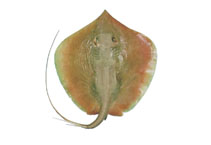 Brevitrygon walga
Photo de Iranian Fisheries Research Organization (IFRO)
Images | Images Google
Photo de Iranian Fisheries Research Organization (IFRO)
Classification / Noms Noms communs | Synonymes | Catalog of Fishes(Genre, Espèce) | ITIS | CoL | WoRMS | Cloffa
Élasmobranches (requins et raies) (sharks and rays) > Myliobatiformes (Stingrays) > Dasyatidae (Stingrays) > Urogymninae
Etymology: Brevitrygon: Name from Latin 'brevis' meaning short and 'trygṓn' meaning stingray, referring to the short, semi-rigid tails of these stingrays; walga: Name is presumably a variant spelling of wolga, from Wolga Tenkée, a local name for this or a related stingray from the Ganges Delta of India.
More on authors: Müller & Henle.
Etymology: Brevitrygon: Name from Latin 'brevis' meaning short and 'trygṓn' meaning stingray, referring to the short, semi-rigid tails of these stingrays; walga: Name is presumably a variant spelling of wolga, from Wolga Tenkée, a local name for this or a related stingray from the Ganges Delta of India.
More on authors: Müller & Henle.
Environnement : milieu / zone climatique / profondeur / gamme de distribution Écologie
marin; saumâtre démersal; profondeur 0 - 40 m (Ref. 121773). Tropical; 30°N - 10°N, 34°E - 76°E
Distribution Territoires | Zones FAO | Écosystèmes | Occurrences | Carte par point | Introductions | Faunafri
Indian Ocean: eastern India (Bay of Bengal, Madras), Bangladesh to Myanmar (East of Bok Ye-gan).
Longueur à la première maturité / Taille / Poids / Âge
Maturité: Lm 16.7 range ? - ? cm
Max length : 20.3 cm WD mâle / non sexé; (Ref. 130662); 23.3 cm WD (female)
Max length : 20.3 cm WD mâle / non sexé; (Ref. 130662); 23.3 cm WD (female)
Demersal on insular and continental shelves, and occasionally found in coastal embayments (Ref. 58048); primarily in shallow water from near the shore in estuaries to nearby fishing grounds in bays (Ref. 130662). Ovoviviparous (Ref. 50449). Caught in large quantities as by-catch of bottom trawl and trammel net fisheries. Utilized for its meat, but of limited value due to its very small size (Ref.58048).
Cycle de vie et comportement reproducteur Maturité | Reproduction | Frai | Œufs | Fécondité | Larves
Ovoviviparous (Ref. 205), with histotrophy. Gives birth to litters of 1-2 pups; no reproductive synchronicity. Born at 8-10 cm WD (Ref.58048). Distinct pairing with embrace (Ref. 205).
Référence principale
Téléchargez vos références | Références | Coordinateur : McEachran, John | Collaborateurs
Last, P.R., S. Weigmann and G.J.P. Naylor, 2023. The Indo-Pacific stingray genus Brevitrygon (Myliobatiformes: Dasyatidae): clarification of historical names and description of a new species, B. manjajiae sp. nov., from the western Indian Ocean. Diversity 15: 1-75. (Ref. 130662)
Statut dans la liste rouge de l'IUCN (Ref. 130435: Version 2025-2 (Global))
Quasi-menacé (NT) (A2d+3d); Date assessed: 09 February 2017
CITES
Not Evaluated
Menace pour l'homme
Harmless
Utilisations par l'homme
Pêcheries: commercial
FAO - Publication: search | FishSource |
Plus d'informations
Écologie trophique
Aliments (proies)
Composition du régime alimentaire
Consommation alimentaire
Rations alimentaires
Prédateurs
Aliments (proies)
Composition du régime alimentaire
Consommation alimentaire
Rations alimentaires
Prédateurs
Écologie
Écologie
Écologie
Dynamique des populations
Paramètres de croissance
Âges / tailles maximales
Longueur-poids rel.
Rel. longueur-longueur.
Fréquences de longueurs
Conversion de masse
Recrutement
Abondance
Paramètres de croissance
Âges / tailles maximales
Longueur-poids rel.
Rel. longueur-longueur.
Fréquences de longueurs
Conversion de masse
Recrutement
Abondance
Cycle de vie
Reproduction
Maturité
Maturité/épines rel.
Fécondité
Frai
Agrégats de frai
Œufs
Développement de l'œuf
Larves
Dynamique des populations larvaires
Reproduction
Maturité
Maturité/épines rel.
Fécondité
Frai
Agrégats de frai
Œufs
Développement de l'œuf
Larves
Dynamique des populations larvaires
Anatomie
Surface branchiale
Cerveau
Otolithe
Surface branchiale
Cerveau
Otolithe
Physiologie
Composition corporelle
Nutriments
Consommation d'oxygène
Type de natation
Vitesse de nage
Pigments visuels
Son de poisson
Maladies et parasites
Toxicité (CL50)
Composition corporelle
Nutriments
Consommation d'oxygène
Type de natation
Vitesse de nage
Pigments visuels
Son de poisson
Maladies et parasites
Toxicité (CL50)
Liées à l'homme
Systèmes d'aquaculture
Profils d'aquaculture
Souches
Cas de ciguatera
Timbres, pièces de monnaie, divers
Systèmes d'aquaculture
Profils d'aquaculture
Souches
Cas de ciguatera
Timbres, pièces de monnaie, divers
Outils
E-book | Guide de terrain | Clés d'identification | Générateur de fréquences de longueur | Outil de dynamique de population | Carte par point |
Capture-MSY |
Articles particuliers
Télécharger en XML
Sources Internet
AFORO (otoliths) | Aquatic Commons | BHL | Cloffa | Websites from users | FishWatcher | CISTI | Catalog of Fishes: Genre, Espèce | DiscoverLife | ECOTOX | FAO - Publication: search | Faunafri | Fishipedia | Fishtrace | GloBI | Google Books | Google Scholar | Google | IGFA World Record | OneZoom | Open Tree of Life | Otolith Atlas of Taiwan Fishes | PubMed | Reef Life Survey | Socotra Atlas | TreeBase | Arbre de Vie | Wikipedia: aller à, chercher | | Zoological Record
Estimations basées sur des modèles
|
Indice de diversité phylogénétique (Réf. 82804) |
PD50 = 0.5312 [Uniqueness, from 0.5 = low to 2.0 = high]. |
| Bayesian length-weight | a=0.00234 (0.00141 - 0.00390), b=3.00 (2.85 - 3.15), in cm total length, based on LWR estimates for this species & (Sub)family-body (Ref. 93245). |
|
Niveau trophique (Réf. 69278) |
3.5 ±0.5 se; based on size and trophs of closest relatives |
|
Résilience (Réf. 120179) |
Faible, temps minimum de doublement de population : 4,5 à 14 années (Assuming fecundity<100). |
|
Vulnérabilité de la pêche (Ref. 59153) |
Very high vulnerability (90 of 100). 🛈 |
|
Catégorie de prix (Ref. 80766) |
Low. |