



Rhynchobatus australiae Whitley, 1939
Bottlenose wedgefish
Beobachtung melden im Fish Watcher
| Native range | All suitable habitat | Point map | Year 2050 |

|
| This map was computer-generated and has not yet been reviewed. |
| Rhynchobatus australiae AquaMaps Data sources: GBIF OBIS |
Hochladen Photos und videos
Bilder | Google Bild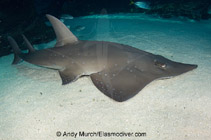 Rhynchobatus australiae
Photo von Murch, A.
Bilder | Google Bild
Photo von Murch, A.
Klassifizierung / Names Namen | Synonyme | Catalog of Fishes(Gattung, Arten) | ITIS | CoL | WoRMS | Cloffa
Elasmobranchii (Haie und Rochen) (sharks and rays) > Rhinopristiformes (Shovelnose rays) > Rhinidae (Wedgefishes)
Etymology: Rhynchobatus: Greek, rhingchos = snout + Greek, batis, -idos = a sting ray (Raja sp.) (Ref. 45335).
More on author: Whitley.
Etymology: Rhynchobatus: Greek, rhingchos = snout + Greek, batis, -idos = a sting ray (Raja sp.) (Ref. 45335).
More on author: Whitley.
Umwelt: Milieu / Klimazone / Tiefenbereich / Verbreitungsgebiet Ökologie
seewasser demersal; tiefenbereich 0 - 60 m (Ref. 106604). Subtropical; 30°N - 30°S, 30°E - 155°E (Ref. 114953)
Verbreitung Territorien | FAO Gebiete | Ökosysteme | Vorkommen | Punkt Karte | Einführungen | Faunafri
Indo-West Pacific: Red Sea, Persian Gulf (Ref. 114953). Gulf of Thailand and the Philippines to Queensland, Australia. A similar and perhaps identical species occurs in the western Indian Ocean off Mozambique and in the Gulf of Aden and is probably sympatric with the true 'Rhynchobatus djiddensis' of the western Indian Ocean and the Red Sea. Distributional range probably wider than reported, but many nominal records of Rhynchobatus djiddensis from the western Pacific and southeastern Indian Ocean cannot be identified to species.
Länge bei der ersten Reifung / Größe / Gewicht / Alter
Geschlechtsreife: Lm ?, range 155 - ? cm
Max length : 124 cm TL Männchen/unbestimmt; (Ref. 114953); 300.0 cm TL (female)
Max length : 124 cm TL Männchen/unbestimmt; (Ref. 114953); 300.0 cm TL (female)
Inhabits inshore waters on the continental shelves (Ref. 9915). Demersal on soft bottoms and near coral reefs (Ref.58048). Female specimens may reach 300 cm in length in Thailand (Ref. 9915). Feeds on bottom crustaceans, mollusks (Ref. 9915) and bottom-dwelling fishes (Ref. 114953). Ovoviviparous (Ref. 50449). Caught commonly by demersal tangle net, and to a lesser extent by trawl and longline fisheries (Ref.58048). Marketed fresh; fins prized for the sharkfin trade (Ref. 9915).
Lebenszyklus und Paarungsverhalten Geschlechtsreife | Fortpflanzung | Ablaichen | Eier | Fruchtbarkeit | Larven
Exhibit ovoviparity (aplacental viviparity), with embryos feeding initially on yolk, then receiving additional nourishment from the mother by indirect absorption of uterine fluid enriched with mucus, fat or protein through specialised structures (Ref. 50449).
Hauptreferenz
Laden Sie Ihre Referenzen hoch | Referenzen | Koordinator | Partner
Compagno, L.J.V. and P.R. Last, 1999. Rhinidae (=Rhynchobatidae). Wedgefishes. p. 1418-1422. In K.E. Carpenter and V. Niem (eds.) FAO identification guide for fishery purposes. The Living Marine Resources of the Western Central Pacific. FAO, Rome. (Ref. 9915)
IUCN Rote Liste Status (Ref. 130435: Version 2025-2 (Global))
vom Aussterben bedroht (CR) (A2bd); Date assessed: 03 December 2018
Bedrohung für Menschen
Harmless
Nutzung durch Menschen
Fischereien: kommerziell
FAO - Fischereien: landungen; Publication: search | FishSource | Das Meer um uns herum
Mehr Information
Trophische Ökologie
Lebensmittel (Beutetiere)
Nahrungszusammensetzung
Nahrungsaufnahme
Lebensmittelrationen
Räuber
Lebensmittel (Beutetiere)
Nahrungszusammensetzung
Nahrungsaufnahme
Lebensmittelrationen
Räuber
Populationsdynamik
Wachstumsparameter
Max. Alter/Größen
Länge-Gewicht-Rel.
Länge-Länge-Verhältnis.
Längenhäufigkeiten
Massenkonvertierung
Rekrutierung
Dichte
Wachstumsparameter
Max. Alter/Größen
Länge-Gewicht-Rel.
Länge-Länge-Verhältnis.
Längenhäufigkeiten
Massenkonvertierung
Rekrutierung
Dichte
Lebenszyklus
Fortpflanzung
Geschlechtsreife
Reifung/Kiemen rel.
Fruchtbarkeit
Ablaichen
Laichaggregationen
Eier
Eientwicklung
Larven
Larven Pop.Dyn.
Fortpflanzung
Geschlechtsreife
Reifung/Kiemen rel.
Fruchtbarkeit
Ablaichen
Laichaggregationen
Eier
Eientwicklung
Larven
Larven Pop.Dyn.
Anatomie
Kiemenoberfläche
Gehirn
Otolith
Kiemenoberfläche
Gehirn
Otolith
Physiologie
Körperliche Zusammensetzung
Nährstoffe
Sauerstoffverbrauch
Schwimmart
Schwimmgeschwindigkeit
Visuelle Pigmente
Fischgeräusche
Krankheiten und Parasiten
Toxizität (LC50s)
Körperliche Zusammensetzung
Nährstoffe
Sauerstoffverbrauch
Schwimmart
Schwimmgeschwindigkeit
Visuelle Pigmente
Fischgeräusche
Krankheiten und Parasiten
Toxizität (LC50s)
Menschenbezogen
Aquakultur-Systeme
Aquakultur Profile
Zuchtlinien
Ciguatera-Fälle
Briefmarken, Münzen, Verschiedenes.
Aquakultur-Systeme
Aquakultur Profile
Zuchtlinien
Ciguatera-Fälle
Briefmarken, Münzen, Verschiedenes.
Tools
E-Book | Feldführer | Bestimmungsschlüssel | Längenhäufigkeits Tool | Lebensdaten Tool | Punkt Karte |
Catch-MSY |
Zusatzinformationen
Download XML
Zusammenfassung | Punktdaten | Namen | Photos
Internet Quellen
AFORO (otoliths) | Aquatic Commons | BHL | Cloffa | Websites from users | FishWatcher Einträge suchen | CISTI | Catalog of Fishes: Gattung, Arten | DiscoverLife | ECOTOX | FAO - Fischereien: landungen; Publication: search | Faunafri | Fishipedia | Fishtrace | GloBI | Google Books | Google Scholar | Google | IGFA World Record | OneZoom | Open Tree of Life | Otolith Atlas of Taiwan Fishes | PubMed | Reef Life Survey | Socotra Atlas | TreeBase | Tree of Life | Wikipedia: Gehe zu, Suchen | World Records Freshwater Fishing | Zoologischer Rekord
Schätzungen auf der Grundlage von Modellen
Bevorzugte Temperatur (Ref. 123201): 23 - 28.4, mean 27.3 °C (based on 802 cells).
Phylogenetischer Diversitätsindex (Ref. 82804): PD50 = 0.5024 [Uniqueness, from 0.5 = low to 2.0 = high].
Bayesian length-weight: a=0.00372 (0.00166 - 0.00830), b=3.11 (2.91 - 3.31), in cm total length, based on LWR estimates for this (Sub)family-body shape (Ref. 93245).
Trophische Ebene (Ref. 69278): 3.5 ±0.50 se; based on food items.
Widerstandsfähigkeit (Ref. 120179): niedrig, Verdopplung der Population dauert 4,5 - 14 Jahre. (Fec assumed to be <100).
Nährstoffe (Ref. 124155): Calcium = 24 [4, 109] mg/100g; Iron = 0.722 [0.186, 2.061] mg/100g; Protein = 19.3 [17.2, 21.3] %; Omega3 = 0.199 [0.088, 0.435] g/100g; Selenium = 23.8 [6.9, 67.8] μg/100g; VitaminA = 6.67 [2.30, 18.89] μg/100g; Zinc = 0.577 [0.286, 1.044] mg/100g (wet weight);