



Nannothrissa parva (Regan, 1917)
Lake Tumba dwarf sprat
muatnaik fotos/gambar dan video
Gambar | imej Google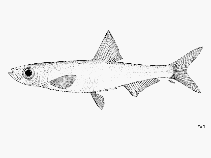 Nannothrissa parva
foto/gambar oleh FAO
Gambar | imej Google
foto/gambar oleh FAO
klasifikasi / Nama Nama-nama umum | Sinonim (persamaan) | Catalog of Fishes(Marga, Jenis) | ITIS | CoL | WoRMS | Cloffa
> Clupeiformes (Herrings) > Dorosomatidae (Gizzard shads and sardinellas)
Etymology: Nannothrissa: Latin, nannus = small + Greek, thrissa, -es = shad (Ref. 45335).
More on author: Regan.
Etymology: Nannothrissa: Latin, nannus = small + Greek, thrissa, -es = shad (Ref. 45335).
More on author: Regan.
Lingkungan: lingkungan / zona iklim / kisaran kedalaman / jangkauan distribusi Ekologi
; air tawar pelagis, permukaan. Tropical; 6°N - 3°S
Penyebaran Wilayah | Daerah-daerah FAO | Ekosistem | Kemunculan | peta titik | Introduksi | Faunafri
Africa: Congo River basin in Democratic Republic of the Congo (Ref. 188, 28136), including Lake Tumba (Ref. 41580, 93833), Ruki River (Ref. 93833) and Ubangui River (Ref. 45441). Reported also from near Kinganga in Lower Congo River (Ref. 42510), but its presence is not confirmed (Ref. 94750).
Ukuran / Berat / umur
deskripsi pendek Kunci identifiaksi (pengenalan) | Morfologi | Morfometrik
Duri punggung (Keseluruhan (total)) : 0; duri punggung lunak (Keseluruhan (total)) : 12 - 15; Duri dubur: 0; Sirip dubur lunak: 20 - 23; vertebrata, bertulang belakang: 39 - 40. Diagnosis: Body slender, depth about 20% of standard length; scutes beginning at isthmus, or just behind, very strongly keeled, 12-15 pre-pelvic and 6-8 post-pelvic scutes; lower jaw projecting, toothless; no teeth on premaxillae or maxillae; posterior supra-maxilla as deep as maxilla blade and with long slender anterior shaft; lower gill rakers 24-31; pelvic fin with 1 unbranched and 6-7 branched rays, its insertion just before dorsal fin origin; anal fin rays 20-23; scales in lateral series 35-40 (Ref. 188, 2263). It differs from Nannothrissa stewarti in having more gillrakers, 24-31 vs. 20-23, more anal fin rays, 20-23 vs. 17-19, and more scales in lateral series, 35-40 vs. 34-35 (Ref. 188, 2263, 94752).
Body shape (shape guide): fusiform / normal; Cross section: compressed.
Body shape (shape guide): fusiform / normal; Cross section: compressed.
Found in rivers and lakes, apparently in both running and still water, often in huge schools (Ref. 188). Feeds on plankton, including unicellular algae, diatoms and especially copepods, but also hydracarians and aquatic insects (Ref. 188, 41580). It breeds in Lake Tumba, ripe fishes being caught in late August and ripe and some spent fishes occurring in about mid-September (Ref. 188, 41580).
Siklus hidup dan perilaku kawin Kematangan | Reproduksi, perkembang biakan | Pemijahan | telur-telur | Fekunditas | Larva
rujukan utama
Unggah referensi Anda | Acuan | Koordinator | mitra
Whitehead, P.J.P., 1985. FAO Species Catalogue. Vol. 7. Clupeoid fishes of the world (suborder Clupeoidei). An annotated and illustrated catalogue of the herrings, sardines, pilchards, sprats, shads, anchovies and wolf-herrings. FAO Fish. Synop. 125(7/1):1-303. Rome: FAO. (Ref. 188)
Status IUCN Red List (Ref. 130435: Version 2025-2 (Global))
kurang bimbang (LC) ; Date assessed: 16 February 2009
CITES
Not Evaluated
ancaman kepada manusia
Harmless
penggunaan manusia
Perikanan: perikanan swasembada
FAO - Publication: search | FishSource |
informasi lanjut
Dinamika populasi
Parameter pertumbuhan
Maks. usia / ukuran
Panjang-berat rel.
Panjang-panjang rel.
ukuran frekuensi
Konversi massa
pemulihan
Kelimpahan
Parameter pertumbuhan
Maks. usia / ukuran
Panjang-berat rel.
Panjang-panjang rel.
ukuran frekuensi
Konversi massa
pemulihan
Kelimpahan
Siklus hidup
Reproduksi, perkembang biakan
Kematangan
Kedewasaan / insang rel.
Fekunditas
Pemijahan
Agregasi pemijahan
telur-telur
pekembangan telor
Larva
Dinamika larva
Reproduksi, perkembang biakan
Kematangan
Kedewasaan / insang rel.
Fekunditas
Pemijahan
Agregasi pemijahan
telur-telur
pekembangan telor
Larva
Dinamika larva
Anatomi
Area insang
Otak
Otolith
Area insang
Otak
Otolith
Fisiologi
Komposisi tubuh
Nutrisi
Konsumsi oksigen
Jenis renang
Kecepatan berenang
Pigmen visual
Suara ikan
Penyakit & Parasit
Toksisitas (LC50)
Komposisi tubuh
Nutrisi
Konsumsi oksigen
Jenis renang
Kecepatan berenang
Pigmen visual
Suara ikan
Penyakit & Parasit
Toksisitas (LC50)
Genetika
genom
Genetika
Heterozigositas
Diturunkan
Keanekaragaman Genetik
genom
Genetika
Heterozigositas
Diturunkan
Keanekaragaman Genetik
Yang berhubungan dengan manusia
Sistem akuakultur
profil budidaya air
Strain
Kasus Ciguatera
Perangko, koin, dll.
Sistem akuakultur
profil budidaya air
Strain
Kasus Ciguatera
Perangko, koin, dll.
Alat, peralatan
E-book | Penuntun lapangan | tanda freqkuenci panjang | peringkat sejarah hidup | peta titik |
Tangkap-MSY |
laporan khas
muat turun XML
Sumber internet
AFORO (otoliths) | Aquatic Commons | BHL | Cloffa | Websites from users | semak peneliti ikan | CISTI | Catalog of Fishes: Marga, Jenis | DiscoverLife | ECOTOX | FAO - Publication: search | Faunafri | Fishipedia | Fishtrace | GloBI | Google Books | Google Scholar | Google | IGFA World Record | OneZoom | Open Tree of Life | Otolith Atlas of Taiwan Fishes | PubMed | Reef Life Survey | Socotra Atlas | TreeBase | Tree of Life | Wikipedia: pergi, Cari | World Records Freshwater Fishing | Catatan Zoologi
Estimasi berdasarkan model
Indeks keanekaragaman filogenetik (Acuan 82804): PD50 = 0.7500 [Uniqueness, from 0.5 = low to 2.0 = high].
Bayesian length-weight: a=0.00871 (0.00414 - 0.01834), b=3.06 (2.89 - 3.23), in cm total length, based on LWR estimates for this (Sub)family-body shape (Ref. 93245).
Tingkat Trofik (Acuan 69278): 2.7 ±0.21 se; based on food items.
Daya lenting (Acuan 120179): Tinggi, Waktu penggandaan populasi minimum kurang dari 15 bulan (Preliminary K or Fecundity.).