



Clupea pallasii Valenciennes, 1847
Pacific herring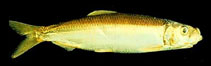
分類 / 名前 共通名の | 類義語 | Catalog of Fishes(部類, 種) | ITIS | CoL | WoRMS | Cloffa
> Clupeiformes (Herrings) > Clupeidae (Herrings, shads, sardines, menhadens)
Etymology: Clupea: Latin, clupea = sardine, derived from Clupeus = shield; doubtless a reference to the scales covering the body of the fish + Greek, odous = teeth (Ref. 45335); pallasii: Named after Petrus Simon Pallas, great Russian naturalist and explorer (Ref. 6885).
Eponymy: Peter Simon Pallas (1741–1811) was a German-born Russian (1767) explorer, zoologist and one of greatest 18th century naturalists. [...] (Ref. 128868), visit book page.
More on author: Valenciennes.
Etymology: Clupea: Latin, clupea = sardine, derived from Clupeus = shield; doubtless a reference to the scales covering the body of the fish + Greek, odous = teeth (Ref. 45335); pallasii: Named after Petrus Simon Pallas, great Russian naturalist and explorer (Ref. 6885).
Eponymy: Peter Simon Pallas (1741–1811) was a German-born Russian (1767) explorer, zoologist and one of greatest 18th century naturalists. [...] (Ref. 128868), visit book page.
More on author: Valenciennes.
環境:環境 / 気候帯 / 深さの範囲 / 分布範囲 生態学
海; 新鮮な水; 汽水性の pelagic-neritic; 移住性ではない; 深さの範囲 0 - 475 m (Ref. 117245). Temperate; 77°N - 33°N, 34°E - 119°W (Ref. 54336)
分布 領土 | 国連食糧農業機関の区域 | エコシステム | 事件 | 目的のマップ | 導入 | Faunafri
Arctic: White Sea eastward to Ob inlet. Western Pacific: Anadyr Bay, eastern coasts of Kamchatka, possibly the Aleutian Islands southward to Japan and west coast of Korea. Eastern Pacific: Kent Peninsula at 107°W and Beaufort Sea southward to northern Baja California, Mexico.
初回成熟時の長さ / サイズ / 重さ / 年齢
成熟: Lm 21.4 range ? - ? cm
Max length : 46.0 cm TL オス/雌雄の選別がない; (Ref. 27436); common length : 25.0 cm SL オス/雌雄の選別がない; (Ref. 188); 最大記録サイズ: 19 年 (Ref. 27547)
Max length : 46.0 cm TL オス/雌雄の選別がない; (Ref. 27436); common length : 25.0 cm SL オス/雌雄の選別がない; (Ref. 188); 最大記録サイズ: 19 年 (Ref. 27547)
簡単な記述 検索表 | 形態学 | 形態計測学
背面の脊椎 (合計) : 0; 背鰭 (合計) : 13 - 21; 肛門の骨: 0; 臀鰭: 12 - 23; 脊つい: 46 - 58. Without prominent keel; no median notch in upper jaw. Gill cover without radiating bony striae. No distinctive dark spots on body or fins. Overlaps C. harengus in White Sea, but distinguished by fewer vertebrae (usually 52 to 55; cf. usually 55 to 57) and fewer post-pelvic scutes (10 to 14; cf. 12 to 16). Dark blue to olivaceous above, shading to silver below (Ref. 27547). Precaudal vertebrae: 29-31-32; caudal vertebrae: 19-22-22 (Ref. 265).
Body shape (shape guide): fusiform / normal; Cross section: compressed.
Body shape (shape guide): fusiform / normal; Cross section: compressed.
Neritic species (Ref. 11230). A coastal and schooling species (Ref. 188). Landlocked populations exist. Mature adults migrate inshore, entering estuaries to breed. During the summer of their first year, young form schools in shallow bays, inlets and channels that appear at the surface; these schools disappear in the fall and remain in deep water for the next 2-3 years (Ref. 6885, 27547). Young feed mainly on crustaceans, but also take decapod and mollusk larvae; adults prey mainly on large crustaceans and small fishes (Ref. 6885, 27547). Because it does not undertake extensive coastal migrations, the mixing of local populations is relatively rare (Ref. 27547). In the eastern Pacific, the fish is mainly caught for roe markets in Asia (Ref. 9988). There is a fishery for eggs laid on kelp, which when salted, is called kazunoko-kombu, and is considered a delicacy in Japan (Ref. 27547). Used in Chinese medicine (Ref. 12166). Utilized fresh, dried or salted, smoked, canned, and frozen; eaten pan-fried, broiled, and baked (Ref. 9988). Possibly to 475 m depth (Ref. 6793).
ライフサイクルと交尾行動 成熟 | 繁殖 | 放精 | 卵 | 生産力 | 幼生
Oviparous (Ref. 265). A female turns to her side, deposits her eggs on the bottom and resumes an upright posture. This procedure is repeated until all eggs have been laid, which may take several days (Ref. 11548). As eggs are being deposited, males are releasing milt, fertilizing the eggs (Ref. 27547). There is no observable pairing of the sexes; the whole spawning area is white with milt (Ref. 11558).
主な参考文献
参考文献のアップロード | 参考文献 | コーディネーター | 協力者
Whitehead, P.J.P., 1985. FAO Species Catalogue. Vol. 7. Clupeoid fishes of the world (suborder Clupeoidei). An annotated and illustrated catalogue of the herrings, sardines, pilchards, sprats, shads, anchovies and wolf-herrings. FAO Fish. Synop. 125(7/1):1-303. Rome: FAO. (Ref. 188)
CITES
Not Evaluated
人間に対する脅威
Harmless
人間の用途
水産業: 高い商業の; ゲームフィッシュ: はい; 餌: usually
FAO - 水産業: 着陸, 種の外形; Publication: search | FishSource | 私達の周りの海
より多くの情報
解剖学
カマ
脳
オトリス
カマ
脳
オトリス
用具
オーガニック・クイズ | 電子書籍 | 野外観察図鑑 | 長さ-周波数ウィザード | 生活史の基盤ツール | 目的のマップ |
キャッチ-MSY |
特記事項
XMLをダウンロードして下さい
インターネットの情報源
AFORO (otoliths) | Aquatic Commons | BHL | Cloffa | Websites from users | Check FishWatcher | CISTI | Catalog of Fishes: 部類, 種 | DiscoverLife | ECOTOX | FAO - 水産業: 着陸, 種の外形; Publication: search | Faunafri | Fishipedia | Fishtrace | GloBI | Google Books | Google Scholar | Google | IGFA World Record | OceanAdapt | OneZoom | Open Tree of Life | Otolith Atlas of Taiwan Fishes | PubMed | Reef Life Survey | Socotra Atlas | TreeBase | 生命の木 | Wikipedia: 行く, 検索する | World Records Freshwater Fishing | Zoobank | 動物に関する記録
モデルに基づく推定値
好ましい温度 (参照 123201): 0.2 - 9.7, mean 2.8 °C (based on 966 cells).
系統多様性指数 (参照 82804): PD50 = 0.6250 [Uniqueness, from 0.5 = low to 2.0 = high].
Bayesian length-weight: a=0.00617 (0.00494 - 0.00770), b=3.13 (3.07 - 3.19), in cm total length, based on LWR estimates for this species (Ref. 93245).
栄養段階 (参照 69278): 3.2 ±0.2 se; based on diet studies.
Generation time: 4.2 (2.3 - 5.9) years. Estimated as median ln(3)/K based on 13 growth studies.
Prior r = 0.74, 95% CL = 0.49 - 1.11, Based on 4 full stock assessments.
栄養素 (Ref. 124155): Calcium = 113 [31, 265] mg/100g; Iron = 0.652 [0.379, 1.109] mg/100g; Protein = 18.4 [16.4, 20.3] %; Omega3 = 1 [1, 2] g/100g; Selenium = 16 [5, 49] μg/100g; VitaminA = 15.1 [3.4, 67.2] μg/100g; Zinc = 1.18 [0.62, 2.02] mg/100g (wet weight); based on nutrient studies.