



Oreochromis karomo (Poll, 1948)
Karomo
Adicionar o seu Fotografias e vídeos
Fotografias | Imagem do Google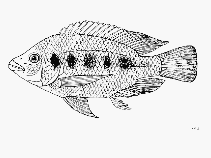 Oreochromis karomo
Male Fotografia de FAO
Fotografias | Imagem do Google
Male Fotografia de FAO
Classificação / Nomes Nomes comuns | Sinónimos | Catalog of Fishes(Género, Espécies) | ITIS | CoL | WoRMS | Cloffa
> Cichliformes (Cichlids, convict blennies) > Cichlidae (Cichlids) > Pseudocrenilabrinae
Etymology: Oreochromis: Latin, aurum = gold + Greek, chromis = a fish, perhaps a perch (Ref. 45335); karomo: Karomo is the local name of the species (Ref. 2).
More on author: Poll.
Etymology: Oreochromis: Latin, aurum = gold + Greek, chromis = a fish, perhaps a perch (Ref. 45335); karomo: Karomo is the local name of the species (Ref. 2).
More on author: Poll.
Ambiente: milieu / zona climática / intervalo de profundidade / gama de distribuição Ecologia
; Água doce bentopelágico. Tropical; 22°C - 28°C (Ref. 2060); 4°S - 6°S
Distribuição Territórios | Áreas FAO | Ecossistemas | Ocorrências | Mapa dos pontos | Introduções | Faunafri
Tamanho / Peso / Idade
Descrição breve Chaves de identificação | Morfologia | Morfometria
Espinhos dorsais (total) : 15 - 16; Raios dorsais moles (total) : 12 - 13; Espinhos anais: 3; Raios anais moles: 10 - 11; Vértebras: 29. Diagnosis: A large bodied Oreochromis, characterised by elongated jaws, projecting forwards to form a long snout, with the tooth-bands meeting in the horizontal plane; broad bands of tricuspid teeth, with long, slender shafts and curved crowns, arranged in broad bands; maxilla with a flange resting on the premaxilla at the curve between its two arms; and dorsal region and flanks dark green/olive, ventral region lighter (Ref. 2, 118638). A tasseled species (Ref. 2). Fins of ripening males dark with orange lappets on the dorsal, female fins plain grey/olive (Ref. 118638). Females and non-breeding males have 3 large blotches on the flanks (Ref. 118638). Fully ripe males are purplish blue with dark spots on the flank scales, a blue-green head, bright blue lips and have blue-white stripes and spots on the dorsal, anal and tail fins; the dorsal and tailfins have broad orange margins, and there is a long, branched orange/red genital tassel (Ref. 118638).
Body shape (shape guide): short and / or deep.
Body shape (shape guide): short and / or deep.
Males were seen scooping up algal debris from the bottom, and occasionally they moved to the adjacent weed beds and rasp epiphytic algae (Ref. 2). A maternal mouthbrooder (Ref. 2, 118638); males defend territories in shallow water, building a small platform of fine sand in the centre of a small pit (Ref. 118638). Important in swamp fishery (Ref. 4967), and an important component of the fisheries catch in Lakes Sagera and Nyamagoma; potential as an aquaculture species (Ref. 118638). The IUCN status is critically endangered, based on small range, fishing pressure and habitat degradation (Ref. 118638). Excellent to eat; occurs in shallow water; common but localized (Ref. 53528).
Ciclo de vida e comportamento de acasalamento Maturidade | Reprodução | Desova | Ovos | Fecundidade | Larvas
A maternal mouthbrooder (Ref. 2, 118638); males defend territories in shallow water, building a small platform of fine sand in the centre of a small pit (Ref. 118638). Males construct and maintain a mating platform which is a circular area of fine sand (Ref. 2), usually only about 10-15cm in diameter which is much smaller than the length of the fish (Ref. 55077), surrounded by a low ridge, on the top of a mound about 10 cm high (Ref. 2), but the mound might be 1m in diameter at its base and 30cm high (Ref. 55074, 55077). The plaque of sand is kept very clean, making the nest visible from a considerable distance (Ref. 55077). Little boundary fighting between close neighbours, but males seen to drive away individuals of other species (e.g. Labeo and Clarias as well as other cichlids)(Ref. 2, 55077). Females are seen in the nests at various times throughout the day; the number of times a male spawns appears to be limited by the number of ripe females available; females cruise over the spawning grounds singly or in small shoals (Ref. 55077). Courtship behaviour short and not particularly complex (Ref. 364), including displaying by the male to attract a female, snout shaking (nose wagging) and tassel dragging (Ref. 364, 55077). Female lays a batch of eggs and immediately picks them up while the male drags his tassel over the nest (Ref. 2, 55077), but it remains unclear whether the eggs are fertilised in the water or in the mouth of the female (Ref. 55077). Two, 3 or more batches of eggs may be laid by the same female before she leaves the nest (Ref. 2, 55077), and the larger the female the more numerous the eggs (Ref. 55077). Normal spawning generally takes less than 5 minutes (Ref. 55077). Breeding individuals spend little time feeding (Ref. 2), and males do not leave their territory to feed (Ref. 5507). Young of 11 mm still with large yolk sacs were the largest seen from the mouth of a female (Ref. 55077). Young of 2-6cm remain in schools in the shallows (Ref. 2, 55077).
Referência principal
Carregar as suas referências | Referências | Coordenador : Kullander, Sven O. | Colaboradores
Trewavas, E., 1983. Tilapiine fishes of the genera Sarotherodon, Oreochromis and Danakilia. British Mus. Nat. Hist., London, UK. 583 p. (Ref. 2)
Categoria na Lista Vermelha da IUCN (Ref. 130435: Version 2025-2 (Global))
Ameaçada (EN) (B1ab(iii,v)); Date assessed: 13 March 2025
CITES
Not Evaluated
Ameaça para o homem
Harmless
Utilização humana
Pescarias: espécies comerciais; Aquacultura: uso futuro provável; Aquário: Espécies comerciais
FAO - Publication: search | FishSource |
Mais informação
Ecologia Trófica
Produtos alimentares (presas)
Composição da dieta
Consumo alimentar
Rações alimentares
Predadores
Produtos alimentares (presas)
Composição da dieta
Consumo alimentar
Rações alimentares
Predadores
Dinâmica das populações
Parâmetros de crescimento
Idades / tamanhos máximos
Comprimento-peso rel.
Comprimento-comprimento rel.
Frequência de comprimento
Conversão de massa
Recrutamento
Abundância
Parâmetros de crescimento
Idades / tamanhos máximos
Comprimento-peso rel.
Comprimento-comprimento rel.
Frequência de comprimento
Conversão de massa
Recrutamento
Abundância
Ciclo de vida
Reprodução
Maturidade
Maturidade/Rel. das guelras
Fecundidade
Desova
Agregações de desova
Ovos
Desenvolvimento dos ovos
Larvas
Dinâmica larvar
Reprodução
Maturidade
Maturidade/Rel. das guelras
Fecundidade
Desova
Agregações de desova
Ovos
Desenvolvimento dos ovos
Larvas
Dinâmica larvar
Anatomia
Área branquial
Cérebro
Otólitos
Área branquial
Cérebro
Otólitos
Fisiologia
Composição corporal
Nutrientes
Consumo de oxigénio
Tipo de natação
Velocidade de natação
Pigmentos visuais
Som de peixe
Doenças e Parasitas
Toxicidade (LC50s)
Composição corporal
Nutrientes
Consumo de oxigénio
Tipo de natação
Velocidade de natação
Pigmentos visuais
Som de peixe
Doenças e Parasitas
Toxicidade (LC50s)
Genética
genoma
Genética
Heterozigotia
Hereditariedade
Diversidade genética
genoma
Genética
Heterozigotia
Hereditariedade
Diversidade genética
Relacionado com o ser humano
Sistemas de aquacultura
Perfis para aquacultura
Estirpes
Casos de Ciguatera
Selos, moedas, diversos.
Sistemas de aquacultura
Perfis para aquacultura
Estirpes
Casos de Ciguatera
Selos, moedas, diversos.
Ferramentas
E-book | Guia de campo | Ferramenta auxiliar de frequências de comprimento | Ferramenta sobre a história de vida | Mapa dos pontos |
Captura-MSY |
Relatórios especiais
Descarregue XML
Fontes da internet
AFORO (otoliths) | Aquatic Commons | BHL | Cloffa | Websites from users | Consultar FishWatcher | CISTI | Catalog of Fishes: Género, Espécies | DiscoverLife | ECOTOX | FAO - Publication: search | Faunafri | Fishipedia | Fishtrace | GloBI | Google Books | Google Scholar | Google | IGFA World Record | OneZoom | Open Tree of Life | Otolith Atlas of Taiwan Fishes | PubMed | Reef Life Survey | Socotra Atlas | TreeBase | Árvore da vida | Wikipedia: ir para, procurar | World Records Freshwater Fishing | Registo zoológico
Estimativas baseadas em modelos
Índice de diversidade filogenética (Ref. 82804): PD50 = 0.5000 [Uniqueness, from 0.5 = low to 2.0 = high].
Bayesian length-weight: a=0.01905 (0.00846 - 0.04293), b=3.01 (2.82 - 3.20), in cm total length, based on LWR estimates for this (Sub)family-body shape (Ref. 93245).
Nível Trófico (Ref. 69278): 2.0 ±0.00 se; based on food items.
Resiliência (Ref. 120179): Médio, tempo mínimo de duplicação da população 1,4 - 4,4 anos (Fec=250).