



Lutjanus goreensis (Valenciennes, 1830)
Gorean snapper
Ajouter votre observation dans Fish Watcher
| Native range | All suitable habitat | Point map | Year 2050 |

|
| This map was computer-generated and has not yet been reviewed. |
| Lutjanus goreensis AquaMaps Data sources: GBIF OBIS |
Envoyez vos Photos et vidéos
Images | Timbres, pièces de monnaie, divers | Images Google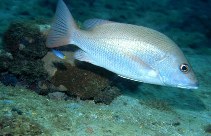 Lutjanus goreensis
Photo de Wirtz, P.
Images | Timbres, pièces de monnaie, divers | Images Google
Photo de Wirtz, P.
Classification / Noms Noms communs | Synonymes | Catalog of Fishes(Genre, Espèce) | ITIS | CoL | WoRMS | Cloffa
> Eupercaria/misc (Various families in series Eupercaria) > Lutjanidae (Snappers) > Lutjaninae
Etymology: Lutjanus: Malay, ikan lutjan, name of a fish.
More on author: Valenciennes.
Etymology: Lutjanus: Malay, ikan lutjan, name of a fish.
More on author: Valenciennes.
Environnement : milieu / zone climatique / profondeur / gamme de distribution Écologie
marin; eau douce; saumâtre récifal; profondeur 0 - 50 m (Ref. 55). Tropical; 34°N - 17°S, 27°W - 14°E (Ref. 55)
Distribution Territoires | Zones FAO | Écosystèmes | Occurrences | Carte par point | Introductions | Faunafri
Eastern Atlantic: west coast of Africa (Ref. 57393) from Senegal to Congo (Ref. 81653), primarily in the Gulf of Guinea and Cape Verde Islands (Ref. 57393, 81653).
Taille / Poids / Âge
Maturité: Lm ? range ? - ? cm
Max length : 80.0 cm TL mâle / non sexé; (Ref. 55); common length : 50.0 cm TL mâle / non sexé; (Ref. 55)
Max length : 80.0 cm TL mâle / non sexé; (Ref. 55); common length : 50.0 cm TL mâle / non sexé; (Ref. 55)
Description synthétique Clés d'identification | Morphologie | Morphométrie
Épines dorsales (Total) : 10; Rayons mous dorsaux (Total) : 14; Épines anales: 3; Rayons mous anaux: 8. Diagnosis: body stocky (Ref. 57393), relatively deep (Ref. 81653). Head pointed, dorsal profile of forehead abrupt/steep (Ref. 55, 57393, 81653). Eyes large (Ref. 81653). Preorbital/lachrymal bone (very) broad (Ref. 55, 81653). Maxilla extending to about mid-eye level (Ref. 55, 57393, 81653). Vomerine tooth plate triangular with a pronounced, long, postero-median extension (Ref. 57393, 81653). Pectoral fins of adult not reaching level of anus (Ref. 55, 81653). Scales medium-sized and ctenoid (Ref. 57393, 81653). Scale rows on back parallel to lateral line (Ref. 55, 57393, 81653), 5-7 rows below spinous part of dorsal fin (Ref. 57393, 81653). 5-6 transverse scale rows on cheek (Ref. 55, 57393, 81653). Presence of narrow blue band from snout to angle of opercle (Ref. 55, 57393, 81653) or a row of broken spots below eye (ref. 55). Small specimens from shallow water mainly brownish (Ref. 55).
Coloration: back vermilion red, becoming bright pink in large individuals and fading progressively to whitish on belly; blue subocular line, either continuous or fragmented, running from upper jaw to angle of opercle; juveniles more or less uniformly brownish (Ref. 57393).
Body shape (shape guide): fusiform / normal; Cross section: oval.
Body shape (shape guide): fusiform / normal; Cross section: oval.
Adults occur on rocky bottoms and in the vicinity of coral reefs (Ref. 55, 57393, 81653). Young are frequently encountered in coastal waters, particularly estuaries and sometimes in lower courses of rivers (Ref. 2683, 57393, 81653). Voracious predator (Ref. 57393), feeds mainly on fishes and bottom-dwelling invertebrates (Ref. 55). Size of juveniles ranges from 7.90 to 19.99 cm in length (Ref. 111357).
Cycle de vie et comportement reproducteur Maturité | Reproduction | Frai | Œufs | Fécondité | Larves
Référence principale
Téléchargez vos références | Références | Coordinateur | Collaborateurs
Allen, G.R., 1985. FAO Species Catalogue. Vol. 6. Snappers of the world. An annotated and illustrated catalogue of lutjanid species known to date. FAO Fish. Synop. 125(6):208 p. Rome: FAO. (Ref. 55)
Statut dans la liste rouge de l'IUCN (Ref. 130435: Version 2025-2 (Global))
Données manquantes (DD) ; Date assessed: 06 May 2013
CITES
Not Evaluated
Menace pour l'homme
Harmless
Utilisations par l'homme
Pêcheries: intérêt commercial mineur
FAO - Publication: search | FishSource |
Plus d'informations
Écologie trophique
Aliments (proies)
Composition du régime alimentaire
Consommation alimentaire
Rations alimentaires
Prédateurs
Aliments (proies)
Composition du régime alimentaire
Consommation alimentaire
Rations alimentaires
Prédateurs
Dynamique des populations
Paramètres de croissance
Âges / tailles maximales
Longueur-poids rel.
Rel. longueur-longueur.
Fréquences de longueurs
Conversion de masse
Recrutement
Abondance
Paramètres de croissance
Âges / tailles maximales
Longueur-poids rel.
Rel. longueur-longueur.
Fréquences de longueurs
Conversion de masse
Recrutement
Abondance
Cycle de vie
Reproduction
Maturité
Maturité/épines rel.
Fécondité
Frai
Agrégats de frai
Œufs
Développement de l'œuf
Larves
Dynamique des populations larvaires
Reproduction
Maturité
Maturité/épines rel.
Fécondité
Frai
Agrégats de frai
Œufs
Développement de l'œuf
Larves
Dynamique des populations larvaires
Anatomie
Surface branchiale
Cerveau
Otolithe
Surface branchiale
Cerveau
Otolithe
Physiologie
Composition corporelle
Nutriments
Consommation d'oxygène
Type de natation
Vitesse de nage
Pigments visuels
Son de poisson
Maladies et parasites
Toxicité (CL50)
Composition corporelle
Nutriments
Consommation d'oxygène
Type de natation
Vitesse de nage
Pigments visuels
Son de poisson
Maladies et parasites
Toxicité (CL50)
Génétique
génôme
Génétique
Hétérozygotie
Héritabilité
Diversité génétique
génôme
Génétique
Hétérozygotie
Héritabilité
Diversité génétique
Liées à l'homme
Systèmes d'aquaculture
Profils d'aquaculture
Souches
Cas de ciguatera
Timbres, pièces de monnaie, divers
Systèmes d'aquaculture
Profils d'aquaculture
Souches
Cas de ciguatera
Timbres, pièces de monnaie, divers
Outils
Quiz bio | E-book | Guide de terrain | Clés d'identification | Générateur de fréquences de longueur | Outil de dynamique de population | Carte par point |
Capture-MSY |
Articles particuliers
Télécharger en XML
Sources Internet
AFORO (otoliths) | Aquatic Commons | BHL | Cloffa | Websites from users | FishWatcher | CISTI | Catalog of Fishes: Genre, Espèce | DiscoverLife | ECOTOX | FAO - Publication: search | Faunafri | Fishipedia | Fishtrace | GloBI | Google Books | Google Scholar | Google | IGFA World Record | OneZoom | Open Tree of Life | Otolith Atlas of Taiwan Fishes | PubMed | Reef Life Survey | Socotra Atlas | TreeBase | Arbre de Vie | Wikipedia: aller à, chercher | World Records Freshwater Fishing | Zoological Record
Estimations basées sur des modèles
Température préférée (Réf. 123201): 23.7 - 28, mean 26.6 °C (based on 66 cells).
Indice de diversité phylogénétique (Réf. 82804): PD50 = 0.5000 [Uniqueness, from 0.5 = low to 2.0 = high].
Bayesian length-weight: a=0.01479 (0.01324 - 0.01652), b=2.96 (2.94 - 2.98), in cm total length, based on LWR estimates for this species (Ref. 93245).
Niveau trophique (Réf. 69278): 4.0 ±0.59 se; based on food items.
Résilience (Réf. 120179): Faible, temps minimum de doublement de population : 4,5 à 14 années (Preliminary K or Fecundity.).
Nutriments (Ref. 124155): Calcium = 24.3 [15.6, 34.7] mg/100g; Iron = 0.283 [0.182, 0.433] mg/100g; Protein = 18.9 [17.4, 20.2] %; Omega3 = 0.13 [0.09, 0.18] g/100g; Selenium = 60.8 [39.8, 89.5] μg/100g; VitaminA = 111 [20, 386] μg/100g; Zinc = 0.455 [0.363, 0.613] mg/100g (wet weight);