



Neosebastes thetidis (Waite, 1899)
Thetis fish
Waarneming toevoegen in Fish Watcher
| Native range | All suitable habitat | Point map | Year 2050 |

|
| This map was computer-generated and has not yet been reviewed. |
| Neosebastes thetidis AquaMaps Data sources: GBIF OBIS |
Uploaden van uw Foto's en video's
Afbeeldingen | Google afbeelding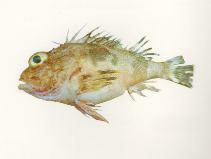 Neosebastes thetidis
Afbeelding van CSIRO
Afbeeldingen | Google afbeelding
Afbeelding van CSIRO
Classificatie / Namen Lokale namen | Synoniemen | Catalog of Fishes(Genus, Soort(en)) | ITIS | CoL | WoRMS | Cloffa
> Perciformes/Scorpaenoidei (Scorpionfishes) > Neosebastidae (Gurnard scorpionfishes)
Etymology: Neosebastes: Greek, neos = new + Greek, sebastes = august, venerable (Ref. 45335).
Eponymy: HMCS ‘Thetis’ was on a trawling expedition off the coast of New South Wales (1898) during which the holotypes were collected. The vessel was named after a sea nymph in Greek mythology. (Ref. 128868), visit book page.
More on author: Waite.
Etymology: Neosebastes: Greek, neos = new + Greek, sebastes = august, venerable (Ref. 45335).
Eponymy: HMCS ‘Thetis’ was on a trawling expedition off the coast of New South Wales (1898) during which the holotypes were collected. The vessel was named after a sea nymph in Greek mythology. (Ref. 128868), visit book page.
More on author: Waite.
Milieu: milieu / Klimaatzone / Diepte / verspreidingsgebied Ecologie
marien demersaal; diepte 45 - 288 m (Ref. 54394). Temperate
Verspreiding Gebieden | FAO regio's | Ecosystemen | Voorkomen | Verspreidingskaart | Introducties | Faunafri
Eastern Indian Ocean to Southwest Pacific: off southeastern and southern and southwestern coasts of Australia.
Grootte / Gewicht / Leeftijd
Korte beschrijving Determinatiesleutels | Morfologie | Morfometrie
Dorsale stekels (totaal) : 8; Dorsale zachte stralen (totaal) : 8; Anale stekels: 3; Anale zachte stralen: 5. Diagnosis: Dorsal rays XIII, 8 (7 or 9 in 3 of 48 specimens), fourth spine longest. Anal rays III, 5 (6 in 1 of 48 specimens). Pectoral rays 18-21 (mode 20), distal margin nearly rounded. Pored lateral-line scales 31-38 (35); longitudinal scale series 50-59 (54); scale rows between base of last dorsal spine and lateral line 6 or 7 (7). Well-developed gill rakers on upper limb 1, lower limb 4-6 (5), total 5-7 (6); rudimentary gill rakers on upper limb 3-5 (4), lower limb 3-8 (5). Swimbladder bilobed anteriorly (length 19% of SL, width 28% of SL, bilobed portion 67% of total swimbladder length). Dorsal profile of snout steep, forming angle of about 60-70° to horizontal axis of head and body. Nasal spine simple or with 2 points, directed upward or slightly forward, length of former approximately equal to or greater than anterior nostril diameter. Posterior margin of premaxilla ascending process just reaching level of anterior margin of posterior nostril when mouth closed. Interorbital ridge indistinct; no scales on narrow midinterorbital space, but scales present on supraorbital both above and below interorbital ridge; interorbital space deep, about one-fourth of orbit extending above dorsal profile of head. Preocular with a prominent pointed spine, its length greater than (rarely smaller) that of nasal spine, directed upward. Supraocular ridge with usually 2 prominent pointed spines (sometimes 3-7 spines), anterior spine with 1-5 points and posterior spine usually simple, canted laterally; supraocular ridge much closer to orbit than interorbital ridge in dorsal view. Sphenotic with 3-13 minute pointed spines. Postorbital spine flattened and serrated; occipital pit absent, nape flat, covered with scales entirely. Nuchal spine simple in young, with 2-5 points or serrated in adults; pterotic spine with 2-11 points; origin of nuchal spine slightly posterior to or just above that of pterotic spine, base smaller than that of latter. Upper posttemporal spine flattened and serrated; lower posttemporal spine with 1-4 points. Supracleithral spine with 1 or 2 points. Posterior margin of maxilla not reaching a vertical at posterior margin of orbit (usually extending beyond posterior margin of pupil); maxilla with scales extending posteriorly from between anterior and posterior lacrimal spines, but no scales on posterior margin. Underside of mandible smooth with 3 distinct pores on each side. Lacrimal ridge distinct with 4-9 points; anterior lacrimal spine simple, directed downward or slightly ventroposteriorly; posterior lacrimal spine with 1 or 2 points, directed downward or ventroposteriorly; length of anterior lacrimal spine 1.5 times or less in that of posterior lacrimal spine. Suborbital pit present, not deep; scales present on entire suborbital pit; suborbital ridge usually with 4 pointed spines in line with lacrimal ridge, directed backward, anterior 2 spines joined at bases and posterior 2 spines joined as bases, 1-3 spines sometimes arising from each suborbital spine; scales present between ventral margin of orbit and suborbital ridge; suborbital scales extending onto lower margin of eye membrane. Preopercle with 4 pointed spines (rarely 5 spines), 3 lower spines usually simple (sometimes with 2 or 3 points on each spine in larger specimens), lacking median ridge, uppermost spine with a median ridge and with a spine (sometimes 2 or 3 spines) distally; length of uppermost preopercular spine greater than pupil diameter. Upper opercular spine simple, lacking median ridge; lower opercular spine with a median ridge and usually with 1 or 2 spines (sometimes with 2 points each spine) arising from latter (opercular spine sometimes serrated); tip of lower opercular spine not extending beyond (rarely extending slightly beyond) opercular margin (Ref. 54394).
Body shape (shape guide): short and / or deep; Cross section: compressed.
Body shape (shape guide): short and / or deep; Cross section: compressed.
Occurs on the continental shelf (Ref. 9563); usually take below 100 m (Ref. 33839). Reported at depths of 20-260 (Ref. 9563).
Levenscyclus en paargedrag Maturiteit | Voortplanting | Paaien | Eieren | Fecunditeit | Larven
Hoofdreferentie
Upload uw referenties | Referenties | Coördinator | Medewerkers
Motomura, H., 2003. Revision of the scorpionfish genus Neosebastes (Scorpaeniformes: Neosebastidae), with descriptions of five new species. Indo-Pac. Fish. (37):46 p. (Ref. 54394)
CITES
Not Evaluated
Gevaar voor de mens
Venomous (Ref. 9563)
Gebruik door de mens
FAO - Publication: search | FishSource |
Meer informatie
Trofische ecologie
Voedsel (prooien)
Dieetsamenstelling
Voedselconsumptie
Voedselrantsoenen
Predatoren
Voedsel (prooien)
Dieetsamenstelling
Voedselconsumptie
Voedselrantsoenen
Predatoren
Ecologie
Ecologie
Ecologie
Populatiedynamica
Groeiparameters
Max. leeftijden / maten
Lengte-gewicht rel.
Lengte-lengte rel.
Lengtefrequenties
Massaconversie
Rekrutering
Abundantie
Groeiparameters
Max. leeftijden / maten
Lengte-gewicht rel.
Lengte-lengte rel.
Lengtefrequenties
Massaconversie
Rekrutering
Abundantie
Levenscyclus
Voortplanting
Maturiteit
Rijpheid/kieuwen rel.
Fecunditeit
Paaien
Paaibestanden
Eieren
Ontwikkeling van de eieren
Larven
Larvale populatiedynamiek
Voortplanting
Maturiteit
Rijpheid/kieuwen rel.
Fecunditeit
Paaien
Paaibestanden
Eieren
Ontwikkeling van de eieren
Larven
Larvale populatiedynamiek
Anatomie
Kieuwoppervlak
Hersenen
Otoliet
Kieuwoppervlak
Hersenen
Otoliet
Fysiologie
Lichaamssamenstelling
Voedingsstoffen
Zuurstofverbruik
Type zwemmen
Zwemsnelheid
Visuele pigmenten
Vis geluid
Ziekten en parasieten
Toxiciteit (LC50)
Lichaamssamenstelling
Voedingsstoffen
Zuurstofverbruik
Type zwemmen
Zwemsnelheid
Visuele pigmenten
Vis geluid
Ziekten en parasieten
Toxiciteit (LC50)
Genetica
genoom
Genetica
Heterozygositeit
Erfelijkheid
Genetische diversiteit
genoom
Genetica
Heterozygositeit
Erfelijkheid
Genetische diversiteit
Menselijk gerelateerd
Aquacultuursystemen
Aquacultuurprofielen
Kweeklijnen
Ciguatera gevallen
Postzegels, munten, diversen.
Aquacultuursystemen
Aquacultuurprofielen
Kweeklijnen
Ciguatera gevallen
Postzegels, munten, diversen.
Tools
Speciale rapporten
Bekijk gegevens voor het houden in een aquarium | Bekijk Fact Sheets voor de soort | Bekijk Aquacultuur Fact Sheets
Download XML
Internetbronnen
AFORO (otoliths) | Aquatic Commons | BHL | Cloffa | Websites from users | Bekijk FishWatcher | CISTI | Catalog of Fishes: Genus, Soort(en) | DiscoverLife | ECOTOX | FAO - Publication: search | Faunafri | Fishipedia | Fishtrace | GloBI | Google Books | Google Scholar | Google | IGFA World Record | OneZoom | Open Tree of Life | Otolith Atlas of Taiwan Fishes | PubMed | Reef Life Survey | Socotra Atlas | TreeBase | Tree of Life | Wikipedia: ga naar, zoek | World Records Freshwater Fishing | Zoological Record
Schattingen op basis van modellen
Gewenste temperatuur (Ref. 123201): 13.8 - 19.4, mean 15.5 °C (based on 64 cells).
Fylogenetische diversiteitsindex (Ref. 82804): PD50 = 0.5002 [Uniqueness, from 0.5 = low to 2.0 = high].
Bayesian length-weight: a=0.01995 (0.00906 - 0.04395), b=3.01 (2.83 - 3.19), in cm total length, based on all LWR estimates for this body shape (Ref. 93245).
Trofisch niveau (Ref. 69278): 3.8 ±0.4 se; based on size and trophs of closest relatives