



Neosebastes bougainvillii (Cuvier, 1829)
Gulf gurnard perch
Добавить Ваши наблюдения в Fish Watcher
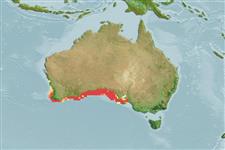
| Native range | All suitable habitat | Point map | Year 2050 |
|
| This map was computer-generated and has not yet been reviewed. |
| Neosebastes bougainvillii AquaMaps Data sources: GBIF OBIS |
Загрузить свой Фото и Видео
изображения | Изображение на Google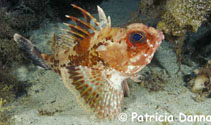 Neosebastes bougainvillii
Изображение сделано Danna, P.
изображения | Изображение на Google
Изображение сделано Danna, P.
Классификация / Имена народные названия | синонимы | Catalog of Fishes(род, виды) | ITIS | CoL | WoRMS | Cloffa
> Perciformes/Scorpaenoidei (Scorpionfishes) > Neosebastidae (Gurnard scorpionfishes)
Etymology: Neosebastes: Greek, neos = new + Greek, sebastes = august, venerable (Ref. 45335).
Eponymy: Admiral Baron Hyacinthe Yves Philippe Potentien de Bouganville (1781–1846) was a French naval officer in command of the corvette ‘Espérance’. [...] (Ref. 128868), visit book page.
More on author: Cuvier.
Etymology: Neosebastes: Greek, neos = new + Greek, sebastes = august, venerable (Ref. 45335).
Eponymy: Admiral Baron Hyacinthe Yves Philippe Potentien de Bouganville (1781–1846) was a French naval officer in command of the corvette ‘Espérance’. [...] (Ref. 128868), visit book page.
More on author: Cuvier.
Окружающая среда: среда / климатическая зона / пределы глубины / диапазон распространения экология
морской ассоциированный с рифами; пределы глубины 10 - 100 m (Ref. 9563). Temperate; 29°S - 36°S
распространение Территории | регионы FAO | Экосистемы | места находок | карта точек | интродукции | Faunafri
Eastern Indian Ocean: endemic to Australia.
Размер / Вес / Возраст
Краткое описание определительные ключи | морфология | морфометрия
колючие лучи спинного плавника (общее число) : 8; членистые (мягкие) лучи спинного плавника (общее число) : 8; колючие лучи анального плавника: 3; членистые (мягкие) лучи анального плавника: 5. Diagnosis: Dorsal rays XIII, 8 (9 in 1 of 20 specimens), third spine longest. Anal rays III, 5. Pectoral rays 20 or 21 (mode 21; 18 in 1 of 20 specimens), distal margin bilobed. Pored lateral-line scales 33-38 (34); longitudinal scale series 62-69 (66); scale rows between base of last dorsal spine and lateral line 7 or 8 (8). Well-developed gill rakers on upper limb 0 or 1 (1), lower limb 5-7 (6), total 5-8 (7); rudimentary gill rakers on upper limb 3-5 (4), lower limb 3-6 (5). Swim bladder absent. Dorsal profile of snout not steep, forming angle of about 50-55° to horizontal axis of head and body. Nasal spine simple (sometimes with 2 points), directed upward or slightly backward, length of former greater than anterior nostril diameter. Posterior margin of premaxilla ascending process extending beyond level of middle of posterior nostril when mouth closed. Interorbital ridge distinct; no scales on midinterorbital space or posterior half of supraorbital, but large and prominent on anterior half of supraorbital above interorbital ridge and on distal margin of supraorbital bone. Interorbital space extremely deep, but only about one-eighth of orbit extending above dorsal profile of head. Preocular with a small simple spine, its length less than that of nasal spine. Supraocular ridge with 3-6 prominent pointed spines, not strongly canted laterally; middle part of supraocular ridge located about midway between interorbital ridge and orbit in dorsal view. Sphenotic with a large spine and 3-7 minute spines. Postorbital spine flattened and serrated. Long, narrow and extremely deep transversal occipital pit, not covered with scales; a cluster of irregular scales protruding along front and behind sides of occipital pit; occipital pit curved posteriorly behind orbit, not covered with scales. Nuchal and supracleithral spines simple. Pterotic spine usually simple (sometimes with 2 points), originating slightly posterior to nuchal spine, base slightly smaller than that of latter. Upper posttemporal spine flattened, smooth or serrated; lower posttemporal spine simple (rarely with 2 points). Posterior margin of maxilla not extending beyond a vertical at posterior margin of pupil. Maxilla with scales extending from below posterior edge of anterior lacrimal spine to posterior margin of maxilla. Underside of mandible with 3 distinct pores and longitudinal ridges on each side, including an inner ridge extending from under lower jaw lip to lower edge of opercle, an outer ridge extending to lower edge of preopercle, and a central ridge extending to posterior part of angular and bearing the third pore posteriorly; distinct lacrimal ridge with 1-4 points. Anterior lacrimal spine usually simple (anterior edge sometimes serrated), directed ventroposteriorly (rarely forward). Posterior lacrimal spine with 1 or 2 points, directed ventroposteriorly; length of anterior lacrimal spine 2 times or less in that of posterior lacrimal spine. Suborbital pit present, front rimmed by a vertical (sometimes oblique) ridge on lacrimal to ventroanterior margin of orbit; large scales on entire suborbital pit. Suborbital ridge with 3-6 pointed spines in line with lacrimal ridge, spines joined at bases, directed backward. no scales between ventral margin of orbit and suborbital ridge, or on eye membrane. Preopercle with 5 spines, 4 lower spines simple, lacking a median ridge, uppermost spine with a median ridge and with a spine (rarely 2 spines) distally; length of uppermost preopercular spine slightly greater than or approximately equal to pupil diameter. Upper opercular spine simple, no median ridge; lower opercular spine simple with a median ridge; tip of lower opercular spine usually not extending beyond (rarely extending slightly beyond) opercular margin (Ref. 54394).
Body reddish brown, with large darker brown patch beneath dorsal fin anteriorly and smaller patches on dorsal half of body posteriorly; lower part of body with irregular orange spots; depth 35-39% SL. Head large 41-46%SL; eyes large 31-37%HL, protruding only slightly above dorsal profile. Caudal fin 13 (Ref. 33839). Lateral line almost straight, lacking the short curve at origin (Ref. 12723).
Body shape (shape guide): short and / or deep; Cross section: compressed.
Body shape (shape guide): short and / or deep; Cross section: compressed.
A temperate species found inshore on reefs (Ref. 7300).
Жизненный цикл и брачное поведение половая зрелость | размножение | нерест | икра | Плодовитость | личинки
Основная ссылка
Загрузите свои рекомендации | ссылки | координатор | соавторы
Motomura, H., 2003. Revision of the scorpionfish genus Neosebastes (Scorpaeniformes: Neosebastidae), with descriptions of five new species. Indo-Pac. Fish. (37):46 p. (Ref. 54394)
CITES
Not Evaluated
Угроза для людей
Venomous (Ref. 9563)
Использование человеком
FAO - Publication: search | FishSource |
дополнительная информация
Трофическая экология
Пищевые предметы (добыча)
состав пищи
потребление пищи
Продовольственные пайки
хищники
Пищевые предметы (добыча)
состав пищи
потребление пищи
Продовольственные пайки
хищники
экология
экология
экология
Динамика численности населения
Параметры роста
Макс. возраст / размер
Отношение длины к весу.
Отношение длины к длине.
Размерный состав
Преобразование массы
пополнение
численность
Параметры роста
Макс. возраст / размер
Отношение длины к весу.
Отношение длины к длине.
Размерный состав
Преобразование массы
пополнение
численность
Жизненный цикл
размножение
половая зрелость
Зрелость/Жиры относительно.
Плодовитость
нерест
Нерестовые скопления
икра
Развитие икры
личинки
динамика численности личинок
размножение
половая зрелость
Зрелость/Жиры относительно.
Плодовитость
нерест
Нерестовые скопления
икра
Развитие икры
личинки
динамика численности личинок
Анатомия
жаберная область
Мозг
Отолит
жаберная область
Мозг
Отолит
Физиология
Состав тела
Питательные вещества
Потребление кислорода
Тип плавания
Скорость плавания
Зрительные пигменты
Звук рыбы
Болезни и паразиты
Токсичность (LC50s)
Состав тела
Питательные вещества
Потребление кислорода
Тип плавания
Скорость плавания
Зрительные пигменты
Звук рыбы
Болезни и паразиты
Токсичность (LC50s)
генетика
Геном
генетика
Гетерозиготность
наследуемость
Генетическое разнообразие
Геном
генетика
Гетерозиготность
наследуемость
Генетическое разнообразие
Связанные с человеком
Системы аквакультуры
особенности рыбоводства
степень растяжения
Случаи заболевания сигуатерой
Марки, монеты и прочее.
Системы аквакультуры
особенности рыбоводства
степень растяжения
Случаи заболевания сигуатерой
Марки, монеты и прочее.
инструменты
Специальные отчеты
Проверить содержание в аквариумах | Проверить опубликованные видовые данные | Проверить опубликованные данные по аквакультуре
Скачать в формате XML
ресурсы в Интернет
AFORO (otoliths) | Aquatic Commons | BHL | Cloffa | Websites from users | Проверить FishWatcher | CISTI | Catalog of Fishes: род, виды | DiscoverLife | ECOTOX | FAO - Publication: search | Faunafri | Fishipedia | Fishtrace | GloBI | Google Books | Google Scholar | Google | IGFA World Record | OneZoom | Open Tree of Life | Otolith Atlas of Taiwan Fishes | PubMed | Reef Life Survey | Socotra Atlas | TreeBase | Tree of Life | Wikipedia: Вперёд, поиск | World Records Freshwater Fishing | Зоологическая летопись
Оценки, основанные на моделях
Предпочтительная температура (ссылка 123201): 17 - 18.7, mean 18 °C (based on 106 cells).
Индекс филогенетического разнообразия (ссылка 82804): PD50 = 0.5002 [Uniqueness, from 0.5 = low to 2.0 = high].
Bayesian length-weight: a=0.01995 (0.00906 - 0.04395), b=3.01 (2.83 - 3.19), in cm total length, based on all LWR estimates for this body shape (Ref. 93245).
Трофический уровень (ссылка 69278): 3.8 ±0.4 se; based on size and trophs of closest relatives
Питательные вещества (Ref. 124155): Calcium = 15.3 [6.3, 32.1] mg/100g; Iron = 0.203 [0.095, 0.400] mg/100g; Protein = 17.8 [16.2, 19.4] %; Omega3 = 0.402 [0.165, 1.321] g/100g; Selenium = 9.84 [4.39, 23.28] μg/100g; VitaminA = 36.4 [8.2, 176.0] μg/100g; Zinc = 0.537 [0.343, 0.847] mg/100g (wet weight);