



Oreochromis variabilis (Boulenger, 1906)
Victoria tilapia
Загрузить свой Фото и Видео
изображения | Изображение на Google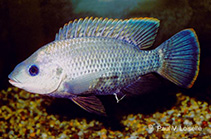 Oreochromis variabilis
Male Изображение сделано Loiselle, P.V.
изображения | Изображение на Google
Male Изображение сделано Loiselle, P.V.
Классификация / Имена народные названия | синонимы | Catalog of Fishes(род, виды) | ITIS | CoL | WoRMS | Cloffa
> Cichliformes (Cichlids, convict blennies) > Cichlidae (Cichlids) > Pseudocrenilabrinae
Etymology: Oreochromis: Latin, aurum = gold + Greek, chromis = a fish, perhaps a perch (Ref. 45335).
More on author: Boulenger.
Etymology: Oreochromis: Latin, aurum = gold + Greek, chromis = a fish, perhaps a perch (Ref. 45335).
More on author: Boulenger.
Окружающая среда: среда / климатическая зона / пределы глубины / диапазон распространения экология
; пресноводный донно-пелагический; пределы глубины 4 - 49 m. Tropical; 23°C - 28°C (Ref. 3)
распространение Территории | регионы FAO | Экосистемы | места находок | карта точек | интродукции | Faunafri
Africa: Lake Victoria and its affluent rivers (Ref. 5166, 34290, 118630, 118638), Victoria Nile above Murchison Falls (Ref. 5166) and Lakes Kyoga, Kwania and Salisbury (Ref. 5166), but strongly declining or disappeared in many areas (Ref. 52331), apparently replaced by Oreochromis niloticus (Ref. 34290). Introduced into several dams in Lake Victoria region (Ref. 118638).
Размер / Вес / Возраст
Краткое описание определительные ключи | морфология | морфометрия
колючие лучи спинного плавника (общее число) : 16 - 18; членистые (мягкие) лучи спинного плавника (общее число) : 10 - 12; колючие лучи анального плавника: 3; членистые (мягкие) лучи анального плавника: 9 - 11; позвонки: 29 - 31. Diagnosis: Large bodied tilapiine cichlid; females and unripe males have a grey/green body and fins with 6-7 dark vertical bars on the flank; ripening males with yellowish chin, and notable bright red/orange margins to the dorsal and caudal fins; fully ripe males are black with a blue sheen on the head, bright red/orange margins to the dorsal and caudal fins and a long, branched whitish or yellow genital tassel (Ref. 118638). The breeding male of Oreochromis variabilis is distinguished from O. niloticus and O. esculentus by the intense orange to scarlet colour of the margin of the dorsal fin and the long, tasselled genital papilla, as well as by the general body colour; the orange dorsal margin is present also in grown females and non-breeding males, though narrower and less brilliant (Ref. 2). Other distinguishing characters are: the tilapia-mark is absent in young longer than 15 mm standard length, whereas in O. esculentus it is conspicuous and with a clear ring up to about 70 mm standard length and may still be detected up to 170 mm; the profile usually has a convexity immediately before the eye; there are usually two rows of scales on the cheek in contrast to usually three in O. esculentus; in half-grown and full-grown fishes there are 4-7 series of teeth in the jaws, 3-5 in O. esculentus; the ratio depth of preorbital to length of head is more than 1/5 in O. variabilis, 1/5 or less in O. esculentus; longer gill-rakers; and whereas O. esculentus does not mount beyond the estuaries, O. variabilis enters rivers from the lake (Ref. 2). Oreochromis variabilis differs from both O. malagarasi and O. upembae, its nearest relatives, in the suppression in most phases of blotches on the flanks, in the body colour of mature males, which is blue-grey to blue-black vs. yellowish in O. upembae, in the shape of the profile, which in O. malagarasi and O. upembae lacks the 'bump' before the eye, a lower modal number of soft dorsal and anal rays, and a higher modal number of vertebrae; Oreochromis upembae also differs from O. variabilis in having usually narrow vertical stripes on the caudal fin (Ref. 2).
Body shape (shape guide): fusiform / normal; Cross section: compressed.
Body shape (shape guide): fusiform / normal; Cross section: compressed.
Adults feed predominantly on bottom algae, some of the planktonic organisms that are found in their stomachs are probably those which have settled on the bottom or were washed shorewards from open waters but they do feed directly on plankton (Ref. 2). A maternal mouthbrooder, males make complex courtship structures in the substrate (Ref. 118638). Was a major component of the fisheries catch in Lake Victoria (Ref. 118638). Some pond culture attempted (Ref. 118638). IUCN conservation status is critically endangered (Ref. 118638).
Жизненный цикл и брачное поведение половая зрелость | размножение | нерест | икра | Плодовитость | личинки
Nests are built on sandy bottoms in shallow waters. Each nest consists of a central shallow saucer 13-15 cm in diameter, around which is a circle of small pits. This structure is the center of a larger pit, 30-39 cm in diameter. Breeding pair makes the T-stand. Female lays batches of eggs; picks them up and sucks at the male's genital tassel.
Основная ссылка
Загрузите свои рекомендации | ссылки | координатор : Kullander, Sven O. | соавторы
Trewavas, E., 1983. Tilapiine fishes of the genera Sarotherodon, Oreochromis and Danakilia. British Mus. Nat. Hist., London, UK. 583 p. (Ref. 2)
Статус Красного Списка МСОП (Ref. 130435: Version 2025-2 (Global))
Близок к исчезновению (NT) (A2bcde); Date assessed: 07 February 2020
CITES
Not Evaluated
Угроза для людей
Harmless
Использование человеком
рыболовство: коммерческий; аквакультура (рыбоводство): экспериментальный; аквариум: коммерческий
FAO - Publication: search | FishSource |
дополнительная информация
Трофическая экология
Пищевые предметы (добыча)
состав пищи
потребление пищи
Продовольственные пайки
хищники
Пищевые предметы (добыча)
состав пищи
потребление пищи
Продовольственные пайки
хищники
Динамика численности населения
Параметры роста
Макс. возраст / размер
Отношение длины к весу.
Отношение длины к длине.
Размерный состав
Преобразование массы
пополнение
численность
Параметры роста
Макс. возраст / размер
Отношение длины к весу.
Отношение длины к длине.
Размерный состав
Преобразование массы
пополнение
численность
Жизненный цикл
размножение
половая зрелость
Зрелость/Жиры относительно.
Плодовитость
нерест
Нерестовые скопления
икра
Развитие икры
личинки
динамика численности личинок
размножение
половая зрелость
Зрелость/Жиры относительно.
Плодовитость
нерест
Нерестовые скопления
икра
Развитие икры
личинки
динамика численности личинок
Анатомия
жаберная область
Мозг
Отолит
жаберная область
Мозг
Отолит
Физиология
Состав тела
Питательные вещества
Потребление кислорода
Тип плавания
Скорость плавания
Зрительные пигменты
Звук рыбы
Болезни и паразиты
Токсичность (LC50s)
Состав тела
Питательные вещества
Потребление кислорода
Тип плавания
Скорость плавания
Зрительные пигменты
Звук рыбы
Болезни и паразиты
Токсичность (LC50s)
генетика
Геном
генетика
Гетерозиготность
наследуемость
Генетическое разнообразие
Геном
генетика
Гетерозиготность
наследуемость
Генетическое разнообразие
Связанные с человеком
Системы аквакультуры
особенности рыбоводства
степень растяжения
Случаи заболевания сигуатерой
Марки, монеты и прочее.
Системы аквакультуры
особенности рыбоводства
степень растяжения
Случаи заболевания сигуатерой
Марки, монеты и прочее.
инструменты
Специальные отчеты
Проверить содержание в аквариумах | Проверить опубликованные видовые данные | Проверить опубликованные данные по аквакультуре
Скачать в формате XML
ресурсы в Интернет
AFORO (otoliths) | Aquatic Commons | BHL | Cloffa | Websites from users | Проверить FishWatcher | CISTI | Catalog of Fishes: род, виды | DiscoverLife | ECOTOX | FAO - Publication: search | Faunafri | Fishipedia | Fishtrace | GloBI | Google Books | Google Scholar | Google | IGFA World Record | OneZoom | Open Tree of Life | Otolith Atlas of Taiwan Fishes | общественные аквариумы | PubMed | Reef Life Survey | Socotra Atlas | TreeBase | Tree of Life | Wikipedia: Вперёд, поиск | World Records Freshwater Fishing | Зоологическая летопись
Оценки, основанные на моделях
Индекс филогенетического разнообразия (ссылка 82804): PD50 = 0.5000 [Uniqueness, from 0.5 = low to 2.0 = high].
Bayesian length-weight: a=0.01479 (0.00656 - 0.03333), b=2.99 (2.82 - 3.16), in cm total length, based on LWR estimates for this Genus-body shape (Ref. 93245).
Трофический уровень (ссылка 69278): 2.0 ±0.00 se; based on food items.
Generation time: 3.1 ( na - na) years. Estimated as median ln(3)/K based on 2 growth studies.
устойчивость к внешним воздействиям (ссылка 120179): средний (среднего размера), минимальное время удвоения популяции 1.4-4.4 года (Fec=500).