



Thunnus alalunga (Bonnaterre, 1788)
Albacore
Lägg till din observation i Fish Watcher
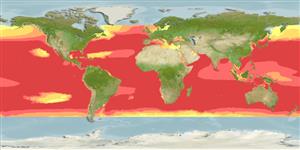
| Native range | All suitable habitat | Point map | Year 2050 |
|
| This map was computer-generated and has not yet been reviewed. |
| Thunnus alalunga AquaMaps Data sources: GBIF OBIS |
Ladda upp din foton och Videor
Bilder | Videor | Frimärken, mynt, diverse. | Google image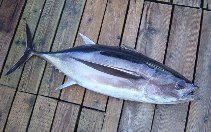 Thunnus alalunga
Bild av Archambault, C.
Bilder | Videor | Frimärken, mynt, diverse. | Google image
Bild av Archambault, C.
Klassificering / Namn Populärnamn | synonymer | Catalog of Fishes(Släkte, Arter) | ITIS | CoL | WoRMS | Cloffa
> Scombriformes (Mackerels) > Scombridae (Mackerels, tunas, bonitos) > Scombrinae
Etymology: Thunnus: Greek, thynnos = tunna (Ref. 45335).
More on author: Bonnaterre.
Etymology: Thunnus: Greek, thynnos = tunna (Ref. 45335).
More on author: Bonnaterre.
Miljö: miljö / Klimatzon / djupintervall / distributionsområde Ekologi
marina pelagic-oceanic; havsvandrande (Ref. 71039); djupintervall 0 - 600 m (Ref. 168). Subtropical; 10°C - 25°C (Ref. 168); 60°N - 50°S, 180°W - 180°E
Utbredning Territorier | FAO områden | Ekosystem | Förekomster | Prickkarta | Utplanteringar | Faunafri
Cosmopolitan in tropical and temperate waters of all oceans including the Mediterranean Sea but not at the surface between 10°N and 10°S. Western Pacific: range extend in a broad band between 40°N and 40°S (Ref. 9684). Often confused with juvenile Thunnus obesus which also have very long pectorals but with rounded tips. Highly migratory species.
Längd vid första mognad / Storlek / Vikt / Ålder
Könsmognad: Lm 85.2, range 83 - ? cm
Max length : 140 cm FL hane/ej könsbestämd; (Ref. 3669); common length : 100.0 cm FL hane/ej könsbestämd; (Ref. 9684); publicerad maxvikt: 60.3 kg (Ref. 40637); rapporterad maxålder: 9 år (Ref. 72462)
Max length : 140 cm FL hane/ej könsbestämd; (Ref. 3669); common length : 100.0 cm FL hane/ej könsbestämd; (Ref. 9684); publicerad maxvikt: 60.3 kg (Ref. 40637); rapporterad maxålder: 9 år (Ref. 72462)
Kort beskrivning Bestämningsnycklar | Morfologi | Morfometri
Taggstrålar i ryggfenan (totalt) : 11 - 14; Mjukstrålar i ryggfenan (totalt) : 12 - 16; Taggstrålar i analfenan: 0; Mjukstrålar i analfenan: 11 - 16. Anterior spines much higher than posterior spines giving the fin a strongly concave outline. Interpelvic process small and bifid. Body with very small scales. Pectoral fins remarkably long, about 30% of fork length or longer in 50 cm or longer fish. Ventral surface of liver striated and the central lobe is largest.
Body shape (shape guide): fusiform / normal; Cross section: oval.
Body shape (shape guide): fusiform / normal; Cross section: oval.
An epipelagic and mesopelagic, oceanic species, abundant in surface waters of 15.6° to 19.4°C; deeper swimming, large albacore are found in waters of 13.5° to 25.2°C; temperatures as low as 9.5°C may be tolerated for short periods (Ref. 168). Known to concentrate along thermal discontinuities (Ref. 168). Form mixed schools with skipjack tuna (Katsuwonus pelamis), yellowfin tuna (Thunnus albacares) and bluefin tuna (T. maccoyii), schools may be associated with floating objects, including sargassum weeds (Ref. 168). Feed on fishes, crustaceans and squids. Eggs and larvae are pelagic (Ref. 6769). Sexual maturity reached at 90 cm (Ref. 36731). Highly appreciated and marketed fresh, smoked, deep frozen or canned. Eaten steamed, broiled, fried and microwaved (Ref. 9987). Also Ref. 1762, 1798, 1804.
Angling: Largely caught offshore, where the waters are mild and blue. Albacore favor those areas where cooler water interfaces with warmer water. They are caught with live of dead baitfish such as mullet, sauries, squid, herring, anchovies, sardines, and other small fish. Albacore strike hard and make powerful runs (Ref. 84357).
Livscykel och parningsbeteende Könsmognad | Reproduktion | Lek | Ägg | Fekunditet | Larver
The sex ratio in catches is about 1:1 for immature individuals, but males predominate among mature fishes, which is possibly due to both differential mortality of sexes and differential growth rate after maturity.
Huvudreferens
Ladda upp dina referenser | referenser | Koordinator : Collette, Bruce B. | Medarbetare
Collette, B.B. and C.E. Nauen, 1983. FAO Species Catalogue. Vol. 2. Scombrids of the world. An annotated and illustrated catalogue of tunas, mackerels, bonitos and related species known to date. Rome: FAO. FAO Fish. Synop. 125(2):137 p. (Ref. 168)
Status på IUCN:s rödlista (Ref. 130435: Version 2025-2 (Global))
Least Concern (LC) ; Date assessed: 15 January 2021
CITES
Not Evaluated
Hot mot människor
Harmless
Mänskliga användningsområden
Fiskeri: kommersiellt viktig; sportfisk: ja
FAO - fiskeri: artprofil, landings search; Publication: search | FIRMS - Stock assessments | FishSource | Havet omkring oss
Ytterligare information
Populationsdynamik
Tillväxtparametrar
Max. åldrar / storlekar
Längd-vikt rel.
Längd-längd rel.
Längd-frekvenser
Massakonvertering
Rekrytering
Abundans
Tillväxtparametrar
Max. åldrar / storlekar
Längd-vikt rel.
Längd-längd rel.
Längd-frekvenser
Massakonvertering
Rekrytering
Abundans
Livscykel
Reproduktion
Könsmognad
Mognad/Gills rel.
Fekunditet
Lek
Lekande aggregat
Ägg
Utveckling av ägg
Larver
Larvdynamik
Reproduktion
Könsmognad
Mognad/Gills rel.
Fekunditet
Lek
Lekande aggregat
Ägg
Utveckling av ägg
Larver
Larvdynamik
Fysiologi
Kroppssammansättning
Näringsämnen
Syreförbrukning
Typ av simning
Simhastighet
Visuella pigment
Ljud från fisk
Sjukdomar & Parasiter
Toxicitet (LC50)
Kroppssammansättning
Näringsämnen
Syreförbrukning
Typ av simning
Simhastighet
Visuella pigment
Ljud från fisk
Sjukdomar & Parasiter
Toxicitet (LC50)
Människorelaterad
Vattenbrukssystem
Vattenbruksprofiler
Avelslinjer
Ciguatera-fall
Frimärken, mynt, diverse.
Vattenbrukssystem
Vattenbruksprofiler
Avelslinjer
Ciguatera-fall
Frimärken, mynt, diverse.
Verktyg
E-bok | Fälthandbok | Bestämningsnycklar | Längdfördelnings-verktyg | Livshistorie-verktyg | Prickkarta |
Fångst-MSY |
Särskilda rapporter
Kontrollera för underhåll av akvarium | Kontrollera om det finns faktablad om arter | Kontrollera om det finns faktablad om vattenbruk
Ladda ner XML
Internet-källor
AFORO (otoliths) | Aquatic Commons | BHL | Cloffa | Websites from users | Check FishWatcher | CISTI | Catalog of Fishes: Släkte, Arter | DiscoverLife | ECOTOX | FAO - fiskeri: artprofil, landings search; Publication: search | Faunafri | Fishipedia | Fishtrace | GloBI | Google Books | Google Scholar | Google | IGFA World Record | Nationella databaser | OneZoom | Open Tree of Life | Otolith Atlas of Taiwan Fishes | PubMed | Reef Life Survey | RFE Identification | Socotra Atlas | TreeBase | Tree of Life | Wikipedia: Go, sök | | Zoologiskt register
Uppskattningar baserade på modeller
|
Index för fylogenetisk mångfald (Ref. 82804) |
PD50 = 0.5039 [Uniqueness, from 0.5 = low to 2.0 = high]. |
| Bayesian length-weight | a=0.01698 (0.01400 - 0.02060), b=3.01 (2.98 - 3.04), in cm total length, based on LWR estimates for this species (Ref. 93245). |
|
Trofisk nivå (Ref. 69278) |
4.3 ±0.2 se; based on diet studies. |
| Generation time | 6.4 (4.8 - 7.8) years. Estimated as median ln(3)/K based on 34 growth studies. |
|
Resiliens (Ref. 120179) |
Mellan, lägsta populationsfördubblingstid 1,4-4,4 år (K=0.18; tm=4-5). |
| Rate of population increase | Prior r = 0.43, 95% CL = 0.28 - 0.64, Based on 15 full stock assessments. |
|
Sårbarhet i fisket (Ref. 59153) |
High to very high vulnerability (71 of 100). 🛈 |
|
Sårbarhet för klimatet (Ref. 125649) |
Moderate vulnerability (42 of 100). 🛈 |
|
Priskategori (Ref. 80766) |
High. |
|
Näringsämnen (Ref. 124155) |
Calcium = 31.2 [17.4, 55.3] mg/100g; Iron = 2.89 [1.17, 7.46] mg/100g; Protein = 23.8 [22.4, 25.1] %; Omega3 = 0.434 [0.280, 0.675] g/100g; Selenium = 38.3 [12.8, 114.7] μg/100g; VitaminA = 29.8 [4.6, 268.7] μg/100g; Zinc = 0.363 [0.203, 0.715] mg/100g (wet weight); based on nutrient studies. |