



Scolecenchelys breviceps (Günther, 1876)
Short-headed worm eel
Waarneming toevoegen in Fish Watcher
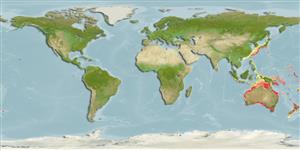
| Native range | All suitable habitat | Point map | Year 2050 |
|
| This map was computer-generated and has not yet been reviewed. |
| Scolecenchelys breviceps AquaMaps Data sources: GBIF OBIS |
Uploaden van uw Foto's en video's
Afbeeldingen | Google afbeelding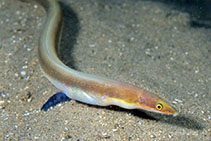 Scolecenchelys breviceps
Afbeelding van Groeneveld, R.
Afbeeldingen | Google afbeelding
Afbeelding van Groeneveld, R.
Classificatie / Namen Lokale namen | Synoniemen | Catalog of Fishes(Genus, Soort(en)) | ITIS | CoL | WoRMS | Cloffa
> Anguilliformes (Eels and morays) > Ophichthidae (Snake eels) > Myrophinae
Etymology: Scolecenchelys: Greek, skolex = worm (1855) + Greek, enchlys, -yos = eel (Ref. 45335).
More on author: Günther.
Etymology: Scolecenchelys: Greek, skolex = worm (1855) + Greek, enchlys, -yos = eel (Ref. 45335).
More on author: Günther.
Milieu: milieu / Klimaatzone / Diepte / verspreidingsgebied Ecologie
marien rifbewoner; diepte 0 - 156 m (Ref. 56887). Temperate
Verspreiding Gebieden | FAO regio's | Ecosystemen | Voorkomen | Verspreidingskaart | Introducties | Faunafri
Eastern Indian Ocean: southern Australia, from Rottnest Island, Western Australia to Port Arthur, Tasmania. Southwest Pacific: New Zealand (Ref. 5755).
Grootte / Gewicht / Leeftijd
Maturiteit: Lm ? range ? - ? cm
Max length : 61.2 cm SL mannelijk / geslacht onbekend; (Ref. 137577)
Max length : 61.2 cm SL mannelijk / geslacht onbekend; (Ref. 137577)
Korte beschrijving Determinatiesleutels | Morfologie | Morfometrie
Diagnosis: Moderately elongate with tail 58-63% of TL; dorsal fin arises slightly ahead of middle of preanal distance; blunt snout; large eye, 11-16 times in HL with posterior margin above or slightly in advance of corner of mouth; eye diameter less than interorbital distance; small, numerous teeth, conical and biserial anteriorly and uniserial posteriorly on jaws and vomer; color tan dorsally, pale ventrally, sharply delineated along mid-flank, anus not within a black spot; MVF 23/56/164; total vertebrae 161-167 (Ref. 56887).
Body shape (shape guide): eel-like.
Body shape (shape guide): eel-like.
Found inshore, in bays (Ref. 9563); burrowing, on soft bottoms (Ref. 7300). Caught under surface nightlights, and by trap, trawl, hook-and-line, and is occasionally discovered in fish stomachs; a benthic species living from tidepool depths to 156 meters (Ref. 56887).
Levenscyclus en paargedrag Maturiteit | Voortplanting | Paaien | Eieren | Fecunditeit | Larven
Hoofdreferentie
Upload uw referenties | Referenties | Coördinator : McCosker, John E. | Medewerkers
May, J.L. and J.G.H. Maxwell, 1986. Trawl fish from temperate waters of Australia. CSIRO Division of Fisheries Research, Tasmania. 492 p. (Ref. 9563)
Status op de Rode Lijst van het IUCN (Ref. 130435: Version 2025-2 (Global))
Niet bedreigd (LC) ; Date assessed: 25 November 2019
CITES
Not Evaluated
Gevaar voor de mens
Harmless
Gebruik door de mens
Visserij: bycatch
FAO - Publication: search | FishSource |
Meer informatie
Trofische ecologie
Voedsel (prooien)
Dieetsamenstelling
Voedselconsumptie
Voedselrantsoenen
Predatoren
Voedsel (prooien)
Dieetsamenstelling
Voedselconsumptie
Voedselrantsoenen
Predatoren
Populatiedynamica
Groeiparameters
Max. leeftijden / maten
Lengte-gewicht rel.
Lengte-lengte rel.
Lengtefrequenties
Massaconversie
Rekrutering
Abundantie
Groeiparameters
Max. leeftijden / maten
Lengte-gewicht rel.
Lengte-lengte rel.
Lengtefrequenties
Massaconversie
Rekrutering
Abundantie
Levenscyclus
Voortplanting
Maturiteit
Rijpheid/kieuwen rel.
Fecunditeit
Paaien
Paaibestanden
Eieren
Ontwikkeling van de eieren
Larven
Larvale populatiedynamiek
Voortplanting
Maturiteit
Rijpheid/kieuwen rel.
Fecunditeit
Paaien
Paaibestanden
Eieren
Ontwikkeling van de eieren
Larven
Larvale populatiedynamiek
Anatomie
Kieuwoppervlak
Hersenen
Otoliet
Kieuwoppervlak
Hersenen
Otoliet
Fysiologie
Lichaamssamenstelling
Voedingsstoffen
Zuurstofverbruik
Type zwemmen
Zwemsnelheid
Visuele pigmenten
Vis geluid
Ziekten en parasieten
Toxiciteit (LC50)
Lichaamssamenstelling
Voedingsstoffen
Zuurstofverbruik
Type zwemmen
Zwemsnelheid
Visuele pigmenten
Vis geluid
Ziekten en parasieten
Toxiciteit (LC50)
Genetica
genoom
Genetica
Heterozygositeit
Erfelijkheid
Genetische diversiteit
genoom
Genetica
Heterozygositeit
Erfelijkheid
Genetische diversiteit
Menselijk gerelateerd
Aquacultuursystemen
Aquacultuurprofielen
Kweeklijnen
Ciguatera gevallen
Postzegels, munten, diversen.
Aquacultuursystemen
Aquacultuurprofielen
Kweeklijnen
Ciguatera gevallen
Postzegels, munten, diversen.
Tools
Speciale rapporten
Bekijk gegevens voor het houden in een aquarium | Bekijk Fact Sheets voor de soort | Bekijk Aquacultuur Fact Sheets
Download XML
Internetbronnen
AFORO (otoliths) | Aquatic Commons | BHL | Cloffa | Websites from users | Bekijk FishWatcher | CISTI | Catalog of Fishes: Genus, Soort(en) | DiscoverLife | ECOTOX | FAO - Publication: search | Faunafri | Fishipedia | Fishtrace | GloBI | Google Books | Google Scholar | Google | IGFA World Record | OneZoom | Open Tree of Life | Otolith Atlas of Taiwan Fishes | PubMed | Reef Life Survey | Socotra Atlas | TreeBase | Tree of Life | Wikipedia: ga naar, zoek | World Records Freshwater Fishing | Zoological Record
Schattingen op basis van modellen
Gewenste temperatuur (Ref. 123201): 14.4 - 18.5, mean 16.8 °C (based on 370 cells).
Fylogenetische diversiteitsindex (Ref. 82804): PD50 = 0.5000 [Uniqueness, from 0.5 = low to 2.0 = high].
Bayesian length-weight: a=0.00076 (0.00029 - 0.00201), b=3.06 (2.83 - 3.29), in cm total length, based on LWR estimates for this (Sub)family-body shape (Ref. 93245).
Trofisch niveau (Ref. 69278): 4.5 ±0.80 se; based on food items.
Weerstandsvermogen (Ref. 120179): Gemiddeld, minimale populatieverdubbelingstijd 1,4-4,4 jaar (Preliminary K or Fecundity.).
Voedingsstoffen (Ref. 124155): Calcium = 13.2 [5.9, 24.4] mg/100g; Iron = 0.203 [0.108, 0.369] mg/100g; Protein = 19.1 [16.8, 21.7] %; Omega3 = 0.359 [0.154, 1.158] g/100g; Selenium = 10.9 [4.9, 24.7] μg/100g; VitaminA = 64.4 [17.0, 265.4] μg/100g; Zinc = 0.373 [0.242, 0.581] mg/100g (wet weight);