This website uses cookies to enhance your browsing experience and ensure the functionality of our site. For more detailed information about the types of cookies we use and how we protect your privacy, please visit our Privacy Information page.
×
Cookie Settings
This website uses different types of cookies to enhance your experience. Please select your preferences below:
> Cichliformes (Cichlids, convict blennies) > Cichlidae (Cichlids) > Pseudocrenilabrinae
Eponymy: Dr Percy Rendall (1861–1948) was a medical practitioner and itinerant naturalist who collected over much of Africa and in Trinidad and other Caribbean locations in the late 19th century. [...] (Ref. 128868), visit book page. More on author: Boulenger.
Umwelt: Milieu / Klimazone / Tiefenbereich / Verbreitungsgebiet Ökologie
Africa: from the middle Congo River basin (Kasai drainage and between the Lomami and Kisangani) up to the upper Lualaba and the Bangweulu area (Ref. 55074). Also in Lake Malawi, Zambesi, coastal areas from Zambesi Delta to Natal, Okavango and Cunene (Ref. 5163) as well as the Limpopo, Malagarasi (Ref. 55074) and Lake Tanganyika (Ref. 55074, 74387). Also present in the Cuanza and Catumbela rivers in Angola (Ref. 11970). Introduced in Lake Kivu, escaped from fish ponds (Ref. 107916). Introduced elsewhere usually for weed control and aquaculture. Several countries report adverse ecological impact after introduction.
Länge bei der ersten Reifung / Größe / Gewicht / Alter
Geschlechtsreife: Lm17.7 range ? - ? cm Max length : 45.0 cm TL Männchen/unbestimmt; (Ref. 26550); max. veröff. Gewicht: 2.5 kg (Ref. 26550); max. veröff. Alter: 7 Jahre (Ref. 7248)
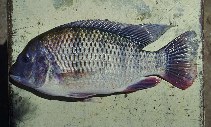
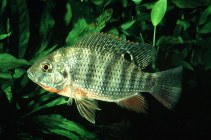
Rückenflossenstacheln (insgesamt) : 15 - 17; Rückenflossenweichstrahlen (insgesamt) : 10 - 13; Afterflossenstacheln: 3; Afterflossenweichstrahlen: 9 - 10; Wirbelzahl: 29. Diagnosis: A large, deep-bodied species with a steep head profile, narrow head and small mouth; often appearing brownish with a white belly, some individuals have bright red bellies (Ref. 118638). The sexes look very similar, although males are usually larger (Ref. 118638). Very difficult to distinguish from Coptodon zillii, but C. rendalli usually have a steeper head profile and less prominent vertical bars; in East Africa, the tailfin of C. rendalli is often divided into a brownish upper part and yellowish lower part, whereas that of C. zillii is uniform and spotted (Ref. 118638).
Body shape (shape guide): fusiform / normal; Cross section: compressed.
Adults prefer quiet, well-vegetated water along river littorals or backwaters, floodplains and swamps. They are tolerant of a wide range of temperatures (8-41°C) and salinities (Ref. 3, 7248, 118638). They form schools; is mainly diurnal. Juveniles feed on plankton (Ref. 52307); adults feed on leaves and stems of underwater plants as well as algae, and vegetative detritus (Ref. 52307), insects and crustaceans. A substrate spawner; male and female form pairs to rear the young; eggs and larvae are usually guarded in a steep-side circular pit dug in the mud (Ref. 118638). Occasionally it spawns in large cave-like structures (Ref. 52307), e.g. in Lake Malawi they are reported to dig a network of tunnels at some sites (Ref. 118638). Make excellent eating (Ref. 5214). Widely exploited in fisheries and aquaculture (Ref. 118638).
Prefers a sloping spawning ground near the marginal fringe of vegetation (Ref. 3). Builds nest in shallow water where both parents guard the eggs and young.
Dunz, A.R. and U.K. Schliewen, 2013. Molecular phylogeny and revised classification of the haplotilapiine cichlid fishes formerly referred to as "Tilapia". Mol. Phylogenet. Evol. 68(1):64-80. (Ref. 93285)
IUCN Rote Liste Status (Ref. 130435: Version 2025-2 (Global))