This website uses cookies to enhance your browsing experience and ensure the functionality of our site. For more detailed information about the types of cookies we use and how we protect your privacy, please visit our Privacy Information page.
×
Cookie Settings
This website uses different types of cookies to enhance your experience. Please select your preferences below:
Elasmobranchii (haaien en roggen) (sharks and rays) > Squaliformes (Sleeper and dogfish sharks) > Somniosidae (Sleeper sharks)
Etymology: Somniosus:Latin for sleepy, reflecting Lesueur’s surmise that these sharks are slow or sluggish because of their relatively small fins (hence the name sleeper sharks) (See ETYFish); microcephalus:micro-, from mikros (Gr.), small; cephalus, from kephale (Gr.), head, allusion not explained, perhaps referring to its short, rounded snout compared with other sharks then included in the catch-all genus Squalus (See ETYFish). More on authors: Bloch & Schneider.
Milieu: milieu / Klimaatzone / Diepte / verspreidingsgebied Ecologie
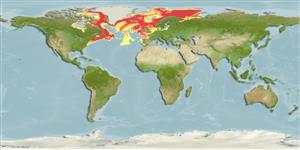
North Atlantic from the USA and Canada to Greenland in the west and from Portugal to the Barents Sea and Eastern Siberian Sea.
Genetic analyses caution that the geographic range of this species may be much narrower, ranging from Canada, Greenland, Iceland, Faroe Islands, and Norway, with occasional records from Cuba, France and Spain (Canary Is.) (Yano et al. 2007, MacNeil et al. 2012, Walter et al. 2017, Simpson et al. 2018).
Records from the western Atlantic, including records from the northern Gulf of Mexico and Canadian side off the Davis Strait exhibit evidence of introgressive hybridisation with Pacific Sleeper Shark (Somniosus pacificus) which has been recorded as far north as the Azores Islands (Portugal) (Walter et al. 2017).
Lengte bij maturiteit / Grootte / Gewicht / Leeftijd
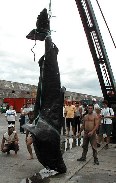
Maturiteit: Lm335.5, range 244 - 427 cm Max length : 427 cm TL mannelijk / geslacht onbekend; (Ref. 247); 550.0 cm TL (female); max. gepubliceerd gewicht: 0.00 g; max. gerapporteerde leeftijd: 392 Jaren (Ref. 110949)
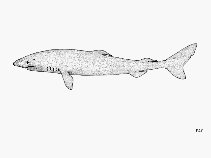
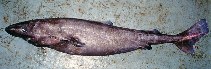
Dorsale stekels (totaal) : 0; Anale stekels: 0; Wervels: 41 - 44. A gigantic, heavily-bodied dogfish shark with a moderately long, rounded snout and small, low dorsal fins; lower caudal lobe long; upper jaw with small single-cusped teeth and lower jaw with moderate-sized, bent-cusped, slicing teeth (Ref. 5578). Medium grey or brown in color, sometimes with transverse dark bands or small light spots (Ref. 5578). Body shape (shape guide): elongated.
Found on continental and insular shelves and upper slopes down to at least 1,200 m (Ref. 247) and to as deep as 2,200 m (Ref. 55584). Epibenthic-pelagic (Ref. 58426). In the Arctic and boreal Atlantic, it occurs inshore in the intertidal and at the surface in shallow bays and river mouths during colder months, retreating to depths of 180-550 m when the temperature rises (Ref. 247). Reported to be found in temperatures from -1.8° to 17.2°C but commonly below 5°C with salinity range of 29.4-35.5. It can undertake long migrations (Ref. 119696). Feeds on pelagic and bottom fishes (herring, Atlantic salmon, Arctic char, capelin, redfish, sculpins, lumpfish, cod, haddock, Atlantic halibut, Greenland halibut and skates (Ref. 5951), sharks and skates (Ref. 5578), seals and small cetaceans, sea birds, squids, crabs, amphipods, marine snails, brittle stars, sea urchins, and jellyfish (Ref. 247, 58240). Radiocarbon dating of eye lens nuclei from 28 caught female Greenland sharks (81-502 cm TL) revealed a life span of at least 272 years, the oldest being nearly 400 years; age of sexual maturity is about 150 years. This large species is slow-growing (Ref. 110949).
Petromyzon marinus was reported to have been attached to S. microcephalus (Ref. 58185). Ovoviviparous (Ref. 205). Utilized fresh and dried for human and sled-dog food (flesh is said to be toxic when fresh); Inuit also used the skin to make boots, and the sharp lower dental bands as knives for cutting hair (Ref. 247). A very sluggish shark (Ref. 28609). Reports in literature of lengths exceeding 640 cm TL (e.g. up to 730 cm TL in Ref. 247) remain unverified. Common length 244-427 cm TL (Ref. 119696).
Yano, K., J.D. Stevens and L.J.V. Compagno, 2004. A review of the systematics of the sleeper shark genus Somniosus with redescriptions of Somniosus (Somniosus) antarcticus and Somniosus (Rhinoscymnus) longus (Squaliformes: Somniosidae). Ichthyol. Res. 51:360-373. (Ref. 50224)
Status op de Rode Lijst van het IUCN (Ref. 130435: Version 2025-2 (Global))