



Istiblennius meleagris (Valenciennes, 1836)
Peacock rockskipper
Ajouter votre observation dans Fish Watcher
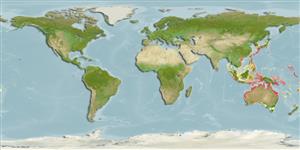
| Native range | All suitable habitat | Point map | Year 2050 |
|
| This map was computer-generated and has not yet been reviewed. |
| Istiblennius meleagris AquaMaps Data sources: GBIF OBIS |
Envoyez vos Photos et vidéos
Images | Images Google Istiblennius meleagris
Photo de Randall, J.E.
Images | Images Google
Photo de Randall, J.E.
Classification / Noms Noms communs | Synonymes | Catalog of Fishes(Genre, Espèce) | ITIS | CoL | WoRMS | Cloffa
> Blenniiformes (Blennies) > Blenniidae (Combtooth blennies) > Salariinae
Etymology: Istiblennius: Greek, istios = sail + Greek, blennios = mucus (Ref. 45335).
More on author: Valenciennes.
Etymology: Istiblennius: Greek, istios = sail + Greek, blennios = mucus (Ref. 45335).
More on author: Valenciennes.
Environnement : milieu / zone climatique / profondeur / gamme de distribution Écologie
marin; saumâtre récifal. Tropical
Distribution Territoires | Zones FAO | Écosystèmes | Occurrences | Carte par point | Introductions | Faunafri
Western Pacific: Queensland to western Australia (Ref. 2334).
Taille / Poids / Âge
Maturité: Lm ? range ? - ? cm
Max length : 15.0 cm TL mâle / non sexé; (Ref. 2334); 10.6 cm SL (female)
Max length : 15.0 cm TL mâle / non sexé; (Ref. 2334); 10.6 cm SL (female)
Description synthétique Clés d'identification | Morphologie | Morphométrie
Épines dorsales (Total) : 12 - 14; Rayons mous dorsaux (Total) : 17 - 21; Épines anales: 2; Rayons mous anaux: 17 - 21. Dorsal fin XII-XIV, 17-21; notched membrane between spinous and segmented-ray of the dorsal fin >75% the length of the first segmented ray; posterior membrane from posteriormost ray beginning somewhere between the dorsal edge of caudal peduncle, anterior to caudal-fin base, to dorsal margin of caudal fin <15% of caudal-fin length, typically on caudal peduncle, rarely posteriorly past the vertical at caudal-fin base; segmented anal fin rays 17-21; pectoral-fin rays 12-15; vertebrae 11 or 12+24 to 28 = 35-39 (usually 37 or 38); nape cirrus present or absent bilaterally or unilaterally, with slight variations between populations; orbital cirrus tree-like with medial and lateral branches; nasal cirri on rim of each anterior nostril short, palmate, with 2-8 branches (typically <6); bi-pored lateral-line tubes often more than 18; membrane from last dorsal-fin ray usually attached to caudal peduncle at or anterior to caudal-fin base; body with numerous small, pale spots; lateral line canal continuous antedorsally with simple pores (no vertical pairs of pores), extending posteriorly to point between verticals from 8th and 13th (rarely only to 8th) dorsal-fin spines, descending to midside and, in specimens >3 cm SL, continuing posteriorly as series of 6 to 26 short, disconnected, horizontally bi-pored canals/tubes in skin, numbering typically more than 10 and higher, proportional to SL; mandibular pores 4-6; lacking posterior canines; ventral margin of upper lip crenulate; no canine teeth present in lower jaw; both sexes with fleshy, blade-like crest on dorsal part of head; spinous- and segmented-ray portions of dorsal fin faintly to darkly dusky, often bearing dark, slender, oblique stripes (males) or dark spots (females). Largest male 11.8 cm SL; largest female 10.6 cm SL. With ophioblennius stage.
Body shape (shape guide): elongated.
Body shape (shape guide): elongated.
Facultative air-breathing (Ref. 126274); Adults occur along rocky and mangrove shores (Ref. 2334); in shallow depths and perhaps, under brackish or freshwater conditions (Ref. 9962). Oviparous. Eggs are demersal and adhesive (Ref. 205), and are attached to the substrate via a filamentous, adhesive pad or pedestal (Ref. 94114). Larvae are planktonic, often found in shallow, coastal waters (Ref. 94114).
Cycle de vie et comportement reproducteur Maturité | Reproduction | Frai | Œufs | Fécondité | Larves
Oviparous, distinct pairing (Ref. 205).
Référence principale
Téléchargez vos références | Références | Coordinateur : Williams, Jeffrey T. | Collaborateurs
Springer, V.G. and J.T. Williams, 1994. The Indo-West Pacific blenniid fish genus Istiblennius reappraised: a revision of Istiblennius, Blenniella, and Paralticus, new genus. Smithson. Contrib. Zool. 565:1-193. (Ref. 9962)
Statut dans la liste rouge de l'IUCN (Ref. 130435: Version 2025-2 (Global))
Préoccupation mineure (LC) ; Date assessed: 27 March 2009
CITES
Not Evaluated
Menace pour l'homme
Harmless
Utilisations par l'homme
Pêcheries: sans intérêt
FAO - Publication: search | FishSource |
Plus d'informations
Écologie trophique
Aliments (proies)
Composition du régime alimentaire
Consommation alimentaire
Rations alimentaires
Prédateurs
Aliments (proies)
Composition du régime alimentaire
Consommation alimentaire
Rations alimentaires
Prédateurs
Dynamique des populations
Paramètres de croissance
Âges / tailles maximales
Longueur-poids rel.
Rel. longueur-longueur.
Fréquences de longueurs
Conversion de masse
Recrutement
Abondance
Paramètres de croissance
Âges / tailles maximales
Longueur-poids rel.
Rel. longueur-longueur.
Fréquences de longueurs
Conversion de masse
Recrutement
Abondance
Cycle de vie
Reproduction
Maturité
Maturité/épines rel.
Fécondité
Frai
Agrégats de frai
Œufs
Développement de l'œuf
Larves
Dynamique des populations larvaires
Reproduction
Maturité
Maturité/épines rel.
Fécondité
Frai
Agrégats de frai
Œufs
Développement de l'œuf
Larves
Dynamique des populations larvaires
Anatomie
Surface branchiale
Cerveau
Otolithe
Surface branchiale
Cerveau
Otolithe
Physiologie
Composition corporelle
Nutriments
Consommation d'oxygène
Type de natation
Vitesse de nage
Pigments visuels
Son de poisson
Maladies et parasites
Toxicité (CL50)
Composition corporelle
Nutriments
Consommation d'oxygène
Type de natation
Vitesse de nage
Pigments visuels
Son de poisson
Maladies et parasites
Toxicité (CL50)
Génétique
génôme
Génétique
Hétérozygotie
Héritabilité
Diversité génétique
génôme
Génétique
Hétérozygotie
Héritabilité
Diversité génétique
Liées à l'homme
Systèmes d'aquaculture
Profils d'aquaculture
Souches
Cas de ciguatera
Timbres, pièces de monnaie, divers
Systèmes d'aquaculture
Profils d'aquaculture
Souches
Cas de ciguatera
Timbres, pièces de monnaie, divers
Outils
E-book | Guide de terrain | Générateur de fréquences de longueur | Outil de dynamique de population | Carte par point |
Capture-MSY |
Articles particuliers
Télécharger en XML
Sources Internet
AFORO (otoliths) | Aquatic Commons | BHL | Cloffa | Websites from users | FishWatcher | CISTI | Catalog of Fishes: Genre, Espèce | DiscoverLife | ECOTOX | FAO - Publication: search | Faunafri | Fishipedia | Fishtrace | GloBI | Google Books | Google Scholar | Google | IGFA World Record | OneZoom | Open Tree of Life | Otolith Atlas of Taiwan Fishes | PubMed | Reef Life Survey | Socotra Atlas | TreeBase | Arbre de Vie | Wikipedia: aller à, chercher | World Records Freshwater Fishing | Zoological Record
Estimations basées sur des modèles
Température préférée (Réf. 123201): 22.2 - 29.3, mean 27.3 °C (based on 920 cells).
Indice de diversité phylogénétique (Réf. 82804): PD50 = 0.5001 [Uniqueness, from 0.5 = low to 2.0 = high].
Bayesian length-weight: a=0.00776 (0.00354 - 0.01702), b=3.00 (2.81 - 3.19), in cm total length, based on LWR estimates for this (Sub)family-body shape (Ref. 93245).
Niveau trophique (Réf. 69278): 2.0 ±0.00 se; based on food items.
Résilience (Réf. 120179): Haut, temps minimum de doublement de population inférieur à 15 mois (Preliminary K or Fecundity.).
Nutriments (Ref. 124155): Calcium = 130 [56, 228] mg/100g; Iron = 0.739 [0.397, 1.359] mg/100g; Protein = 18.3 [17.0, 19.5] %; Omega3 = 0.0708 [, ] g/100g; Selenium = 17 [8, 39] μg/100g; VitaminA = 98.2 [25.0, 375.3] μg/100g; Zinc = 2.82 [1.81, 4.38] mg/100g (wet weight);