



Scomberomorus sierra Jordan & Starks, 1895
Pacific sierra
Waarneming toevoegen in Fish Watcher
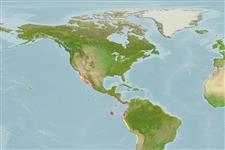
| Native range | All suitable habitat | Point map | Year 2050 |
|
| This map was computer-generated and has not yet been reviewed. |
| Scomberomorus sierra AquaMaps Data sources: GBIF OBIS |
Uploaden van uw Foto's en video's
Afbeeldingen | video's | Google afbeelding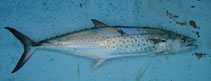 Scomberomorus sierra
Afbeelding van Reddish, P.E.
Afbeeldingen | video's | Google afbeelding
Afbeelding van Reddish, P.E.
Classificatie / Namen Lokale namen | Synoniemen | Catalog of Fishes(Genus, Soort(en)) | ITIS | CoL | WoRMS | Cloffa
> Scombriformes (Mackerels) > Scombridae (Mackerels, tunas, bonitos) > Scombrinae
Etymology: Scomberomorus: Latin, scomber = mackerel + Greek, moros = silly, stupid (Ref. 45335).
More on authors: Jordan & Starks.
Etymology: Scomberomorus: Latin, scomber = mackerel + Greek, moros = silly, stupid (Ref. 45335).
More on authors: Jordan & Starks.
Milieu: milieu / Klimaatzone / Diepte / verspreidingsgebied Ecologie
marien pelagic-neritic; oceanodroom (Ref. 51243); diepte 10 - 60 m (Ref. 91172). Tropical; 33°N - 27°S, 121°W - 70°W (Ref. 168)
Verspreiding Gebieden | FAO regio's | Ecosystemen | Voorkomen | Verspreidingskaart | Introducties | Faunafri
Eastern Central Pacific: La Jolla in southern California, USA to the Galapagos Islands and Paita, Peru. Recently reported from Antofagasta, Chile. Many authors have erroneously considered this species to be a synonym of Scomberomorus maculatus, or a subspecies of it.
Lengte bij maturiteit / Grootte / Gewicht / Leeftijd
Maturiteit: Lm 43.9, range 26 - 32 cm
Max length : 99.0 cm FL mannelijk / geslacht onbekend; (Ref. 40637); common length : 60.0 cm FL mannelijk / geslacht onbekend; (Ref. 168); max. gepubliceerd gewicht: 8.2 kg (Ref. 4699)
Max length : 99.0 cm FL mannelijk / geslacht onbekend; (Ref. 40637); common length : 60.0 cm FL mannelijk / geslacht onbekend; (Ref. 168); max. gepubliceerd gewicht: 8.2 kg (Ref. 4699)
Korte beschrijving Determinatiesleutels | Morfologie | Morfometrie
Dorsale stekels (totaal) : 15 - 18; Dorsale zachte stralen (totaal) : 16 - 19; Anale zachte stralen: 16 - 21; Wervels: 46 - 49. Interpelvic process small and bifid. Body covered with small scales. Lateral line gradually curving down toward caudal peduncle. Intestine with 2 folds and 3 limbs. Swim bladder absent. Pelvic fins relatively long. Sides silvery with numerous round brownish (orange in life) spots, three rows above lateral line, one above. The first dorsal fin is black distally and white at the base. The second dorsal fin is tinged with yellowish and with black margin. The anal fin is white.
Body shape (shape guide): fusiform / normal; Cross section: oval.
Body shape (shape guide): fusiform / normal; Cross section: oval.
A schooling species believed to spawn close to the coast over most of its range. Adults occur near the surface of coastal waters to over bottom of the continental shelf (Ref. 11035). Adults feed on small fishes, particularly anchovies (Anchoa and Cetengraulis) and clupeids (Odontognathus and Opisthonema). The most abundant game fish along the Pacific coasts of Mexico and Central America. An excellent food fish enough to support a commercial fishery. Marketed fresh and frozen; also used for ceviche (Ref. 9987).
Levenscyclus en paargedrag Maturiteit | Voortplanting | Paaien | Eieren | Fecunditeit | Larven
Hoofdreferentie
Upload uw referenties | Referenties | Coördinator : Collette, Bruce B. | Medewerkers
Collette, B.B. and C.E. Nauen, 1983. FAO Species Catalogue. Vol. 2. Scombrids of the world. An annotated and illustrated catalogue of tunas, mackerels, bonitos and related species known to date. Rome: FAO. FAO Fish. Synop. 125(2):137 p. (Ref. 168)
Status op de Rode Lijst van het IUCN (Ref. 130435: Version 2025-2 (Global))
Niet bedreigd (LC) ; Date assessed: 01 September 2022
CITES
Not Evaluated
Gevaar voor de mens
Harmless
Gebruik door de mens
Visserij: commercieel; sportvis: ja
FAO - visserij: aanvoer; Publication: search | FishSource | Sea Around Us
Meer informatie
Trofische ecologie
Voedsel (prooien)
Dieetsamenstelling
Voedselconsumptie
Voedselrantsoenen
Predatoren
Voedsel (prooien)
Dieetsamenstelling
Voedselconsumptie
Voedselrantsoenen
Predatoren
Populatiedynamica
Groeiparameters
Max. leeftijden / maten
Lengte-gewicht rel.
Lengte-lengte rel.
Lengtefrequenties
Massaconversie
Rekrutering
Abundantie
Groeiparameters
Max. leeftijden / maten
Lengte-gewicht rel.
Lengte-lengte rel.
Lengtefrequenties
Massaconversie
Rekrutering
Abundantie
Levenscyclus
Voortplanting
Maturiteit
Rijpheid/kieuwen rel.
Fecunditeit
Paaien
Paaibestanden
Eieren
Ontwikkeling van de eieren
Larven
Larvale populatiedynamiek
Voortplanting
Maturiteit
Rijpheid/kieuwen rel.
Fecunditeit
Paaien
Paaibestanden
Eieren
Ontwikkeling van de eieren
Larven
Larvale populatiedynamiek
Anatomie
Kieuwoppervlak
Hersenen
Otoliet
Kieuwoppervlak
Hersenen
Otoliet
Fysiologie
Lichaamssamenstelling
Voedingsstoffen
Zuurstofverbruik
Type zwemmen
Zwemsnelheid
Visuele pigmenten
Vis geluid
Ziekten en parasieten
Toxiciteit (LC50)
Lichaamssamenstelling
Voedingsstoffen
Zuurstofverbruik
Type zwemmen
Zwemsnelheid
Visuele pigmenten
Vis geluid
Ziekten en parasieten
Toxiciteit (LC50)
Menselijk gerelateerd
Aquacultuursystemen
Aquacultuurprofielen
Kweeklijnen
Ciguatera gevallen
Postzegels, munten, diversen.
Aquacultuursystemen
Aquacultuurprofielen
Kweeklijnen
Ciguatera gevallen
Postzegels, munten, diversen.
Tools
Speciale rapporten
Bekijk gegevens voor het houden in een aquarium | Bekijk Fact Sheets voor de soort | Bekijk Aquacultuur Fact Sheets
Download XML
Internetbronnen
AFORO (otoliths) | Aquatic Commons | BHL | Cloffa | Websites from users | Bekijk FishWatcher | CISTI | Catalog of Fishes: Genus, Soort(en) | DiscoverLife | ECOTOX | FAO - visserij: aanvoer; Publication: search | Faunafri | Fishipedia | Fishtrace | GloBI | Google Books | Google Scholar | Google | IGFA World Record | OneZoom | Open Tree of Life | Otolith Atlas of Taiwan Fishes | PubMed | Reef Life Survey | RFE identificatie | Socotra Atlas | TreeBase | Tree of Life | Wikipedia: ga naar, zoek | World Records Freshwater Fishing | Zoobank | Zoological Record
Schattingen op basis van modellen
Gewenste temperatuur (Ref. 123201): 19.4 - 28.9, mean 25.8 °C (based on 80 cells).
Fylogenetische diversiteitsindex (Ref. 82804): PD50 = 0.5000 [Uniqueness, from 0.5 = low to 2.0 = high].
Bayesian length-weight: a=0.00617 (0.00404 - 0.00942), b=2.93 (2.81 - 3.05), in cm total length, based on LWR estimates for this species & Genus-body shape (Ref. 93245).
Trofisch niveau (Ref. 69278): 4.5 ±0.8 se; based on diet studies.
Weerstandsvermogen (Ref. 120179): Gemiddeld, minimale populatieverdubbelingstijd 1,4-4,4 jaar (Assuming tm=2-4).
Prior r = 0.57, 95% CL = 0.37 - 0.85, Based on 1 data-limited stock assessment.
Voedingsstoffen (Ref. 124155): Calcium = 32.7 [14.5, 115.5] mg/100g; Iron = 0.827 [0.363, 2.008] mg/100g; Protein = 20.7 [19.4, 21.9] %; Omega3 = 0.253 [0.153, 0.419] g/100g; Selenium = 54.2 [19.9, 174.5] μg/100g; VitaminA = 23.4 [5.6, 102.0] μg/100g; Zinc = 0.651 [0.429, 1.035] mg/100g (wet weight);