



Brevitrygon imbricata (Bloch & Schneider, 1801)
Coromandel whipray
Ajouter votre observation dans Fish Watcher
| Native range | All suitable habitat | Point map | Year 2050 |

|
| This map was computer-generated and has not yet been reviewed. |
| Brevitrygon imbricata AquaMaps Data sources: GBIF OBIS |
Envoyez vos Photos et vidéos
Images | Images Google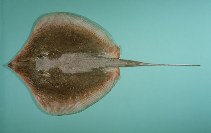 Brevitrygon imbricata
Photo de Randall, J.E.
Images | Images Google
Photo de Randall, J.E.
Classification / Noms Noms communs | Synonymes | Catalog of Fishes(Genre, Espèce) | ITIS | CoL | WoRMS | Cloffa
Élasmobranches (requins et raies) (sharks and rays) > Myliobatiformes (Stingrays) > Dasyatidae (Stingrays) > Urogymninae
Etymology: Brevitrygon: Name from Latin 'brevis' meaning short and 'trygṓn' meaning stingray, referring to the short, semi-rigid tails of these stingrays; imbricata: Name fro Latin 'imbricata' meaning overlapping each other, referring to the secondary denticle band, which is very narrow over the branchial region and abdomen in this species.
More on authors: Bloch & Schneider.
Etymology: Brevitrygon: Name from Latin 'brevis' meaning short and 'trygṓn' meaning stingray, referring to the short, semi-rigid tails of these stingrays; imbricata: Name fro Latin 'imbricata' meaning overlapping each other, referring to the secondary denticle band, which is very narrow over the branchial region and abdomen in this species.
More on authors: Bloch & Schneider.
Environnement : milieu / zone climatique / profondeur / gamme de distribution Écologie
marin; eau douce; saumâtre démersal; amphidrome (Ref. 51243); profondeur 1 - 45 m (Ref. 130662). Tropical
Distribution Territoires | Zones FAO | Écosystèmes | Occurrences | Carte par point | Introductions | Faunafri
Indian Ocean: India, Sri Lanka (Arabian Sea, Laccadive Sea and Bay of Bengal) and nw Indonesia (off Singapore); questionable in Myanmar and Taiwan.
Longueur à la première maturité / Taille / Poids / Âge
Maturité: Lm 19.0 range ? - ? cm
Max length : 25.5 cm WD mâle / non sexé; (Ref. 121648); 31.0 cm WD (female); poids max. publié: 590.00 g (Ref. 121648); poids max. publié: 590.00 g
Max length : 25.5 cm WD mâle / non sexé; (Ref. 121648); 31.0 cm WD (female); poids max. publié: 590.00 g (Ref. 121648); poids max. publié: 590.00 g
Description synthétique Clés d'identification | Morphologie | Morphométrie
Disc width equal to disc length; tail shorter than body; ventral surface of disc entirely white (Ref. 12693).
Body shape (shape guide): other.
Body shape (shape guide): other.
Found in inshore coastal waters (Ref. 30573). Typically found in estuarine habitats, but also reported from the Great Lake. The single record from the Great Lake may in fact refer to Dasyatis laosensis. Young and adults feed on benthic invertebrates (Ref. 12693). Ovoviviparous (Ref. 124). Feeds on bottom-living invertebrates (Ref. 68964). May grow to a maximum of 140 cm disc length in the sea (Ref. 43081). Juveniles may be present in mangroves (Ref. 43081). Examined adult males 17.1 cm DW (32.0 cm TL) - 20.5 cm DW (39.8 cm TL); females 13.8 cm DW (25.6 cm TL) - 20.4 cm DW (39.6 cm TL); early juveniles (USNM 222564, immature male 12.0 cm DW and female 8.8 cm DW) have lost umbilical scars. Reported maximum disc width 30.0 cm (Ref. 11312) was found excessive (Ref. 130662).
Cycle de vie et comportement reproducteur Maturité | Reproduction | Frai | Œufs | Fécondité | Larves
Exhibit ovoviparity (aplacental viviparity), with embryos feeding initially on yolk, then receiving additional nourishment from the mother by indirect absorption of uterine fluid enriched with mucus, fat or protein through specialised structures (Ref. 50449). Distinct pairing with embrace (Ref. 205).
Référence principale
Téléchargez vos références | Références | Coordinateur : McEachran, John | Collaborateurs
Last, P.R., S. Weigmann and G.J.P. Naylor, 2023. The Indo-Pacific stingray genus Brevitrygon (Myliobatiformes: Dasyatidae): clarification of historical names and description of a new species, B. manjajiae sp. nov., from the western Indian Ocean. Diversity 15: 1-75. (Ref. 130662)
Statut dans la liste rouge de l'IUCN (Ref. 130435: Version 2025-2 (Global))
Vulnérable (VU) (A2d); Date assessed: 30 April 2020
CITES
Not Evaluated
Menace pour l'homme
Venomous (Ref. 43081)
Utilisations par l'homme
Pêcheries: intérêt commercial mineur
FAO - Publication: search | FishSource |
Plus d'informations
Écologie trophique
Aliments (proies)
Composition du régime alimentaire
Consommation alimentaire
Rations alimentaires
Prédateurs
Aliments (proies)
Composition du régime alimentaire
Consommation alimentaire
Rations alimentaires
Prédateurs
Dynamique des populations
Paramètres de croissance
Âges / tailles maximales
Longueur-poids rel.
Rel. longueur-longueur.
Fréquences de longueurs
Conversion de masse
Recrutement
Abondance
Paramètres de croissance
Âges / tailles maximales
Longueur-poids rel.
Rel. longueur-longueur.
Fréquences de longueurs
Conversion de masse
Recrutement
Abondance
Cycle de vie
Reproduction
Maturité
Maturité/épines rel.
Fécondité
Frai
Agrégats de frai
Œufs
Développement de l'œuf
Larves
Dynamique des populations larvaires
Reproduction
Maturité
Maturité/épines rel.
Fécondité
Frai
Agrégats de frai
Œufs
Développement de l'œuf
Larves
Dynamique des populations larvaires
Anatomie
Surface branchiale
Cerveau
Otolithe
Surface branchiale
Cerveau
Otolithe
Physiologie
Composition corporelle
Nutriments
Consommation d'oxygène
Type de natation
Vitesse de nage
Pigments visuels
Son de poisson
Maladies et parasites
Toxicité (CL50)
Composition corporelle
Nutriments
Consommation d'oxygène
Type de natation
Vitesse de nage
Pigments visuels
Son de poisson
Maladies et parasites
Toxicité (CL50)
Liées à l'homme
Systèmes d'aquaculture
Profils d'aquaculture
Souches
Cas de ciguatera
Timbres, pièces de monnaie, divers
Systèmes d'aquaculture
Profils d'aquaculture
Souches
Cas de ciguatera
Timbres, pièces de monnaie, divers
Outils
E-book | Guide de terrain | Clés d'identification | Générateur de fréquences de longueur | Outil de dynamique de population | Carte par point |
Capture-MSY |
Articles particuliers
Télécharger en XML
Sources Internet
AFORO (otoliths) | Aquatic Commons | BHL | Cloffa | Websites from users | FishWatcher | CISTI | Catalog of Fishes: Genre, Espèce | DiscoverLife | ECOTOX | FAO - Publication: search | Faunafri | Fishipedia | Fishtrace | GloBI | Google Books | Google Scholar | Google | IGFA World Record | Bases de données nationales | OneZoom | Open Tree of Life | Otolith Atlas of Taiwan Fishes | PubMed | Reef Life Survey | Socotra Atlas | TreeBase | Arbre de Vie | Wikipedia: aller à, chercher | World Records Freshwater Fishing | Zoological Record
Estimations basées sur des modèles
Température préférée (Réf. 123201): 26.4 - 29.2, mean 28.4 °C (based on 1288 cells).
Indice de diversité phylogénétique (Réf. 82804): PD50 = 0.5312 [Uniqueness, from 0.5 = low to 2.0 = high].
Bayesian length-weight: a=0.01698 (0.01048 - 0.02752), b=3.12 (2.97 - 3.27), in cm total length, based on LWR estimates for this species & (Sub)family-body (Ref. 93245).
Niveau trophique (Réf. 69278): 3.5 ±0.37 se; based on food items.
Generation time: 1.9 ( na - na) years. Estimated as median ln(3)/K based on 2 growth studies.
Résilience (Réf. 120179): Très faible, temps minimum de doublement de population supérieur à 14 ans (K=0.59; Fec=1).