



Rhinobatos lionotus Norman, 1926
Smoothback guitarfish
Загрузить свой Фото и Видео
Изображение на Google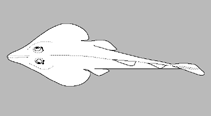 No image available for this species;
drawing shows typical species in Rhinobatidae.
Изображение на Google
drawing shows typical species in Rhinobatidae.
Классификация / Имена народные названия | синонимы | Catalog of Fishes(род, виды) | ITIS | CoL | WoRMS | Cloffa
Пластиножаберные (акулы и скаты) (sharks and rays) > Rhinopristiformes (Shovelnose rays) > Rhinobatidae (Guitarfishes)
Etymology: Rhinobatos: Greek, rhinos = nose + Greek, batis, -idos = a ray (Raja sp.) (Ref. 45335).
More on author: Norman.
Etymology: Rhinobatos: Greek, rhinos = nose + Greek, batis, -idos = a ray (Raja sp.) (Ref. 45335).
More on author: Norman.
Окружающая среда: среда / климатическая зона / пределы глубины / диапазон распространения экология
морской; солоноватоводный демерсальный; амфидромный (Ref. 51243); пределы глубины 70 - 76 m (Ref. 123963). Tropical; 24°N - 5°N, 66°E - 91°E (Ref. 114953)
распространение Территории | регионы FAO | Экосистемы | места находок | карта точек | интродукции | Faunafri
Indian Ocean: West Bengal to Myanmar, upper Bay of Bengal (India) to possibly Arabian Sea; Sri Lanka (Ref. 114953).
Размер / Вес / Возраст
Краткое описание определительные ключи | морфология | морфометрия
This species is distinguished by the following set of characters: disc is wedge-shaped, rather large, its width 35-37% TL, its length 1.2-1.3 times width; snout is relatively short, length 2.5-2.7 times interspiracular distance, ~3.4 times interorbital width; orbit diameter 1.2-1.4 times the spiracle length; nostrils are moderately oblique, length 1.3-1.5 times internarial distance; mouth width 6.3-6.9% TL; preoral length 5.5-5.9 times internarial distance; posterior nasal flaps are broad; two spiracular folds, the outermost fold subequal to marginally taller than inner fold; ridges of the rostral cartilage almost parallel, widely separated, converging slightly anteriorly but not constricted medially; anterior cartilage weakly sickle-shaped, almost truncate posteriorly; distance between the fifth gill slits 2.5-2.7 times in ventral head length; prebranchial sensory pore system distinct, extending posteriorly to margin of first gill slit; postscapular sensory canal notched, the lateral pores exposed; with weak thorn patches on supraorbit and scapular region, and row of rudimentary thorns (inconspicuous) along dorsal midline; denticles on dorsal fins densest anteriorly, more sparse posteriorly; dorsal fins are small, height of first 7.7-8.1% TL; pelvic-fin inner margin subequal to or shorter than its base length; interdorsal distance 2.3-2.9 times first dorsal-fin base; dorsal caudal margin 1.9-2.0 times the preventral margin; upper jaw with ~118 tooth rows; snout angle ~61°; pectoral radials 68-72; post-synarcual centra ~164; nasal lamellae ~49. Colouration: dorsal fins brownish anteriorly while dusky posteriorly and apically; dorsal disc of adults is uniformly brown to greenish, with or without large, regularly spaced cloudy blotches (faint orange to dusky, more or less symmetrically arranged and of irregular sizes); ventral disc and tail are pale; undersurface of snout without large, black, teardrop marking (Ref. 123963).
Cross section: flattened.
Cross section: flattened.
Found on benthic inshore areas on continental shelf to at least 76 m depth (Ref. 123963). Also known to inhabit river mouths. Ovoviviparous (Ref. 50449). Confused with other species in the Indian Ocean, biology unknown (Ref. 114953).
Жизненный цикл и брачное поведение половая зрелость | размножение | нерест | икра | Плодовитость | личинки
Exhibit ovoviparity (aplacental viviparity), with embryos feeding initially on yolk, then receiving additional nourishment from the mother by indirect absorption of uterine fluid enriched with mucus, fat or protein through specialised structures (Ref. 50449).
Основная ссылка
Загрузите свои рекомендации | ссылки | координатор : McEachran, John | соавторы
Last, P.R., B. Séret and G.J.P. Naylor, 2019. Description of Rhinobatos ranongensis sp. nov.(Rhinopristiformes: Rhinobatidae) from the Andaman Sea and Bay of Bengal with a review of its northern Indian Ocean congeners. Zootaxa 4576(2):257-287. (Ref. 123963)
Статус Красного Списка МСОП (Ref. 130435: Version 2025-2 (Global))
В критическом состоянии (CR) (A2d); Date assessed: 13 May 2019
Угроза для людей
Harmless
Использование человеком
рыболовство: не имеет хозяйственного значения
FAO - Publication: search | FishSource |
дополнительная информация
Трофическая экология
Пищевые предметы (добыча)
состав пищи
потребление пищи
Продовольственные пайки
хищники
Пищевые предметы (добыча)
состав пищи
потребление пищи
Продовольственные пайки
хищники
экология
экология
экология
Динамика численности населения
Параметры роста
Макс. возраст / размер
Отношение длины к весу.
Отношение длины к длине.
Размерный состав
Преобразование массы
пополнение
численность
Параметры роста
Макс. возраст / размер
Отношение длины к весу.
Отношение длины к длине.
Размерный состав
Преобразование массы
пополнение
численность
Жизненный цикл
размножение
половая зрелость
Зрелость/Жиры относительно.
Плодовитость
нерест
Нерестовые скопления
икра
Развитие икры
личинки
динамика численности личинок
размножение
половая зрелость
Зрелость/Жиры относительно.
Плодовитость
нерест
Нерестовые скопления
икра
Развитие икры
личинки
динамика численности личинок
Анатомия
жаберная область
Мозг
Отолит
жаберная область
Мозг
Отолит
Физиология
Состав тела
Питательные вещества
Потребление кислорода
Тип плавания
Скорость плавания
Зрительные пигменты
Звук рыбы
Болезни и паразиты
Токсичность (LC50s)
Состав тела
Питательные вещества
Потребление кислорода
Тип плавания
Скорость плавания
Зрительные пигменты
Звук рыбы
Болезни и паразиты
Токсичность (LC50s)
генетика
Геном
генетика
Гетерозиготность
наследуемость
Генетическое разнообразие
Геном
генетика
Гетерозиготность
наследуемость
Генетическое разнообразие
Связанные с человеком
Системы аквакультуры
особенности рыбоводства
степень растяжения
Случаи заболевания сигуатерой
Марки, монеты и прочее.
Системы аквакультуры
особенности рыбоводства
степень растяжения
Случаи заболевания сигуатерой
Марки, монеты и прочее.
инструменты
Специальные отчеты
Проверить содержание в аквариумах | Проверить опубликованные видовые данные | Проверить опубликованные данные по аквакультуре
Скачать в формате XML
ресурсы в Интернет
AFORO (otoliths) | Aquatic Commons | BHL | Cloffa | Websites from users | Проверить FishWatcher | CISTI | Catalog of Fishes: род, виды | DiscoverLife | ECOTOX | FAO - Publication: search | Faunafri | Fishipedia | Fishtrace | GloBI | Google Books | Google Scholar | Google | IGFA World Record | OneZoom | Open Tree of Life | Otolith Atlas of Taiwan Fishes | PubMed | Reef Life Survey | Socotra Atlas | TreeBase | Tree of Life | Wikipedia: Вперёд, поиск | World Records Freshwater Fishing | Зоологическая летопись
Оценки, основанные на моделях
Индекс филогенетического разнообразия (ссылка 82804): PD50 = 0.5000 [Uniqueness, from 0.5 = low to 2.0 = high].
Bayesian length-weight: a=0.00295 (0.00150 - 0.00581), b=3.13 (2.96 - 3.30), in cm total length, based on LWR estimates for this (Sub)family-body shape (Ref. 93245).
Трофический уровень (ссылка 69278): 3.7 ±0.4 se; based on size and trophs of closest relatives
устойчивость к внешним воздействиям (ссылка 120179): низкий, минимальное время удвоения популяции 4.5-14 лет (Fec assumed to be <100).