This website uses cookies to enhance your browsing experience and ensure the functionality of our site. For more detailed information about the types of cookies we use and how we protect your privacy, please visit our Privacy Information page.
×
Cookie Settings
This website uses different types of cookies to enhance your experience. Please select your preferences below:
Madurez: Lm? range ? - ? cm Max length : 9.5 cm SL macho / no sexado; (Ref. 2694)
Descripción breve Claves de identificación | Morfología | Morfometría
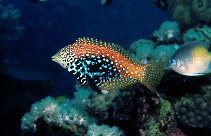
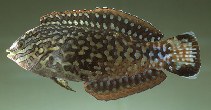
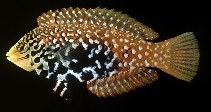
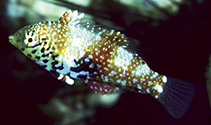
Espinas dorsales (total) : 9; Radios blandos dorsales (total) : 11; Espinas anales: 3; Radios blandos anales: 11. This species is distinguished by the following characters: D IX,11; A III,11; pectoral rays 12 (including upper rudimentary ray); complete lateral line, angling downward below last 3 or 4 dorsal rays to straight peduncular portion, 27 pored scales (plus 1 on base of caudal fin); anterior lateral-line scales with 2 or 3 (rarely 4) pores; gill rakers 14-17; body depth 2.6-2.9 in SL; head length (HL) 2.95-3.05 in SL; snout short, 3.3-3.7 in HL; upper jaw with 2 pairs of canine teeth, 1st pair straight and strongly projecting anteriorly, 2nd pair about two-thirds as long, with tips recurved and outflaring; lower jaw with a medial pair of long, straight, forward-jutting, canine teeth, each with an adjacent more slender canine about two-thirds as long, with recurved tip; side of jaws with single row of close-set conical teeth, progressively shorter posteriorly; a very large, slender, forward-projecting, canine tooth posteriorly on upper jaw; lower pharyngeal plate with an enormous central molariform tooth, on each side anteriorly with a row of small conical teeth, continuing as a single row on the long anterior process; each of the pair of upper pharyngeal plates with 2 large, nearly square molars, preceded by a patch of small stout conical teeth; orbit diameter 4.25-4.95 in HL; origin of dorsal fin slightly anterior to a vertical at upper end of gill opening; first dorsal spine 4.25-5.25 in HL; remaining spines progressively longer, 9th 3.1-3.25 in HL; 5th or 6th dorsal soft ray longest, 1.9-2.2 in HL; 3rd anal spine longest, 2.45-3.55 in HL; 5th or 6th anal soft ray longest, 1.95-2.2 in HL; caudal fin slightly rounded, 1.2-1.3 in HL; pectoral fins 1.4-1.5 in HL; pelvic fins 1.35-1.8 in HL, usually reaching to or slightly posterior to origin of anal fin in mature males, usually not reaching anus in females (Ref. 93522). Body shape (shape guide): short and / or deep; Cross section: compressed.
Ciclo vital y comportamiento de apareamiento Madurez | Reproducción | Puesta | Huevos | Fecundidad | Larva
Oviparous, distinct pairing during breeding (Ref. 205).
Randall, J.E., 2013. Seven new species of labrid fishes (Coris, Iniistius, Macropharyngodon, Novaculops, and Pteragogus) from the Western Indian Ocean. J. Ocean Sci. Found. 7:1-43. (Ref. 93522)
Situación en la Lista Roja de la UICN (Ref. 130435: Version 2025-2 (Global))
Ecología Trófica Alimentos (presas) Composición de la dieta consumo de alimento Raciones de comida Despredadores
Ecología Ecología
Dinámica de la población Coeficiente del crecimiento para Edades / tallas máximas Longitud-peso rel. Longitud-longitud rel. Longitud-frecuencias Conversión de masas Reclutamiento Abundancia
Ciclo de vida Reproducción Madurez Madurez/Gills rel. Fecundidad Puesta Agregaciones de desove Huevos Desarrollo de los huevos Larva Dinámica larvaria
Fisiología Composición corporal Nutrientes Consumo del oxígeno Tipo de natación Velocidad de natación Pigmentos visuales Sonido de peces Enfermedades y parásitos Toxicidad (CL50)
Temperatura preferida (Referencia 123201): 24.6 - 29.3, mean 27.5 °C (based on 183 cells).
Índice de diversidad filogenética (Referencia 82804): PD50 = 0.5002 [Uniqueness, from 0.5 = low to 2.0 = high].
Bayesian length-weight: a=0.01995 (0.00906 - 0.04395), b=3.01 (2.83 - 3.19), in cm total length, based on all LWR estimates for this body shape (Ref. 93245).
Nivel trófico (Referencia 69278): 3.5 ±0.4 se; based on size and trophs of closest relatives
Resiliencia (Referencia 120179): Alto, población duplicada en un tiempo mínimo inferior a 15 meses (Preliminary K or Fecundity.).
Vulnerabilidad pesquera (Ref. 59153): Low vulnerability (10 of 100). 🛈