



Trichiurus lepturus Linnaeus, 1758
Largehead hairtail
Masukkan pemerhatian anda di Fish Watcher
| Native range | All suitable habitat | Point map | Year 2050 |

|
| This map was computer-generated and has not yet been reviewed. |
| Trichiurus lepturus AquaMaps Data sources: GBIF OBIS |
muatnaik fotos/gambar dan video
Gambar | imej Google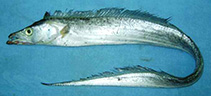 Trichiurus lepturus
foto/gambar oleh Osmany, H.B.
Gambar | imej Google
foto/gambar oleh Osmany, H.B.
klasifikasi / Nama Nama-nama umum | Sinonim (persamaan) | Catalog of Fishes(Marga, Jenis) | ITIS | CoL | WoRMS | Cloffa
> Scombriformes (Mackerels) > Trichiuridae (Cutlassfishes) > Trichiurinae
Etymology: Trichiurus: Greek, thrix = hair + Greek, oura = tail (Ref. 45335); lepturus: Specific name from Greek 'lepturus', for its thin or slender tail.
More on author: Linnaeus.
Etymology: Trichiurus: Greek, thrix = hair + Greek, oura = tail (Ref. 45335); lepturus: Specific name from Greek 'lepturus', for its thin or slender tail.
More on author: Linnaeus.
Lingkungan: lingkungan / zona iklim / kisaran kedalaman / jangkauan distribusi Ekologi
laut; payau bentopelagis; amphidromus (Ref. 51243); kisaran kedalaman 0 - 589 m (Ref. 58018), usually 100 - 350 m (Ref. 35388). Subtropical; 49°N - 54°S, 114°W - 180°E (Ref. 54931)
Penyebaran Wilayah | Daerah-daerah FAO | Ekosistem | Kemunculan | peta titik | Introduksi | Faunafri
Circumtropical and Circumtemperate: including Gulf of Mexico, Caribbean Sea, Mediterranean Sea, Sea of Marmara, Red Sea, Persian Gulf.
Panjang pada saat jatuh tempo pertama / Ukuran / Berat / umur
Kematangan: Lm 50.6, range 30 - 99 cm
Max length : 234 cm TL jantan/; (Ref. 26340); common length : 100.0 cm TL jantan/; (Ref. 26999); Berat maksimum terpublikasi: 5.0 kg (Ref. )
Max length : 234 cm TL jantan/; (Ref. 26340); common length : 100.0 cm TL jantan/; (Ref. 26999); Berat maksimum terpublikasi: 5.0 kg (Ref. )
deskripsi pendek Kunci identifiaksi (pengenalan) | Morfologi | Morfometrik
Duri punggung (Keseluruhan (total)) : 3; duri punggung lunak (Keseluruhan (total)) : 130 - 135; Sirip dubur lunak: 100 - 105. Body extremely elongate, compressed and tapering to a point. Mouth large with a dermal process at the tip of each jaw. Dorsal fin relatively high; anal fin reduced to minute spinules usually embedded in the skin or slightly breaking through; anterior margin of pectoral fin spine not serrated. Pelvic and caudal fins absent. Lateral line beginning at the upper margin of the gill cover, running oblique to behind the tip of the pectoral fins, then straight close to the ventral contour. Fresh specimens steely blue with silvery reflections, becoming uniformly silvery gray sometime after death (Ref. 6181).
Body shape (shape guide): eel-like; Cross section: compressed.
Body shape (shape guide): eel-like; Cross section: compressed.
Generally over muddy bottoms of shallow coastal waters (Ref. 9351). Often enter estuaries (Ref. 9351). Juveniles feed mostly on euphausiids, small pelagic planktonic crustaceans and small fishes; adults feed mainly on fishes and occasionally on squids and crustaceans (Ref. 6181). Adults and juveniles have opposing complementary vertical diurnal feeding migration. Large adults usually feed near the surface during the daytime and migrate to the bottom at night. Juveniles and small adults form schools 100 m above the bottom during the daytime and form loose feeding aggregations at night near the surface. Pelagic eggs (Ref. 35388) and larvae (Ref. 6768). Max weight of 1.5 kg given in Ref. 28023 seems too low. The current angling world record was caught in Rio de Janeiro's Guanabara Bay and weighed 3.69 kg. Commercial fisherman have caught fish of up to 5 kg (Capt. Eduardo Baumeier, pers. Comm., 2001). Marketed salted or dried and also frozen (Ref. 9351). Excellent taste when fried or grilled; also for sashimi when fresh.
Siklus hidup dan perilaku kawin Kematangan | Reproduksi, perkembang biakan | Pemijahan | telur-telur | Fekunditas | Larva
rujukan utama
Unggah referensi Anda | Acuan | Koordinator : Parin, Nikolay V. | mitra
Nakamura, I. and N.V. Parin, 1993. FAO Species Catalogue. Vol. 15. Snake mackerels and cutlassfishes of the world (families Gempylidae and Trichiuridae). An annotated and illustrated catalogue of the snake mackerels, snoeks, escolars, gemfishes, sackfishes, domine, oilfish, cutlassfishes,. scabbardfishes, hairtails, and frostfishes known to date. FAO Fish. Synop. 125(15):136 p. (Ref. 6181)
Status IUCN Red List (Ref. 130435: Version 2025-2 (Global))
kurang bimbang (LC) ; Date assessed: 29 January 2013
CITES
Not Evaluated
ancaman kepada manusia
Harmless
penggunaan manusia
Perikanan: bernilai komersial tinggi; Ikan buruan: ya
FAO - Perikanan: pendaratan, profail spesis; Publication: search | FIRMS - Stock assessments | FishSource | Laut di Sekitar Kita
informasi lanjut
Dinamika populasi
Parameter pertumbuhan
Maks. usia / ukuran
Panjang-berat rel.
Panjang-panjang rel.
ukuran frekuensi
Konversi massa
pemulihan
Kelimpahan
Parameter pertumbuhan
Maks. usia / ukuran
Panjang-berat rel.
Panjang-panjang rel.
ukuran frekuensi
Konversi massa
pemulihan
Kelimpahan
Siklus hidup
Reproduksi, perkembang biakan
Kematangan
Kedewasaan / insang rel.
Fekunditas
Pemijahan
Agregasi pemijahan
telur-telur
pekembangan telor
Larva
Dinamika larva
Reproduksi, perkembang biakan
Kematangan
Kedewasaan / insang rel.
Fekunditas
Pemijahan
Agregasi pemijahan
telur-telur
pekembangan telor
Larva
Dinamika larva
Fisiologi
Komposisi tubuh
Nutrisi
Konsumsi oksigen
Jenis renang
Kecepatan berenang
Pigmen visual
Suara ikan
Penyakit & Parasit
Toksisitas (LC50)
Komposisi tubuh
Nutrisi
Konsumsi oksigen
Jenis renang
Kecepatan berenang
Pigmen visual
Suara ikan
Penyakit & Parasit
Toksisitas (LC50)
Yang berhubungan dengan manusia
Sistem akuakultur
profil budidaya air
Strain
Kasus Ciguatera
Perangko, koin, dll.
Sistem akuakultur
profil budidaya air
Strain
Kasus Ciguatera
Perangko, koin, dll.
Alat, peralatan
E-book | Penuntun lapangan | Kunci identifiaksi (pengenalan) | tanda freqkuenci panjang | peringkat sejarah hidup | peta titik |
Tangkap-MSY |
laporan khas
muat turun XML
Sumber internet
AFORO (otoliths) | Aquatic Commons | BHL | Cloffa | Websites from users | semak peneliti ikan | CISTI | Catalog of Fishes: Marga, Jenis | DiscoverLife | ECOTOX | FAO - Perikanan: pendaratan, profail spesis; Publication: search | Faunafri | Fishipedia | Fishtrace | GloBI | GoMexSI (interaction data) | Google Books | Google Scholar | Google | IGFA World Record | Pangkalan data nasional | OceanAdapt | OneZoom | Open Tree of Life | Otolith Atlas of Taiwan Fishes | PubMed | Reef Life Survey | pengenalan RFE | Socotra Atlas | TreeBase | Tree of Life | Wikipedia: pergi, Cari | World Records Freshwater Fishing | Zoobank | Catatan Zoologi
Estimasi berdasarkan model
Suhu yang disukai (Acuan 123201): 10.1 - 23.2, mean 15.2 °C (based on 1178 cells).
Indeks keanekaragaman filogenetik (Acuan 82804): PD50 = 0.5010 [Uniqueness, from 0.5 = low to 2.0 = high].
Bayesian length-weight: a=0.00032 (0.00027 - 0.00039), b=3.17 (3.12 - 3.22), in cm total length, based on LWR estimates for this species (Ref. 93245).
Tingkat Trofik (Acuan 69278): 4.4 ±0.4 se; based on diet studies.
Generation time: 2.9 (1.3 - 4.2) years. Estimated as median ln(3)/K based on 15 growth studies.
Daya lenting (Acuan 120179): sedang, Waktu penggandaan populasi minimum 1.4 - 4.4 tahun (K=0.25-0.29; tm=2-3.7; tmax=15; Fec=21,672).
Prior r = 0.21, 95% CL = 0.14 - 0.32, Based on 3 full stock assessments.
Nutrisi (Ref. 124155): Calcium = 100 [30, 212] mg/100g; Iron = 1.23 [0.36, 2.72] mg/100g; Protein = 19.4 [17.7, 21.0] %; Omega3 = 0.256 [0.133, 0.574] g/100g; Selenium = 173 [63, 488] μg/100g; VitaminA = 3.29 [0.71, 21.47] μg/100g; Zinc = 0.855 [0.444, 1.405] mg/100g (wet weight); based on nutrient studies.