



Mastacembelus praensis (Travers, 1992)
Hochladen Photos und videos
Google Bild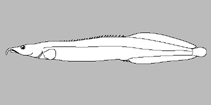 No image available for this species;
drawing shows typical species in Mastacembelidae.
Google Bild
drawing shows typical species in Mastacembelidae.
Klassifizierung / Names Namen | Synonyme | Catalog of Fishes(Gattung, Arten) | ITIS | CoL | WoRMS | Cloffa
> Synbranchiformes (Spiny eels) > Mastacembelidae (Spiny eels)
Etymology: Mastacembelus: Greek, mastax, -agos = bite + Greek, emballo = to throw oneself (Ref. 45335).
Etymology: Mastacembelus: Greek, mastax, -agos = bite + Greek, emballo = to throw oneself (Ref. 45335).
Umwelt: Milieu / Klimazone / Tiefenbereich / Verbreitungsgebiet Ökologie
; süßwasser benthopelagisch. Tropical
Verbreitung Territorien | FAO Gebiete | Ökosysteme | Vorkommen | Punkt Karte | Einführungen | Faunafri
Africa: discontinuous distribution: from Cavally (Liberia-Ivory Coast border) to Sassandra basins (Ivory Coast) and from Bia (Ivory Coast) to Densu River basins (Ghana); also recorded from the inner Niger River delta (Mali) (Ref. 57415).
Größe / Gewicht / Alter
Kurzbeschreibung Bestimmungsschlüssel | Morphologie | Morphometrie
Rückenflossenstacheln (insgesamt) : 24 - 28; Rückenflossenweichstrahlen (insgesamt) : 84 - 103; Afterflossenweichstrahlen: 70 - 91; Wirbelzahl: 88 - 97. Diagnosis: 23+1 up to 27+1 (median 25+1) dorsal spines; distance from anterior border of snout to last externally visible dorsal spine relatively short, 46.2-52.5% SL (m=49.6), increasing with size; distance from posterior edge of pectoral fin to anterior origin of 1st dorsal spine between (-8.1) and 10.4% HL (m=1.0); no pre-orbital or pre-opercular spines; snout with a more blunted appearance; distance from anterior border of snout to last externally visible dorsal spine smaller than distance from anterior border of snout to last externally visible anal spine, which is 51.8-59.3% SL (m=56.3), both decreasing with size; post-anal length 44.3-51.6% SL (m=47.7), smaller than pre-anal length, becoming equal to latter with increasing size, 47.0-53.6% SL (m=51.1); 9-11 caudal fin rays; 5-7 predorsal vertebrae; 34-38 abdominal vertebrae; 3-8 in-between vertebrae; 52-60 caudal vertebrae (Ref. 57415).
Coloration: uniformly light brown overall background colour; dorsal midline with a series of small, dark brown spots; not well contrasted dark brown band originating at base of rostral appendage, passing through eye, above pectoral fin and continuing along lateral side of body and tail; indeed, a battlement pattern delimiting upper edge is still discernable at some places; lower sides of body and tail lighter brown, yellowish, with small, irregularly shaped yellowish white spots; ventral side of head, belly and abdomen uniformly yellowish-white; dorsal, caudal and anal fins white of overall background colour; dorsal and anal fin base with a series of dark brown spots; dorsal fin base brown, diminishing contrast between dorsal-fin base series of dark brown spots with remaining part of dorsal-fin base; dorsal fin with some small, irregularly disposed, dark brown, spots; caudal fin with a vertical, dark brown, bar towards outer margin of fin; nevertheless, caudal fin with a white outermost margin; in addition, unpaired fins quite white of overall general appearance; pectoral fins white of overall background colour with a few dark brown spots; colour pattern changes with size, notably a general darkening of unpaired fins; nevertheless, outermost margin of unpaired fins remains white; in addition, small dark brown spots situated towards distal part of unpaired fins form a more or less continuous band; sometimes, brown spots at base of anal fin may contact dark brown, black band resulting in a series of yellowish, white or light brown spots at base of anal; colour pattern of M. praensis shows close affinity with that of M. nigromarginatus (Ref. 57415).
Body shape (shape guide): eel-like.
Body shape (shape guide): eel-like.
Lebenszyklus und Paarungsverhalten Geschlechtsreife | Fortpflanzung | Ablaichen | Eier | Fruchtbarkeit | Larven
Hauptreferenz
Laden Sie Ihre Referenzen hoch | Referenzen | Koordinator | Partner
Vreven, E.J., 2003. Mastacembelidae. p. 708-737 In C. Lévêque, D. Paugy and G.G. Teugels (eds.) Faune des poissons d'eaux douce et saumâtres de l'Afrique de l'Ouest, Tome 2. Coll. Faune et Flore tropicales 40. Musée Royal de l'Afrique Centrale, Tervuren, Belgique, Museum National d'Histoire Naturalle, Paris, France and Institut de Recherche pour le Développement, Paris, France. 815 p. (Ref. 57415)
IUCN Rote Liste Status (Ref. 130435: Version 2025-2 (Global))
nicht bedroht (LC) ; Date assessed: 30 November 2019
CITES
Not Evaluated
Bedrohung für Menschen
Harmless
Nutzung durch Menschen
FAO - Publication: search | FishSource |
Mehr Information
Trophische Ökologie
Lebensmittel (Beutetiere)
Nahrungszusammensetzung
Nahrungsaufnahme
Lebensmittelrationen
Räuber
Lebensmittel (Beutetiere)
Nahrungszusammensetzung
Nahrungsaufnahme
Lebensmittelrationen
Räuber
Ökologie
Ökologie
Ökologie
Populationsdynamik
Wachstumsparameter
Max. Alter/Größen
Länge-Gewicht-Rel.
Länge-Länge-Verhältnis.
Längenhäufigkeiten
Massenkonvertierung
Rekrutierung
Dichte
Wachstumsparameter
Max. Alter/Größen
Länge-Gewicht-Rel.
Länge-Länge-Verhältnis.
Längenhäufigkeiten
Massenkonvertierung
Rekrutierung
Dichte
Lebenszyklus
Fortpflanzung
Geschlechtsreife
Reifung/Kiemen rel.
Fruchtbarkeit
Ablaichen
Laichaggregationen
Eier
Eientwicklung
Larven
Larven Pop.Dyn.
Fortpflanzung
Geschlechtsreife
Reifung/Kiemen rel.
Fruchtbarkeit
Ablaichen
Laichaggregationen
Eier
Eientwicklung
Larven
Larven Pop.Dyn.
Anatomie
Kiemenoberfläche
Gehirn
Otolith
Kiemenoberfläche
Gehirn
Otolith
Physiologie
Körperliche Zusammensetzung
Nährstoffe
Sauerstoffverbrauch
Schwimmart
Schwimmgeschwindigkeit
Visuelle Pigmente
Fischgeräusche
Krankheiten und Parasiten
Toxizität (LC50s)
Körperliche Zusammensetzung
Nährstoffe
Sauerstoffverbrauch
Schwimmart
Schwimmgeschwindigkeit
Visuelle Pigmente
Fischgeräusche
Krankheiten und Parasiten
Toxizität (LC50s)
Genetik
Genom
Genetik
Heterozygotie
Vererbbarkeit
Genetische Vielfalt
Genom
Genetik
Heterozygotie
Vererbbarkeit
Genetische Vielfalt
Menschenbezogen
Aquakultur-Systeme
Aquakultur Profile
Zuchtlinien
Ciguatera-Fälle
Briefmarken, Münzen, Verschiedenes.
Aquakultur-Systeme
Aquakultur Profile
Zuchtlinien
Ciguatera-Fälle
Briefmarken, Münzen, Verschiedenes.
Tools
E-Book | Feldführer | Bestimmungsschlüssel | Längenhäufigkeits Tool | Lebensdaten Tool | Punkt Karte |
Catch-MSY |
Zusatzinformationen
Download XML
Zusammenfassung | Punktdaten | Namen | Photos
Internet Quellen
AFORO (otoliths) | Aquatic Commons | BHL | Cloffa | Websites from users | FishWatcher Einträge suchen | CISTI | Catalog of Fishes: Gattung, Arten | DiscoverLife | ECOTOX | FAO - Publication: search | Faunafri | Fishipedia | Fishtrace | GloBI | Google Books | Google Scholar | Google | IGFA World Record | OneZoom | Open Tree of Life | Otolith Atlas of Taiwan Fishes | PubMed | Reef Life Survey | Socotra Atlas | TreeBase | Tree of Life | Wikipedia: Gehe zu, Suchen | World Records Freshwater Fishing | Zoologischer Rekord
Schätzungen auf der Grundlage von Modellen
Phylogenetischer Diversitätsindex (Ref. 82804): PD50 = 0.5000 [Uniqueness, from 0.5 = low to 2.0 = high].
Bayesian length-weight: a=0.00269 (0.00129 - 0.00562), b=2.94 (2.76 - 3.12), in cm total length, based on LWR estimates for this (Sub)family-body shape (Ref. 93245).
Trophische Ebene (Ref. 69278): 3.8 ±0.6 se; based on size and trophs of closest relatives
Widerstandsfähigkeit (Ref. 120179): mittel, Verdopplung der Population dauert 1,4 - 4,4 Jahre. (Preliminary K or Fecundity.).