



Waarneming toevoegen in Fish Watcher
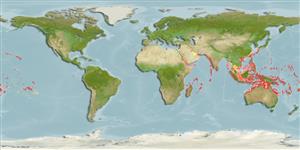
| Native range | All suitable habitat | Point map | Year 2050 |
|
| This map was computer-generated and has not yet been reviewed. |
| Zebrasoma velifer AquaMaps Data sources: GBIF OBIS |
Uploaden van uw Foto's en video's
Afbeeldingen | video's | Postzegels, munten, diversen. | Google afbeelding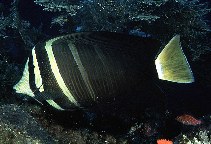 Zebrasoma velifer
Afbeelding van Randall, J.E.
Afbeeldingen | video's | Postzegels, munten, diversen. | Google afbeelding
Afbeelding van Randall, J.E.
Classificatie / Namen Lokale namen | Synoniemen | Catalog of Fishes(Genus, Soort(en)) | ITIS | CoL | WoRMS | Cloffa
> Acanthuriformes (Surgeonfishes) > Acanthuridae (Surgeonfishes, tangs, unicornfishes) > Acanthurinae
Etymology: Zebrasoma: Derived from Zebra = African horse + Greek, soma = body; referring to the stripes (Ref. 45335).
More on author: Bloch.
Etymology: Zebrasoma: Derived from Zebra = African horse + Greek, soma = body; referring to the stripes (Ref. 45335).
More on author: Bloch.
Milieu: milieu / Klimaatzone / Diepte / verspreidingsgebied Ecologie
marien rifbewoner; diepte 0 - 45 m (Ref. 90102), usually 2 - 30 m (Ref. 27115). Tropical; 24°C - 28°C (Ref. 27115); 36°N - 25°S, 33°E - 134°W
Verspreiding Gebieden | FAO regio's | Ecosystemen | Voorkomen | Verspreidingskaart | Introducties | Faunafri
Eastern Indian Ocean to the Pacific Ocean: Christmas Island and most of the East Indian region to South China Sea, Hawaii and Pitcairn Islands; north to Japan and Ogasawara Islands; south to western and eastern Australia; Replaced by Zebrasoma desjardinii in the Indian Ocean.
Grootte / Gewicht / Leeftijd
Maturiteit: Lm ? range ? - ? cm
Max length : 40.0 cm SL mannelijk / geslacht onbekend; (Ref. 9710); max. gerapporteerde leeftijd: 27 Jaren (Ref. 52229)
Max length : 40.0 cm SL mannelijk / geslacht onbekend; (Ref. 9710); max. gerapporteerde leeftijd: 27 Jaren (Ref. 52229)
Korte beschrijving Determinatiesleutels | Morfologie | Morfometrie
Dorsale stekels (totaal) : 4 - 5; Dorsale zachte stralen (totaal) : 29 - 33; Anale stekels: 3; Anale zachte stralen: 23 - 26. Smalls juveniles have alternating yellow and black bars. No brush-like patch of setae posteriorly on side of body. Dorsal fin very elevated, the longest ray 2.1 to 2.5 times in SL (Ref 9808).
Body shape (shape guide): short and / or deep; Cross section: compressed.
Body shape (shape guide): short and / or deep; Cross section: compressed.
Benthopelagic (Ref. 58302). Occurs in lagoon and seaward reefs from the lower surge zone to a depth of at least 30 m. Solitary juveniles found among rocks or coral (Ref. 58534) of shallow protected, sometimes turbid reefs (Ref. 1602, 48637). Feeds on leafy macroalgae. It possesses, fewer and larger pharyngeal teeth, compared to the other Zebrasoma spp. (Ref. 33204). Diurnal species (Ref. 113699:32); courtship and spawning takes place from morning to afternoon and is often confined to ebb tides (Ref. 38697). The species is never poisonous (Ref. 4795). Minimum depth reported taken from Ref. 128797.
Levenscyclus en paargedrag Maturiteit | Voortplanting | Paaien | Eieren | Fecunditeit | Larven
Paired spawning (Ref. 240).
Hoofdreferentie
Upload uw referenties | Referenties | Coördinator : Randall, John E. | Medewerkers
Myers, R.F., 1999. Micronesian reef fishes: a comprehensive guide to the coral reef fishes of Micronesia, 3rd revised and expanded edition. Coral Graphics, Barrigada, Guam. 330 p. (Ref. 37816)
Status op de Rode Lijst van het IUCN (Ref. 130435: Version 2025-2 (Global))
Niet bedreigd (LC) ; Date assessed: 07 May 2010
CITES
Not Evaluated
Gevaar voor de mens
Harmless
Gebruik door de mens
Visserij: van minder commercieel belang; Aquarium: Commercieel
FAO - Publication: search | FishSource | Sea Around Us
Meer informatie
Trofische ecologie
Voedsel (prooien)
Dieetsamenstelling
Voedselconsumptie
Voedselrantsoenen
Predatoren
Voedsel (prooien)
Dieetsamenstelling
Voedselconsumptie
Voedselrantsoenen
Predatoren
Populatiedynamica
Groeiparameters
Max. leeftijden / maten
Lengte-gewicht rel.
Lengte-lengte rel.
Lengtefrequenties
Massaconversie
Rekrutering
Abundantie
Groeiparameters
Max. leeftijden / maten
Lengte-gewicht rel.
Lengte-lengte rel.
Lengtefrequenties
Massaconversie
Rekrutering
Abundantie
Levenscyclus
Voortplanting
Maturiteit
Rijpheid/kieuwen rel.
Fecunditeit
Paaien
Paaibestanden
Eieren
Ontwikkeling van de eieren
Larven
Larvale populatiedynamiek
Voortplanting
Maturiteit
Rijpheid/kieuwen rel.
Fecunditeit
Paaien
Paaibestanden
Eieren
Ontwikkeling van de eieren
Larven
Larvale populatiedynamiek
Fysiologie
Lichaamssamenstelling
Voedingsstoffen
Zuurstofverbruik
Type zwemmen
Zwemsnelheid
Visuele pigmenten
Vis geluid
Ziekten en parasieten
Toxiciteit (LC50)
Lichaamssamenstelling
Voedingsstoffen
Zuurstofverbruik
Type zwemmen
Zwemsnelheid
Visuele pigmenten
Vis geluid
Ziekten en parasieten
Toxiciteit (LC50)
Genetica
genoom
Genetica
Heterozygositeit
Erfelijkheid
Genetische diversiteit
genoom
Genetica
Heterozygositeit
Erfelijkheid
Genetische diversiteit
Menselijk gerelateerd
Aquacultuursystemen
Aquacultuurprofielen
Kweeklijnen
Ciguatera gevallen
Postzegels, munten, diversen.
Aquacultuursystemen
Aquacultuurprofielen
Kweeklijnen
Ciguatera gevallen
Postzegels, munten, diversen.
Tools
Biologische quiz | E-boek | Veldgids | Determinatiesleutels | Lengtefrequentie Tool | Levenscyclus tool | Verspreidingskaart |
Vangst-MSY |
Speciale rapporten
Bekijk gegevens voor het houden in een aquarium | Bekijk Fact Sheets voor de soort | Bekijk Aquacultuur Fact Sheets
Download XML
Internetbronnen
AFORO (otoliths) | Exoten/Invasieve soorten database | Aquatic Commons | BHL | Cloffa | Websites from users | Bekijk FishWatcher | CISTI | Catalog of Fishes: Genus, Soort(en) | DiscoverLife | ECOTOX | FAO - Publication: search | Faunafri | Fishipedia | Fishtrace | GloBI | Google Books | Google Scholar | Google | IGFA World Record | Nationale databanken | OneZoom | Open Tree of Life | Otolith Atlas of Taiwan Fishes | Publieke aquaria | PubMed | Reef Life Survey | Socotra Atlas | TreeBase | Tree of Life | Wikipedia: ga naar, zoek | World Records Freshwater Fishing | Zoological Record
Schattingen op basis van modellen
|
Fylogenetische diversiteitsindex (Ref. 82804) |
PD50 = 0.5078 [Uniqueness, from 0.5 = low to 2.0 = high]. |
| Bayesian length-weight | a=0.02570 (0.01649 - 0.04006), b=2.93 (2.80 - 3.06), in cm total length, based on LWR estimates for this species & (Sub)family-body (Ref. 93245). |
|
Trofisch niveau (Ref. 69278) |
2.0 ±0.00 se; based on food items. |
| Generation time | 3.9 ( na - na) years. Estimated as median ln(3)/K based on 1 growth studies. |
|
Weerstandsvermogen (Ref. 120179) |
laag, minimale populatieverdubbelingstijd 4,5-14 jaar (K=0.282; tmax=27). |
|
Kwetsbaarheid van de visserij (Ref. 59153) |
Moderate vulnerability (37 of 100). 🛈 |
|
Prijsklasse (Ref. 80766) |
Medium. |
|
Voedingsstoffen (Ref. 124155) |
Calcium = 30.7 [14.1, 91.0] mg/100g; Iron = 0.723 [0.256, 1.679] mg/100g; Protein = 18.1 [16.8, 19.4] %; Omega3 = 0.131 [0.063, 0.270] g/100g; Selenium = 14.2 [5.0, 55.8] μg/100g; VitaminA = 42.1 [9.4, 172.9] μg/100g; Zinc = 1.83 [0.83, 3.21] mg/100g (wet weight); |