



Scomberomorus maculatus (Mitchill, 1815)
Atlantic Spanish mackerel
Waarneming toevoegen in Fish Watcher
| Native range | All suitable habitat | Point map | Year 2050 |

|
| This map was computer-generated and has not yet been reviewed. |
| Scomberomorus maculatus AquaMaps Data sources: GBIF OBIS |
Uploaden van uw Foto's en video's
Afbeeldingen | Google afbeelding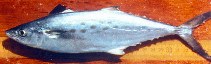 Scomberomorus maculatus
Afbeelding van Wiggers, R.
Afbeeldingen | Google afbeelding
Afbeelding van Wiggers, R.
Classificatie / Namen Lokale namen | Synoniemen | Catalog of Fishes(Genus, Soort(en)) | ITIS | CoL | WoRMS | Cloffa
> Scombriformes (Mackerels) > Scombridae (Mackerels, tunas, bonitos) > Scombrinae
Etymology: Scomberomorus: Latin, scomber = mackerel + Greek, moros = silly, stupid (Ref. 45335).
More on author: Mitchill.
Etymology: Scomberomorus: Latin, scomber = mackerel + Greek, moros = silly, stupid (Ref. 45335).
More on author: Mitchill.
Milieu: milieu / Klimaatzone / Diepte / verspreidingsgebied Ecologie
marien pelagic-neritic; oceanodroom (Ref. 51243); diepte 10 - 35 m (Ref. 26912). Subtropical; 20°C - 30°C (Ref. 54882); 44°N - 19°N, 97°W - 64°W (Ref. 54882)
Verspreiding Gebieden | FAO regio's | Ecosystemen | Voorkomen | Verspreidingskaart | Introducties | Faunafri
Western Atlantic: Canada (Ref. 5951) to Cape Cod to Miami (USA) and Gulf of Mexico coasts from Florida, USA to Yucatan, Mexico. Three species namely: Scomberomorus tritor in eastern Atlantic, Scomberomorus sierra in eastern Pacific, and Scomberomorus brasiliensis in the Caribbean and Atlantic coast of South America have often been confused with this species. Absent in the Bahamas (Ref. 26938).
Lengte bij maturiteit / Grootte / Gewicht / Leeftijd
Maturiteit: Lm 40.5, range 25 - 51.2 cm
Max length : 91.0 cm FL mannelijk / geslacht onbekend; (Ref. 40637); max. gepubliceerd gewicht: 5.9 kg (Ref. 40637); max. gerapporteerde leeftijd: 5 Jaren (Ref. 72462)
Max length : 91.0 cm FL mannelijk / geslacht onbekend; (Ref. 40637); max. gepubliceerd gewicht: 5.9 kg (Ref. 40637); max. gerapporteerde leeftijd: 5 Jaren (Ref. 72462)
Korte beschrijving Determinatiesleutels | Morfologie | Morfometrie
Dorsale stekels (totaal) : 17 - 19; Dorsale zachte stralen (totaal) : 17 - 20; Anale zachte stralen: 17 - 20; Wervels: 51 - 53. Interpelvic process small and bifid. Lateral line gradually curving down toward caudal peduncle. Vertebrae 21-22 precaudal plus 30-31 caudal, total 51-53. Intestine with 2 folds and 3 limbs. Swim bladder absent. Body covered with small scales. First dorsal fin black anteriorly and at distal margin posteriorly. Generally silvery with sides marked with about three rows of round to elliptical dark spots (orange in life).
Body shape (shape guide): fusiform / normal; Cross section: oval.
Body shape (shape guide): fusiform / normal; Cross section: oval.
Migrates in large schools over great distances along the shore. Larvae are found in surface waters between 19.6° and 29.8°C with salinities of 28.3 to 37.4 ppt. Feeds mainly on small fishes (clupeoids and anchovies), few quantities of penaeoid shrimps and cephalopods. Casting, live-bait fishing, jigging, and drift fishing are also employed in capturing this species. Aerial spotting is sometimes used in locating the fish. Marketed fresh, frozen or smoked; eaten pan-fried, broiled and baked.
Levenscyclus en paargedrag Maturiteit | Voortplanting | Paaien | Eieren | Fecunditeit | Larven
Hoofdreferentie
Upload uw referenties | Referenties | Coördinator : Collette, Bruce B. | Medewerkers
Collette, B.B. and C.E. Nauen, 1983. FAO Species Catalogue. Vol. 2. Scombrids of the world. An annotated and illustrated catalogue of tunas, mackerels, bonitos and related species known to date. Rome: FAO. FAO Fish. Synop. 125(2):137 p. (Ref. 168)
Status op de Rode Lijst van het IUCN (Ref. 130435: Version 2025-2 (Global))
Niet bedreigd (LC) ; Date assessed: 10 November 2022
CITES
Not Evaluated
Gevaar voor de mens
Reports of ciguatera poisoning (Ref. 31172)
Gebruik door de mens
Visserij: van groot commercieel belang; sportvis: ja
FAO - visserij: aanvoer, soortsprofiel; Publication: search | FishSource | Sea Around Us
Meer informatie
Trofische ecologie
Voedsel (prooien)
Dieetsamenstelling
Voedselconsumptie
Voedselrantsoenen
Predatoren
Voedsel (prooien)
Dieetsamenstelling
Voedselconsumptie
Voedselrantsoenen
Predatoren
Populatiedynamica
Groeiparameters
Max. leeftijden / maten
Lengte-gewicht rel.
Lengte-lengte rel.
Lengtefrequenties
Massaconversie
Rekrutering
Abundantie
Groeiparameters
Max. leeftijden / maten
Lengte-gewicht rel.
Lengte-lengte rel.
Lengtefrequenties
Massaconversie
Rekrutering
Abundantie
Levenscyclus
Voortplanting
Maturiteit
Rijpheid/kieuwen rel.
Fecunditeit
Paaien
Paaibestanden
Eieren
Ontwikkeling van de eieren
Larven
Larvale populatiedynamiek
Voortplanting
Maturiteit
Rijpheid/kieuwen rel.
Fecunditeit
Paaien
Paaibestanden
Eieren
Ontwikkeling van de eieren
Larven
Larvale populatiedynamiek
Fysiologie
Lichaamssamenstelling
Voedingsstoffen
Zuurstofverbruik
Type zwemmen
Zwemsnelheid
Visuele pigmenten
Vis geluid
Ziekten en parasieten
Toxiciteit (LC50)
Lichaamssamenstelling
Voedingsstoffen
Zuurstofverbruik
Type zwemmen
Zwemsnelheid
Visuele pigmenten
Vis geluid
Ziekten en parasieten
Toxiciteit (LC50)
Menselijk gerelateerd
Aquacultuursystemen
Aquacultuurprofielen
Kweeklijnen
Ciguatera gevallen
Postzegels, munten, diversen.
Aquacultuursystemen
Aquacultuurprofielen
Kweeklijnen
Ciguatera gevallen
Postzegels, munten, diversen.
Tools
E-boek | Veldgids | Determinatiesleutels | Lengtefrequentie Tool | Levenscyclus tool | Verspreidingskaart |
Vangst-MSY |
Speciale rapporten
Bekijk gegevens voor het houden in een aquarium | Bekijk Fact Sheets voor de soort | Bekijk Aquacultuur Fact Sheets
Download XML
Internetbronnen
AFORO (otoliths) | Aquatic Commons | BHL | Cloffa | Websites from users | Bekijk FishWatcher | CISTI | Catalog of Fishes: Genus, Soort(en) | DiscoverLife | ECOTOX | FAO - visserij: aanvoer, soortsprofiel; Publication: search | Faunafri | Fishipedia | Fishtrace | GloBI | GoMexSI (interaction data) | Google Books | Google Scholar | Google | IGFA World Record | OceanAdapt | OneZoom | Open Tree of Life | Otolith Atlas of Taiwan Fishes | PubMed | Reef Life Survey | Socotra Atlas | TreeBase | Tree of Life | Wikipedia: ga naar, zoek | World Records Freshwater Fishing | Zoological Record
Schattingen op basis van modellen
Gewenste temperatuur (Ref. 123201): 22.9 - 26.8, mean 24.1 °C (based on 132 cells).
Fylogenetische diversiteitsindex (Ref. 82804): PD50 = 0.5000 [Uniqueness, from 0.5 = low to 2.0 = high].
Bayesian length-weight: a=0.00776 (0.00636 - 0.00948), b=3.03 (2.99 - 3.07), in cm total length, based on LWR estimates for this species (Ref. 93245).
Trofisch niveau (Ref. 69278): 4.5 ±0.5 se; based on diet studies.
Generation time: 3.3 (2.4 - 5.5) years. Estimated as median ln(3)/K based on 11 growth studies.
Weerstandsvermogen (Ref. 120179): Gemiddeld, minimale populatieverdubbelingstijd 1,4-4,4 jaar (K=0.2-0.38; tm=2-3; Fec=280,000).
Prior r = 0.48, 95% CL = 0.32 - 0.72, Based on 2 full stock assessments.
Voedingsstoffen (Ref. 124155): Calcium = 21.4 [8.9, 76.1] mg/100g; Iron = 0.795 [0.336, 1.892] mg/100g; Protein = 21.3 [20.0, 22.6] %; Omega3 = 0.362 [0.222, 0.615] g/100g; Selenium = 20.7 [7.1, 67.3] μg/100g; VitaminA = 17.7 [3.8, 87.6] μg/100g; Zinc = 0.468 [0.294, 0.797] mg/100g (wet weight);