



Sphoeroides spengleri (Bloch, 1785)
Bandtail puffer
Beobachtung melden im Fish Watcher
| Native range | All suitable habitat | Point map | Year 2050 |

|
| This map was computer-generated and has not yet been reviewed. |
| Sphoeroides spengleri AquaMaps Data sources: GBIF OBIS |
Klassifizierung / Names Namen | Synonyme | Catalog of Fishes(Gattung, Arten) | ITIS | CoL | WoRMS | Cloffa
> Tetraodontiformes (Puffers and filefishes) > Tetraodontidae (Puffers) > Tetraodontinae
Etymology: Sphoeroides: Greek, sphaira = ball + Greek, suffix, oides = similar to (Ref. 45335).
Eponymy: Lorentz Spengler (1720–1807) was a zoologist employed by Det Kongelige Danske Kunstkammer, Copenhagen, as Assistant to the Keeper (1765). [...] (Ref. 128868), visit book page.
More on author: Bloch.
Etymology: Sphoeroides: Greek, sphaira = ball + Greek, suffix, oides = similar to (Ref. 45335).
Eponymy: Lorentz Spengler (1720–1807) was a zoologist employed by Det Kongelige Danske Kunstkammer, Copenhagen, as Assistant to the Keeper (1765). [...] (Ref. 128868), visit book page.
More on author: Bloch.
Umwelt: Milieu / Klimazone / Tiefenbereich / Verbreitungsgebiet Ökologie
seewasser; brackwasser riff-verbunden; tiefenbereich 2 - 70 m (Ref. 26999). Subtropical; 43°N - 30°S, 98°W - 34°W
Verbreitung Territorien | FAO Gebiete | Ökosysteme | Vorkommen | Punkt Karte | Einführungen | Faunafri
Western Atlantic: Massachusetts, USA to Santa Catarina, Brazil (Ref. 57756). Replaced by Sphoeroides marmoratus in the eastern Atlantic (P. Wirtz, pers. comm. 10/04).
Größe / Gewicht / Alter
Geschlechtsreife: Lm ? range ? - ? cm
Max length : 30.0 cm TL Männchen/unbestimmt; (Ref. 26999); common length : 12.0 cm TL Männchen/unbestimmt; (Ref. 3821)
Max length : 30.0 cm TL Männchen/unbestimmt; (Ref. 26999); common length : 12.0 cm TL Männchen/unbestimmt; (Ref. 3821)
Kurzbeschreibung Bestimmungsschlüssel | Morphologie | Morphometrie
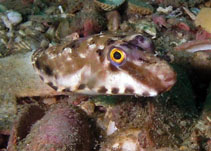
Rückenflossenweichstrahlen (insgesamt) : 9. 11-14 sharply defined round black spots on head and lower side of body. The numerous tan lappers on the rear part of the body and distinct spots along the lower side make it unmistakable (Ref. 26938).
Body shape (shape guide): fusiform / normal.
Body shape (shape guide): fusiform / normal.
Abundant in all inshore habitats where there is adequate cover, such as seagrass beds and reef flats. Feeds on mollusks, crustaceans and echinoderms (Ref. 36453), also on worms and zooplankton larvae (Ref. 131040). Generally common (Ref. 9710). Traded as an aquarium fish at Ceará, Brazil (Ref. 49392).
Lebenszyklus und Paarungsverhalten Geschlechtsreife | Fortpflanzung | Ablaichen | Eier | Fruchtbarkeit | Larven
Oviparous (Ref. 101750).
Hauptreferenz
Laden Sie Ihre Referenzen hoch | Referenzen | Koordinator : Matsuura, Keiichi | Partner
Robins, C.R. and G.C. Ray, 1986. A field guide to Atlantic coast fishes of North America. Houghton Mifflin Company, Boston, U.S.A. 354 p. (Ref. 7251)
IUCN Rote Liste Status (Ref. 130435: Version 2025-2 (Global))
nicht bedroht (LC) ; Date assessed: 07 June 2011
CITES
Not Evaluated
Bedrohung für Menschen
Poisonous to eat (Ref. 3821)
Nutzung durch Menschen
Fischereien: kommerziell; Aquarium: Kommerziell
FAO - Publication: search | FishSource |
Mehr Information
Trophische Ökologie
Lebensmittel (Beutetiere)
Nahrungszusammensetzung
Nahrungsaufnahme
Lebensmittelrationen
Räuber
Lebensmittel (Beutetiere)
Nahrungszusammensetzung
Nahrungsaufnahme
Lebensmittelrationen
Räuber
Populationsdynamik
Wachstumsparameter
Max. Alter/Größen
Länge-Gewicht-Rel.
Länge-Länge-Verhältnis.
Längenhäufigkeiten
Massenkonvertierung
Rekrutierung
Dichte
Wachstumsparameter
Max. Alter/Größen
Länge-Gewicht-Rel.
Länge-Länge-Verhältnis.
Längenhäufigkeiten
Massenkonvertierung
Rekrutierung
Dichte
Lebenszyklus
Fortpflanzung
Geschlechtsreife
Reifung/Kiemen rel.
Fruchtbarkeit
Ablaichen
Laichaggregationen
Eier
Eientwicklung
Larven
Larven Pop.Dyn.
Fortpflanzung
Geschlechtsreife
Reifung/Kiemen rel.
Fruchtbarkeit
Ablaichen
Laichaggregationen
Eier
Eientwicklung
Larven
Larven Pop.Dyn.
Anatomie
Kiemenoberfläche
Gehirn
Otolith
Kiemenoberfläche
Gehirn
Otolith
Physiologie
Körperliche Zusammensetzung
Nährstoffe
Sauerstoffverbrauch
Schwimmart
Schwimmgeschwindigkeit
Visuelle Pigmente
Fischgeräusche
Krankheiten und Parasiten
Toxizität (LC50s)
Körperliche Zusammensetzung
Nährstoffe
Sauerstoffverbrauch
Schwimmart
Schwimmgeschwindigkeit
Visuelle Pigmente
Fischgeräusche
Krankheiten und Parasiten
Toxizität (LC50s)
Menschenbezogen
Aquakultur-Systeme
Aquakultur Profile
Zuchtlinien
Ciguatera-Fälle
Briefmarken, Münzen, Verschiedenes.
Aquakultur-Systeme
Aquakultur Profile
Zuchtlinien
Ciguatera-Fälle
Briefmarken, Münzen, Verschiedenes.
Tools
E-Book | Feldführer | Bestimmungsschlüssel | Längenhäufigkeits Tool | Lebensdaten Tool | Punkt Karte |
Catch-MSY |
Zusatzinformationen
Download XML
Zusammenfassung | Punktdaten | Namen | Photos
Internet Quellen
AFORO (otoliths) | Aquatic Commons | BHL | Cloffa | Websites from users | FishWatcher Einträge suchen | CISTI | Catalog of Fishes: Gattung, Arten | DiscoverLife | DORIS | ECOTOX | FAO - Publication: search | Faunafri | Fishipedia | Fishtrace | GloBI | GoMexSI (interaction data) | Google Books | Google Scholar | Google | IGFA World Record | Nationale Datenbanken | OceanAdapt | OneZoom | Open Tree of Life | Otolith Atlas of Taiwan Fishes | Öffentliche Aquarien | PubMed | Reef Life Survey | Socotra Atlas | TreeBase | Tree of Life | Wikipedia: Gehe zu, Suchen | | Zoologischer Rekord
Schätzungen auf der Grundlage von Modellen
|
Phylogenetischer Diversitätsindex (Ref. 82804) |
PD50 = 0.5000 [Uniqueness, from 0.5 = low to 2.0 = high]. |
| Bayesian length-weight | a=0.01738 (0.01361 - 0.02219), b=2.90 (2.83 - 2.97), in cm total length, based on LWR estimates for this species (Ref. 93245). |
|
Trophische Ebene (Ref. 69278) |
3.3 ±0.2 se; based on diet studies. |
|
Widerstandsfähigkeit (Ref. 120179) |
hoch, Verdopplung der Population dauert weniger als 15 Monate. (Preliminary K or Fecundity.). |
|
Anfälligkeit der Fischerei (Ref. 59153) |
Low vulnerability (25 of 100). 🛈 |
|
Nährstoffe (Ref. 124155) |
Calcium = 32.6 [10.8, 107.5] mg/100g; Iron = 0.68 [0.34, 1.43] mg/100g; Protein = 19.7 [17.5, 21.9] %; Omega3 = 0.262 [0.123, 0.509] g/100g; Selenium = 15.9 [7.1, 34.3] μg/100g; VitaminA = 42.4 [13.0, 139.6] μg/100g; Zinc = 0.993 [0.654, 1.519] mg/100g (wet weight); |