



Enteromius pallidus (Smith, 1841)
Goldie barb
Tải lên của bạn hình ảnh Và Video
Các tranh (Ảnh) | Google image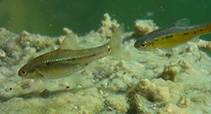 Enteromius pallidus
Hình ảnh của van Zyl, P.E.
Các tranh (Ảnh) | Google image
Hình ảnh của van Zyl, P.E.
Phân loại / Tên Tên thường gặp | Các synonym ( Các tên trùng) | Catalog of Fishes(Giống, Các loài) | ITIS | CoL | WoRMS | Cloffa
> Cypriniformes (Carps) > Cyprinidae (Minnows or carps) > Smiliogastrinae
Etymology: Enteromius: Greek, enteron = intestine + Greek, myo, mys = muscle (Ref. 45335).
Etymology: Enteromius: Greek, enteron = intestine + Greek, myo, mys = muscle (Ref. 45335).
Môi trường: môi trường / vùng khí hậu / Mức độ sâu / phạm vi phân phối Sinh thái học
; nước ngọt sống nổi và đáy. Subtropical; 24°S - 33°S
Sự phân bố Lãnh thổ | Các khu vực của FAO | Các hệ sinh thái | Những lần xuất hiện | Bản đồ điểm | Những chỉ dẫn | Faunafri
Africa: endemic to the eastern Cape Fold Ecoregion in South Africa, where it is distributed from the Krom to the Great Fish river system (Ref. 52193, 122070). Specimens identified as Enteromius pallidus from tributaries of the Orange-Vaal, Tugela, Mfolozi, Pongolo, Incomati and Limpopo rivers (Ref. 7248, 13332) are not related and should be treated as misidentifications (Ref. 122070).
Chiều dài lúc trưởng thành đầu tiên / Bộ gần gũi / Khối lượng (Trọng lượng) / Tuổi
Chín muồi sinh dục: Lm ?, range 4 - ? cm
Max length : 7.0 cm SL con đực/không giới tính; (Ref. 52193)
Max length : 7.0 cm SL con đực/không giới tính; (Ref. 52193)
Mô tả ngắn gọn Khóa để định loại | Hình thái học | Sinh trắc học
Các tia vây lưng cứng (tổng cộng) : 0; Các vây lưng mềm (tổng cộng) : 10; Tia cứng vây hậu môn: 0; Tia mềm vây hậu môn: 8. Diagnosis: Enteromius pallidus can be identified by the slightly convex dorsal surface; posterior barbel 2.0 to 3.0 times the length of anterior barbel; a slightly prominent snout; an incomplete lateral line; deep translucent light brown to golden sheen with the presence of irregular and scattered spots in mature adults; and the presence of 3-7 bold spots above the lateral line in juveniles and subadults (Ref. 122070). This species belongs to the group of Enteromius species in southern Africa that is characterised by a simple and flexible unbranched primary dorsal fin ray (Ref. 122070). It is distinguished from E. amatolicus, E. anoplus, E. annectens, E. toppini and E. radiatus by possession of two pairs of prominent and long barbels vs. single pair and/or minute oral barbels in other species; it is distinguished from E. lineomaculatus, E. viviparus and E. unitaeniatus by absence of distinct chevron markings on the lateral line vs. presence of conspicuous chevron markings on the lateral line in the other three species, and from E. bifrenatus by absence of a distinct lateral stripe and absence of black tubular markings around lateral line pores vs. presence in E. bifrenatus; it is distinguished from E. anoplus, E. amatolicus, E. annectens, E. unitaeniatus, E. bifrenatus, E. gurneyi, E. motebensis, E. radiatus, E. toppini, E. treurensis and E. viviparus by the presence of scattered black spots on the body, particularly in juveniles vs. absence of scattered black spots in the other species (Ref. 122070). Lateral pigmentation pattern of E. pallidus is closely similar to that of E. brevipinnis and E. neefi, but it is distinguished from these two species by having an incomplete lateral line vs. complete lateral line in both E. neefi and E. brevipinnis; it is further separated from E. neefi by absence of wavy lines along the scale rows vs. presence of conspicuous wavy lines along the scale rows in E. neefi, and from E. brevipinnis by lack of black pigmentation around the borders of the scales vs. presence of distinct black pigmentation around the scales in E. brevipinnis, giving a mesh-like pattern on the lateral side of the fish (Ref. 122070).
Body shape (shape guide): fusiform / normal; Cross section: compressed.
Body shape (shape guide): fusiform / normal; Cross section: compressed.
Inhabits pools in clear, rocky streams often streams with emergent marginal vegetation (Ref. 7248, 52193). Spawning is likely to begin in summer, from October to November (Ref. 122070); breeding pairs lay eggs in vegetation (Ref. 7248, 52193).
Vòng đời và hành vi giao phối Chín muồi sinh dục | Sự tái sinh sản | Đẻ trứng | Các trứng | Sự sinh sản | Ấu trùng
Tài liệu tham khảo chính
Tải lên tài liệu tham khảo của bạn | Các tài liệu tham khảo | Người điều phối | Người cộng tác
Skelton, P.H., 2001. A complete guide to the freshwater fishes of southern Africa. Cape Town (South Africa): Struik Publishers, 395 p. (Ref. 52193)
Tình trạng Sách đỏ IUCN (Ref. 130435: Version 2025-2 (Global))
Least Concern (LC) ; Date assessed: 05 February 2018
CITES
Not Evaluated
Mối đe dọa đối với con người
Harmless
Sử dụng của con người
Các nghề cá: tính thương mại; Bể nuôi cá: Tính thương mại
FAO - Publication: search | FishSource |
Thêm thông tin
Sinh thái dinh dưỡng
Thức ăn (con mồi)
Thành phần thức ăn
Thành phần thức ăn
Khẩu phần ăn
Các động vật ăn mồi
Thức ăn (con mồi)
Thành phần thức ăn
Thành phần thức ăn
Khẩu phần ăn
Các động vật ăn mồi
Sinh thái học
Sinh thái học
Sinh thái học
Biến động dân số
Các thông số tăng trưởng
Độ tuổi / kích thước tối đa
Chiều dài-trọng lượng tương đối
Chiều dài-chiều dài tương đối.
Chiều dài-tần số
Chuyển đổi khối lượng
Bổ xung
Sự phong phú
Các thông số tăng trưởng
Độ tuổi / kích thước tối đa
Chiều dài-trọng lượng tương đối
Chiều dài-chiều dài tương đối.
Chiều dài-tần số
Chuyển đổi khối lượng
Bổ xung
Sự phong phú
Vòng đời
Sự tái sinh sản
Chín muồi sinh dục
Độ trưởng thành/Mang liên quan
Sự sinh sản
Đẻ trứng
Tập hợp sinh sản
Các trứng
Sự phát triển của trứng
Ấu trùng
Sự biến động ấu trùng
Sự tái sinh sản
Chín muồi sinh dục
Độ trưởng thành/Mang liên quan
Sự sinh sản
Đẻ trứng
Tập hợp sinh sản
Các trứng
Sự phát triển của trứng
Ấu trùng
Sự biến động ấu trùng
Sự phân bố
Lãnh thổ
Các khu vực của FAO
Các hệ sinh thái
Những lần xuất hiện
Những chỉ dẫn
BRUVS - Video
Lãnh thổ
Các khu vực của FAO
Các hệ sinh thái
Những lần xuất hiện
Những chỉ dẫn
BRUVS - Video
Giải phẫu
Vùng mang
Não
sỏi tai
Vùng mang
Não
sỏi tai
Sinh lý học
Thành phần cơ thể
Chất dinh dưỡng
Thành phần ô-xy
Kiểu bơi
Tốc độ bơi
Sắc tố thị giác
Tiếng cá
Bệnh tật & Ký sinh trùng
Độc tính (LC50)
Thành phần cơ thể
Chất dinh dưỡng
Thành phần ô-xy
Kiểu bơi
Tốc độ bơi
Sắc tố thị giác
Tiếng cá
Bệnh tật & Ký sinh trùng
Độc tính (LC50)
Di truyền
Bộ gen
Di truyền
Sự dị hợp tử
Di sản
Đa dạng di truyền
Bộ gen
Di truyền
Sự dị hợp tử
Di sản
Đa dạng di truyền
Liên quan đến con người
Hệ thống nuôi trồng thủy sản
Các tổng quan nuôi trồng thủy sản
Các giống
Các trường hợp ngộ độc Ciguatera
Tem, tiền xu, v.v.
Hệ thống nuôi trồng thủy sản
Các tổng quan nuôi trồng thủy sản
Các giống
Các trường hợp ngộ độc Ciguatera
Tem, tiền xu, v.v.
Các công cụ
Sách điện tử | Hướng dẫn hiện trường | Khóa để định loại | Tần suất chiều dài Wizard | Công cụ của vòng đời | Bản đồ điểm |
Bắt-MSY |
Báo cáo đặc biệt
Kiểm tra bảo trì bể cá | Kiểm tra các tờ thông tin về loài | Kiểm tra các tờ thông tin về nuôi trồng thủy sản
Tải xuống XML
Các nguồn internet
AFORO (otoliths) | Aquatic Commons | BHL | Cloffa | Websites from users | Check FishWatcher | CISTI | Catalog of Fishes: Giống, Các loài | DiscoverLife | ECOTOX | FAO - Publication: search | Faunafri | Fishipedia | Fishtrace | GloBI | Google Books | Google Scholar | Google | IGFA World Record | OneZoom | Open Tree of Life | Otolith Atlas of Taiwan Fishes | PubMed | Reef Life Survey | Socotra Atlas | TreeBase | Cây Đời sống | Wikipedia: Go, tìm | World Records Freshwater Fishing | Tạp chí Zoological Record
Ước tính dựa trên mô hình
Chỉ số đa dạng phát sinh loài (Tài liệu tham khảo 82804): PD50 = 0.5000 [Uniqueness, from 0.5 = low to 2.0 = high].
Bayesian length-weight: a=0.00603 (0.00282 - 0.01286), b=3.06 (2.87 - 3.25), in cm total length, based on LWR estimates for this (Sub)family-body shape (Ref. 93245).
Mức dinh dưỡng (Tài liệu tham khảo 69278): 3.0 ±0.3 se; based on size and trophs of closest relatives
Thích nghi nhanh (Tài liệu tham khảo 120179): Chiêù cao, thời gian nhân đôi của chủng quần tối thiểu là dưới 15 tháng (Preliminary K or Fecundity.).