



Nemacheilus masyae Smith, 1933
Arrow loach
Hochladen Photos und videos
Bilder | Google Bild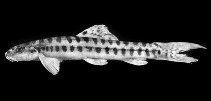 Nemacheilus masyae
Photo von Ott, G.
Bilder | Google Bild
Photo von Ott, G.
Klassifizierung / Names Namen | Synonyme | Catalog of Fishes(Gattung, Arten) | ITIS | CoL | WoRMS | Cloffa
> Cypriniformes (Carps) > Nemacheilidae (Brook loaches)
Etymology: Nemacheilus: Greek, nema, -atos = filament + Greek, cheilos = lip (Ref. 45335); masyae: Named for a man.
Eponymy: Luang Masya Chitrakarn (1896–1965), also known as Prasop Teeranunt, was a Thai ichthyologist and illustrator of fishes, renowned for his skill with both brush and pen who worked for the Siamese Department of Fisheries. [...] (Ref. 128868), visit book page.
More on author: Smith.
Etymology: Nemacheilus: Greek, nema, -atos = filament + Greek, cheilos = lip (Ref. 45335); masyae: Named for a man.
Eponymy: Luang Masya Chitrakarn (1896–1965), also known as Prasop Teeranunt, was a Thai ichthyologist and illustrator of fishes, renowned for his skill with both brush and pen who worked for the Siamese Department of Fisheries. [...] (Ref. 128868), visit book page.
More on author: Smith.
Umwelt: Milieu / Klimazone / Tiefenbereich / Verbreitungsgebiet Ökologie
; süßwasser benthopelagisch. Tropical
Verbreitung Territorien | FAO Gebiete | Ökosysteme | Vorkommen | Punkt Karte | Einführungen | Faunafri
Asia: western Malaysia, Peninsular Thailand, the Meklong and part of the Mae Nam Chao Phraya basins (Ref. 39226). Likely to occur in the Mekong basin (Ref. 12693).
Größe / Gewicht / Alter
Kurzbeschreibung Bestimmungsschlüssel | Morphologie | Morphometrie
Rückenflossenweichstrahlen (insgesamt) : 13; Afterflossenweichstrahlen: 8. Distinguished from all other species of nemacheilines in Indochinese area by its color pattern consisting of a light background with 14-18 dark blotches along sides and 12-17 dark saddles along the back, a black spot at posterior extremity of lateral line and a black spot on anterior dorsal rays at about one fourth of ray length. From the closely related N. pallidus, it is distinguished by a slender body (body depth 12.6-17.6% SL versus 14.8-19.1), eye situated more on the top of head (interorbital width 4.9-6.8% SL, versus 5.7-8.0; and darker and wider markings (spots and saddles usually wider than interspaces, versus thinner).
Body shape (shape guide): eel-like.
Body shape (shape guide): eel-like.
Inhabits shallow depths of 2 m or less in rivers and streams with moderate current and muddy to sandy bottoms (Ref. 12693). Occurs in forest streams flowing clear and slightly black waters, as well as in turbid waters (Ref. 39226). Feeds on insect larvae and aquatic invertebrates (Ref. 39226).
Lebenszyklus und Paarungsverhalten Geschlechtsreife | Fortpflanzung | Ablaichen | Eier | Fruchtbarkeit | Larven
Hauptreferenz
Laden Sie Ihre Referenzen hoch | Referenzen | Koordinator | Partner
Rainboth, W.J., 1996. Fishes of the Cambodian Mekong. FAO species identification field guide for fishery purposes. FAO, Rome, 265 p. (Ref. 12693)
IUCN Rote Liste Status (Ref. 130435: Version 2025-2 (Global))
nicht bedroht (LC) ; Date assessed: 09 August 2019
CITES
Not Evaluated
Bedrohung für Menschen
Harmless
Nutzung durch Menschen
Fischereien: kommerziell; Aquarium: Kommerziell
FAO - Publication: search | FishSource |
Mehr Information
Trophische Ökologie
Lebensmittel (Beutetiere)
Nahrungszusammensetzung
Nahrungsaufnahme
Lebensmittelrationen
Räuber
Lebensmittel (Beutetiere)
Nahrungszusammensetzung
Nahrungsaufnahme
Lebensmittelrationen
Räuber
Populationsdynamik
Wachstumsparameter
Max. Alter/Größen
Länge-Gewicht-Rel.
Länge-Länge-Verhältnis.
Längenhäufigkeiten
Massenkonvertierung
Rekrutierung
Dichte
Wachstumsparameter
Max. Alter/Größen
Länge-Gewicht-Rel.
Länge-Länge-Verhältnis.
Längenhäufigkeiten
Massenkonvertierung
Rekrutierung
Dichte
Lebenszyklus
Fortpflanzung
Geschlechtsreife
Reifung/Kiemen rel.
Fruchtbarkeit
Ablaichen
Laichaggregationen
Eier
Eientwicklung
Larven
Larven Pop.Dyn.
Fortpflanzung
Geschlechtsreife
Reifung/Kiemen rel.
Fruchtbarkeit
Ablaichen
Laichaggregationen
Eier
Eientwicklung
Larven
Larven Pop.Dyn.
Anatomie
Kiemenoberfläche
Gehirn
Otolith
Kiemenoberfläche
Gehirn
Otolith
Physiologie
Körperliche Zusammensetzung
Nährstoffe
Sauerstoffverbrauch
Schwimmart
Schwimmgeschwindigkeit
Visuelle Pigmente
Fischgeräusche
Krankheiten und Parasiten
Toxizität (LC50s)
Körperliche Zusammensetzung
Nährstoffe
Sauerstoffverbrauch
Schwimmart
Schwimmgeschwindigkeit
Visuelle Pigmente
Fischgeräusche
Krankheiten und Parasiten
Toxizität (LC50s)
Genetik
Genom
Genetik
Heterozygotie
Vererbbarkeit
Genetische Vielfalt
Genom
Genetik
Heterozygotie
Vererbbarkeit
Genetische Vielfalt
Menschenbezogen
Aquakultur-Systeme
Aquakultur Profile
Zuchtlinien
Ciguatera-Fälle
Briefmarken, Münzen, Verschiedenes.
Aquakultur-Systeme
Aquakultur Profile
Zuchtlinien
Ciguatera-Fälle
Briefmarken, Münzen, Verschiedenes.
Tools
E-Book | Feldführer | Bestimmungsschlüssel | Längenhäufigkeits Tool | Lebensdaten Tool | Punkt Karte |
Catch-MSY |
Zusatzinformationen
Download XML
Zusammenfassung | Punktdaten | Namen | Photos
Internet Quellen
AFORO (otoliths) | Aquatic Commons | BHL | Cloffa | Websites from users | FishWatcher Einträge suchen | CISTI | Catalog of Fishes: Gattung, Arten | DiscoverLife | ECOTOX | FAO - Publication: search | Faunafri | Fishipedia | Fishtrace | GloBI | Google Books | Google Scholar | Google | IGFA World Record | OneZoom | Open Tree of Life | Otolith Atlas of Taiwan Fishes | PubMed | Reef Life Survey | Socotra Atlas | TreeBase | Tree of Life | Wikipedia: Gehe zu, Suchen | World Records Freshwater Fishing | Zoobank | Zoologischer Rekord
Schätzungen auf der Grundlage von Modellen
Phylogenetischer Diversitätsindex (Ref. 82804): PD50 = 0.5000 [Uniqueness, from 0.5 = low to 2.0 = high].
Bayesian length-weight: a=0.00148 (0.00056 - 0.00392), b=3.07 (2.84 - 3.30), in cm total length, based on LWR estimates for this (Sub)family-body shape (Ref. 93245).
Trophische Ebene (Ref. 69278): 3.0 ±0.31 se; based on food items.
Widerstandsfähigkeit (Ref. 120179): mittel, Verdopplung der Population dauert 1,4 - 4,4 Jahre. (Preliminary K or Fecundity.).